

 Reviewed by
Key Takeaways:
More than 1 in 3 small business owners (37%) feel pressured to borrow for AI just to keep up with competitors.
1 in 3 business owners (33%) have used personal funds for their AI investments. On average, business owners have spent $10,600 on AI tools, services, and initiatives in the past year.
19% of business owners have sought financing for AI investments in the last 6 months. A majority of them (57%) are seeking a loan of $15K or less.
Over 4 in 5 business owners (88%) are investing in AI tools or software, 39% in workflow automation, and 30% in upskilling their employees for AI.
Over half of business owners (59%) say AI has directly increased their revenue, though only 46% set ROI goals for their AI investments.
How Businesses Are Paying for AI
AI spending is climbing fast, and most business owners are pulling from their own pockets to fund it.
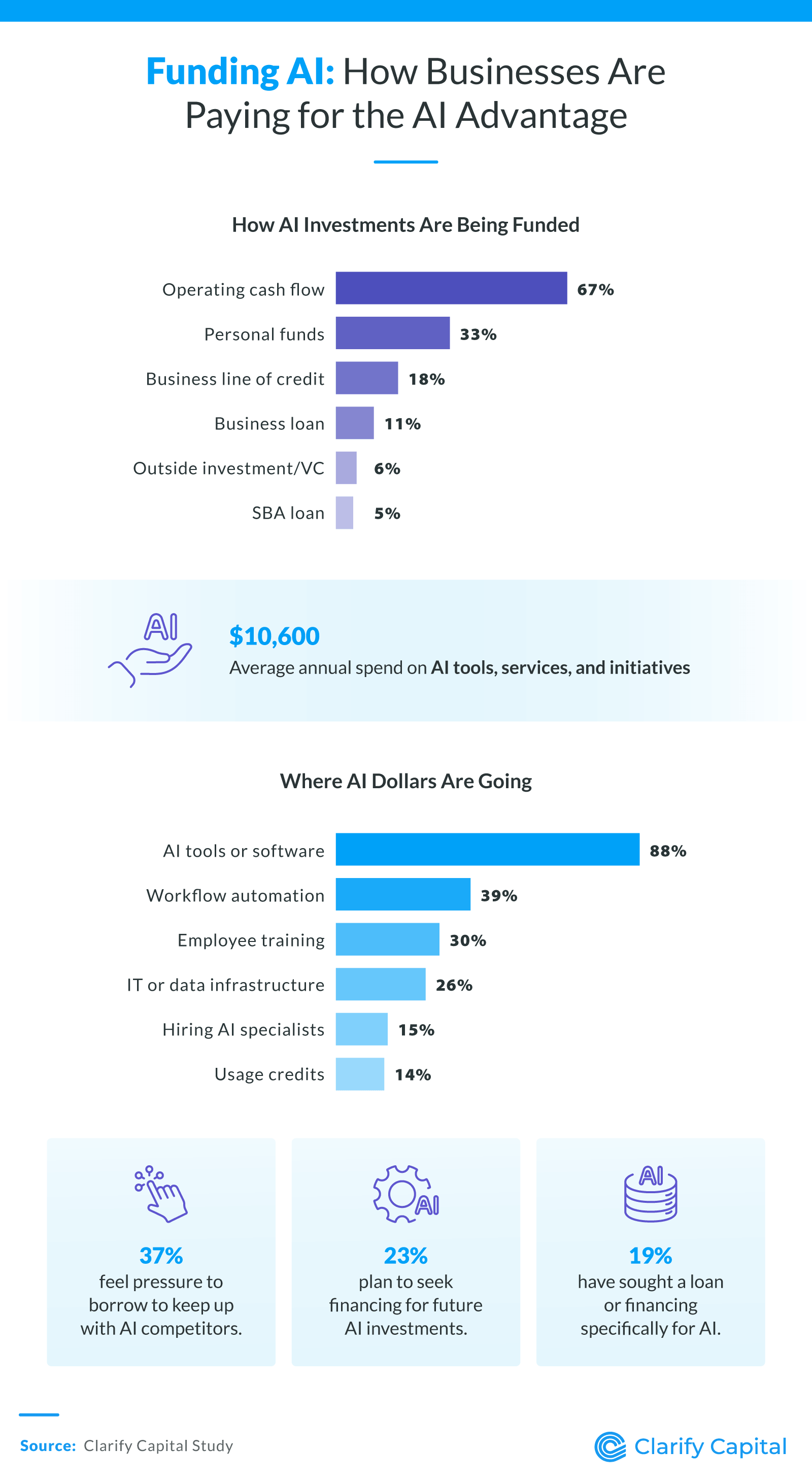
The most common funding source is operating cash flow (67%), but 33% of owners have dipped into personal funds to cover AI costs. Beyond that, 18% used a business line of credit, and 11% took out a business loan.
The average annual spend on AI tools, services, and initiatives came in at $10,600, and 19% of business owners said they've already sought a loan or financing specifically for AI in the past six months. Another 23% plan to seek financing this year, and 23% are still on the fence.
Among those who financed AI, the most common loan size was $5,000 to $14,999 (37%), though the average loan amount was $33,400. When asked why they chose financing over cash:
54% said it offered better terms than draining their reserves.
22% said they simply didn't have enough cash on hand.
20% said they felt pressure to keep up with competitors.
That competitive pressure shows up across the data. 37% of all business owners feel some level of pressure to borrow just to stay on pace with AI-investing rivals.
Financial services firms feel it the most, with 55% reporting competitive pressure and 45% having already sought AI financing. Retail and wholesale businesses were the most likely to stay on the sidelines, with the lowest rate of seeking an AI loan (9%) and the highest reliance on cash flow or personal funds.
When it comes to where the money goes, AI tools and software top the list by a wide margin (88%). Workflow automation (39%) and employee training (30%) round out the top three, with IT infrastructure (26%), hiring AI specialists (15%), and usage credits (14%) following behind.
What AI Is Actually Delivering for Business Owners
Spending without a clear return is a risk most small businesses can't afford. We looked into what owners are actually getting back.
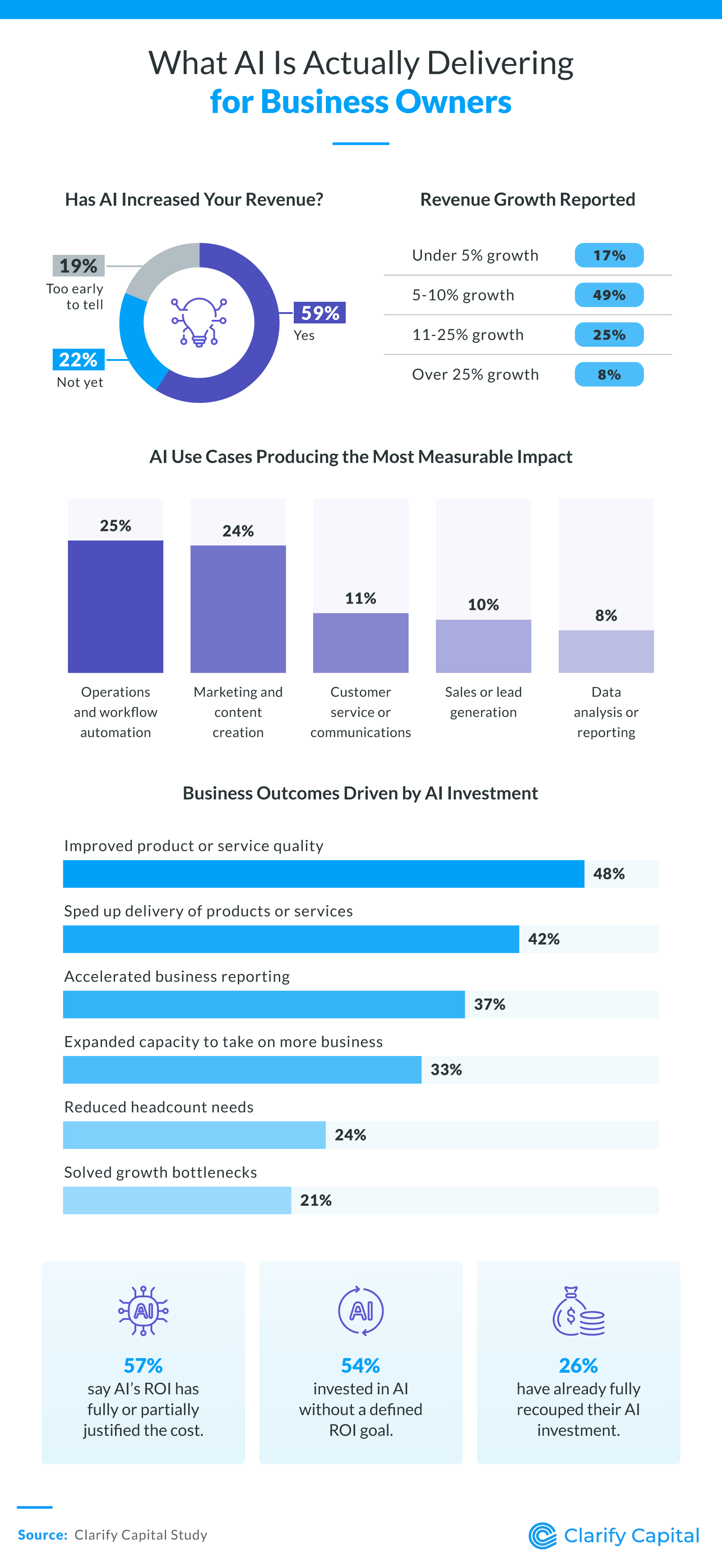
The results are encouraging for most: 59% of business owners said AI has directly increased their revenue (15% meaningfully, 43% somewhat). Among those who saw revenue growth, nearly half (49%) attributed 5% to 10% of that growth to AI.
Operations and workflow automation came in as the single most impactful area (25%), narrowly edging out marketing and content creation (24%). Customer service and communications (11%), sales and lead generation (10%), and data analysis (8%) round out the top five.
Business owners also reported concrete operational improvements from AI use:
Improved the quality of their products or services: 48%
Sped up delivery: 42%
Accelerated business reporting: 37%
Expanded their capacity to take on more business: 33%
Reduced headcount needs: 24%
Solved growth bottlenecks: 21%
Many business owners (54%) invested in AI without clearly defined ROI goals or a timeline to recoup the investment. Despite that, more than 1 in 4 (26%) said they've already fully recouped what they spent. Overall, 57% feel their AI investment has been fully or partially justified, and 83% report no regrets about how much they've invested.
Looking ahead, 48% expect to recoup their investment within the year. Business owners who have already seen ROI are more than twice as likely to plan a moderate or significant increase in AI spending compared to those who haven't (52% vs. 22%). That's a clear sign that early returns tend to drive bigger bets.
The Bottom Line on AI Spending
AI has gone from a competitive edge to a competitive expectation for many small businesses. Whether you're funding it through cash flow, a line of credit, or a small business loan, the data suggests the investment is paying off for most, especially in operations and marketing. The business owners most likely to see continued returns are the ones pairing smart AI adoption with a clear plan for how to pay for it and measure what it produces.
Methodology
Clarify Capital surveyed 241 business owners of small to mid-sized businesses to explore how many are investing in AI and seeking financing to fund their innovation. Respondents were asked how much they had invested in AI in the past year, if they're currently seeking financing for AI, and questions about the return on their investment so far.
By industry, this survey includes 44 business owners in technology, 37 in professional services, 32 in retail or wholesale, 29 in financial services, 22 in e-commerce, 15 in healthcare, and 45 identified as “other.” Survey data was collected between April 10, 2026, and April 14, 2026.
About Clarify Capital
Clarify Capital helps small and midsize business owners access the financing they need to grow with confidence. Whether you're investing in AI tools, automation, or new software, our technology business loans give you a straightforward path to the capital your next investment requires.
Fair Use Statement
Feel free to share these findings for noncommercial purposes. Please link back to Clarify Capital and credit us appropriately so readers can access the full results and methodology.

Michael Baynes
Co-founder, Clarify
Michael has over 15 years of experience in the business finance industry working directly with entrepreneurs. He co-founded Clarify Capital with the mission to cut through the noise in the finance industry by providing fast funding and clear answers. He holds dual degrees in Accounting and Finance from the Kelley School of Business at Indiana University. More about the Clarify team →
Related Posts