


 Reviewed by
The U.S. cleaning industry is massive: Janitorial services alone generated $110 billion in revenue in 2025. Whether you're running a two-person residential crew or managing a 50-employee commercial janitorial operation, you've probably hit the same wall: needing capital sooner than you can earn it. Cleaning business owners across all segments face this, from solo operators to franchise-scale companies.
Cleaning business loans close that gap. They cover the floor scrubbers, the second van, the payroll during a slow February, and the supplies you're restocking every month. I've worked with cleaning company owners who needed $15,000 for a pressure washer and others who needed $500,000 to staff up for a new hospital contract. The loan type that worked best was different every time.
I'll show you the specific financing options that tend to fit cleaning businesses, what each one actually costs, eligibility requirements, and how to match your business needs to the right financing solutions.
Types of Cleaning Business Loans
Term Loans
A lump sum you repay on a fixed daily, weekly, or monthly schedule. At Clarify Capital, term loans range from 6% to 12% APR with repayment terms from six months to 10 years. Short-term options run six to 24 months with weekly or monthly payments; long-term options stretch three to 10 years with monthly payments.
Monthly payments are predictable, which makes budgeting easier when you're managing cleaning company margins that typically run 10% to 28%, depending on the service type.
This is the workhorse product for large purchases: outfitting a crew, signing a warehouse lease, and buying out a competitor's accounts. Approval takes longer than some alternatives because lenders want to see at least six months of operating history and consistent revenue.
Business Line of Credit
Seasonal revenue is the norm in residential cleaning. Bookings crater in winter. Your employees still need paychecks.
A business line of credit solves this. You draw funds when cash flow dips, repay when revenue recovers, and the credit resets. Clarify's lines run 6% to 14% APR, with draw periods from six to 36 months and no reapplication required each cycle. Think of it like a credit card with better interest rates and higher limits.
One cleaning company owner I worked with drew $9,000 every November to cover payroll during her slow season and repaid it by March. No reapplication, no new paperwork.
SBA Loans
Government-backed loans through the Small Business Administration carry the lowest interest rates and longest repayment terms available. SBA 7(a) loans cover general business purposes: equipment, working capital, and real estate. SBA CAPLines are revolving credit facilities built for businesses with cyclical revenue, which makes them a strong fit for seasonal cleaning operations.
The catch: SBA loans take 30 to 90 days to fund. They require two years in business, a credit score of 680 or higher, tax returns, a business plan, and personal financial statements. If you need money this week to replace a broken floor scrubber, an SBA loan won't get you there.
Equipment Financing
Floor scrubbers, carpet extractors, pressure washers, commercial vacuums, vehicles. Equipment financing covers the purchase of specific assets, and the equipment itself serves as collateral. That means qualification is less strict than a traditional bank loan. A cleaning company owner with a 560 credit score can get approved if the equipment holds resale value and the business revenue supports the payments.
Clarify funds up to 100% of the equipment's value with terms of 24 to 72 months. APRs range widely (4% to 45%) depending on creditworthiness and the age of the equipment.
Invoice Factoring
Janitorial companies with corporate contracts know the frustration: you've finished the work, the client won't pay for 60 days, and your supply vendor wants their check now. Invoice factoring converts those unpaid invoices into immediate cash. The factoring company buys your receivables at a discount (0.5% to 3% per 30 days at Clarify) and advances 70% to 100% of the invoice value.
Credit score barely matters. Factoring companies evaluate your clients' creditworthiness, not yours. Borrowers with bad credit can qualify if their customers are reliable payers.
Merchant Cash Advances
MCAs are expensive. A factor rate of 1.30 on a $50,000 advance means you're repaying $65,000, and there's no interest rate to compare against other products because it's structured as a purchase of future revenue, not a loan.
Why does anyone use them? Speed. Same-day business funding is possible, and credit score requirements are minimal. A cleaning service business that processes steady credit card payments can qualify with a 550 score and six months of operating history. But don't treat a merchant cash advance as long-term financing. It's a short-term fix for a cash emergency, and the cost reflects that.
How Cleaning Companies Use Business Loans
Cleaning businesses carry operational costs that don't wait for your next invoice to clear. Small business owners in this industry come to us for funding for a range of reasons:

Commercial floor equipment
Walk-behind scrubbers start around $3,000, but ride-on models for warehouse or hospital contracts run $12,000 to $60,000. That's a lot of money to pay up front before you've cleaned a single floor.
Pressure washers
You'd need one of these for exterior work. Costs range from $300 for a basic electric unit to over $6,000 for a commercial hot-water machine.

Vehicles and fleet expansion
A reliable work van costs $5,000 to $20,000, and most growing companies need more than one.

Payroll gaps
The time between when you complete a commercial job and when the client actually pays might be anywhere from 30 to 90 days.

Restocking cleaning supplies
This can include things like chemicals, microfiber cloths, and disposable gloves each month. Many cleaning service business owners also purchase new cleaning equipment as they add services (carpet extractors, window cleaning rigs, etc.)

Office or warehouse space
Commercial cleaning companies that store equipment and manage dispatch need a physical location, and commercial real estate deposits aren't cheap.
Operational costs in the cleaning industry stack up fast. A single new commercial contract can require $25,000 in new equipment and supplies before you've invoiced a dollar. That mismatch between when you spend and when you get paid is the core reason cleaning business owners take out loans.
Picking the Right Financing for Your Cleaning Business
These example scenarios should help:
You just landed a 50,000-square-foot office contract and need two ride-on floor scrubbers. Equipment financing: The machines secure the loan, so credit score matters less. At 10% APR over 48 months, a $40,000 equipment loan runs about $1,015 a month.
Revenue dips 40% every November through February, but payroll doesn't. A business line of credit lets you draw what you need during slow months and repay when spring cleaning season picks back up. You're only paying interest on what you borrow, and the credit resets after repayment.
Two corporate clients owe you $40,000 combined, but neither will pay for 45 more days. Invoice factoring gets you 85% to 100% of that within 24 to 48 hours. No new debt on your balance sheet.
Expanding from residential into commercial and need a van, industrial equipment, and enough working capital to hire two employees before the first contract payment arrives? A term loan packages it into a single monthly payment. At 8% APR over five years, $50,000 works out to roughly $1,014 a month.
The Application Process
Clarify's loan application takes about two minutes: You enter basic business information, the amount you're requesting, and what you plan to use it for. From there, we pull three or four months of bank statements to verify revenue and cash flow patterns (no tax returns needed for most products). Your Clarify adviser matches you with the loan options you qualify for, including specific rates and terms.
Accept an offer, and funds land in your account the same day for most products. Equipment financing and SBA loans take longer: 24 to 72 hours and 30 to 90 days, respectively.
Credit scores over 550 qualify for most loans through Clarify. There may be fewer loan options for scores below that, but invoice factoring and some MCAs don't have a credit floor.
Your Cleaning Company's Next Move Starts With the Right Capital
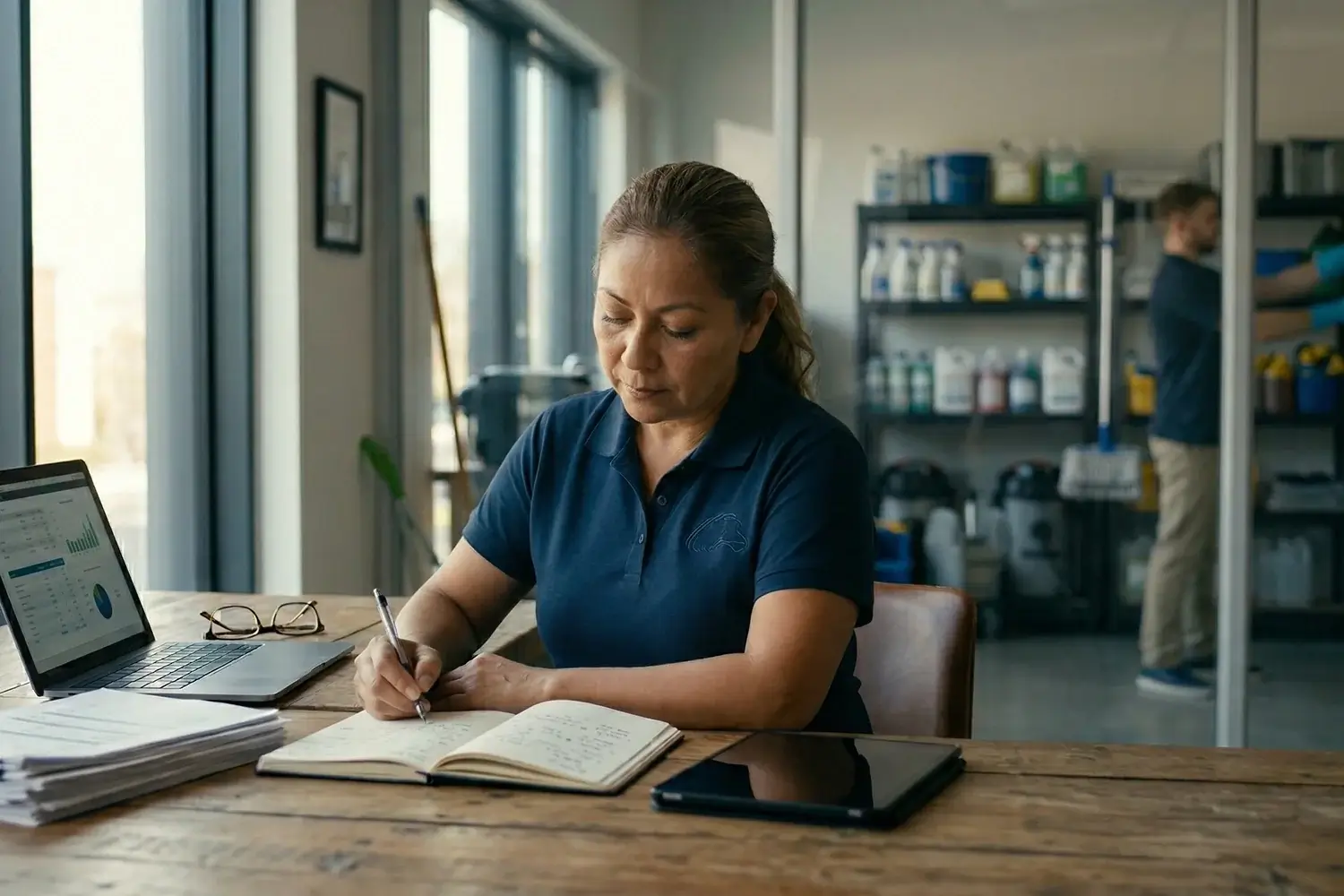
The cleaning industry is growing. We've funded nearly $1 billion to more than 50,000 small business owners across 1,000 industries, with an average funding time of 24 hours. Apply now and talk with an adviser about cleaning company funding.
FAQ
These are the most common questions I'm asked about business financing for cleaning companies.
How Much Does a $50,000 Cleaning Business Loan Cost Per Month?
At 7% APR over five years, a $50,000 business loan will cost roughly $990 a month. Shorter terms or higher rates can push that up.
Can a New Cleaning Business Get an SBA Loan?
Most SBA programs require two years in business. Newer cleaning companies usually qualify for working capital loans, equipment financing, or microloans from CDFIs instead.
What Credit Score Do I Need?
Clarify Capital looks for credit scores 550 and above for term loans and lines of credit (680 for SBA loans). Invoice factoring has no credit floor.
How Much Does It Cost To Start a Cleaning Business?
A solo residential operation can cost anywhere from $1,000 to $3,000. Commercial operations with employees and industrial equipment could cost over $20,000.
What's the Difference Between a Cleaning Business Loan and a Merchant Cash Advance?
A loan has a fixed APR and a set repayment schedule. An MCA takes a percentage of daily sales until the advance is repaid. MCAs cost more but fund faster.

Michael Baynes
Co-founder, Clarify
Michael has over 15 years of experience in the business finance industry working directly with entrepreneurs. He co-founded Clarify Capital with the mission to cut through the noise in the finance industry by providing fast funding and clear answers. He holds dual degrees in Accounting and Finance from the Kelley School of Business at Indiana University. More about the Clarify team →
Related Posts