

 Reviewed by
Key Takeaways:
Restaurant industry hourly wages have surged 47% since 2019, outpacing overall private-sector wage growth by 12 percentage points.
Restaurants in Richmond, VA, have seen the fastest wage growth in the country (+49.7%), while those in Minneapolis, MN, have seen the slowest (+21.2%).
9 in 10 restaurant owners are borrowing or seeking financing in 2026, and most of it is going toward operational reinvestment like kitchen equipment, technology, and renovations, not expansion.
More than half of restaurant owners (51%) have gone without a paycheck in the past 12 months so they could make payroll for their staff.
41% of owners have considered selling in the past 12 months because the stress no longer feels worth the margin, and only 31% feel very positive about their own 2026 outlook.
Where Restaurant Wages Are Rising and by How Much
Labor has always been one of the highest costs in the restaurant business, but the past several years have changed the math for many owners. As wages climbed across the country, some markets saw especially sharp increases that put added pressure on already-thin margins.
Restaurant industry hourly wages have surged 47% since 2019. That increase outpaced overall private-sector wage growth of 35% by 12 percentage points, showing how sharply restaurant labor costs have risen compared to the broader economy.
The fastest wage growth among major metros appeared in Richmond, VA, where restaurant wages rose 49.7%. The top 10 cities with the highest wage growth (and their spike in rent costs) included:
Richmond, VA: 49.7% wage growth; 37.0% rent growth
Denver, CO: 48.4% wage growth; 26.0% rent growth
Sacramento, CA: 46.3% wage growth; 31.8% rent growth
Virginia Beach, VA: 46.3% wage growth; 41.4% rent growth
Buffalo, NY: 43.9% wage growth; 38.1% rent growth
San Jose, CA: 43.5% wage growth; 10.5% rent growth
Riverside, CA: 43.2% wage growth; 45.8% rent growth
Tampa, FL: 43.1% wage growth; 50.9% rent growth
Nashville, TN: 42.6% wage growth; 30.6% rent growth
Los Angeles, CA: 41.1% wage growth; 26.1% rent growth
In some of these markets, rent growth added another layer of pressure. Tampa, FL saw rent rise 50.9%, Riverside, CA, saw rent climb 45.8%, and Virginia Beach, VA, saw rent increase 41.4%, meaning some restaurant owners were facing steep increases in both labor and occupancy costs.
Wage growth was slower in other large cities, though costs still moved higher. Those with the slowest restaurant wage growth were:
Minneapolis, MN: 21.2% wage growth; 16.7% rent growth
San Antonio, TX: 25.7% wage growth; 22.6% rent growth
Houston, TX: 26.8% wage growth; 22.5% rent growth
Las Vegas, NV: 26.9% wage growth; 38.1% rent growth
Pittsburgh, PA: 27.0% wage growth; 26.5% rent growth
Oklahoma City, OK: 28.1% wage growth; 29.8% rent growth
Raleigh, NC: 28.2% wage growth; 32.8% rent growth
New Orleans, LA: 28.8% wage growth; 26.2% rent growth
San Francisco, CA: 29.7% wage growth; 6.6% rent growth
Austin, TX: 29.8% wage growth; 23.7% rent growth
Even in the markets with the slower wage growth, restaurants still faced meaningful increases compared with 2019 levels.
Profitable, but Borrowing To Stay That Way
For many restaurant owners, profitability does not always mean comfort. A strong month can still come with payroll stress, equipment needs, and financing decisions that determine whether the business can keep moving forward.
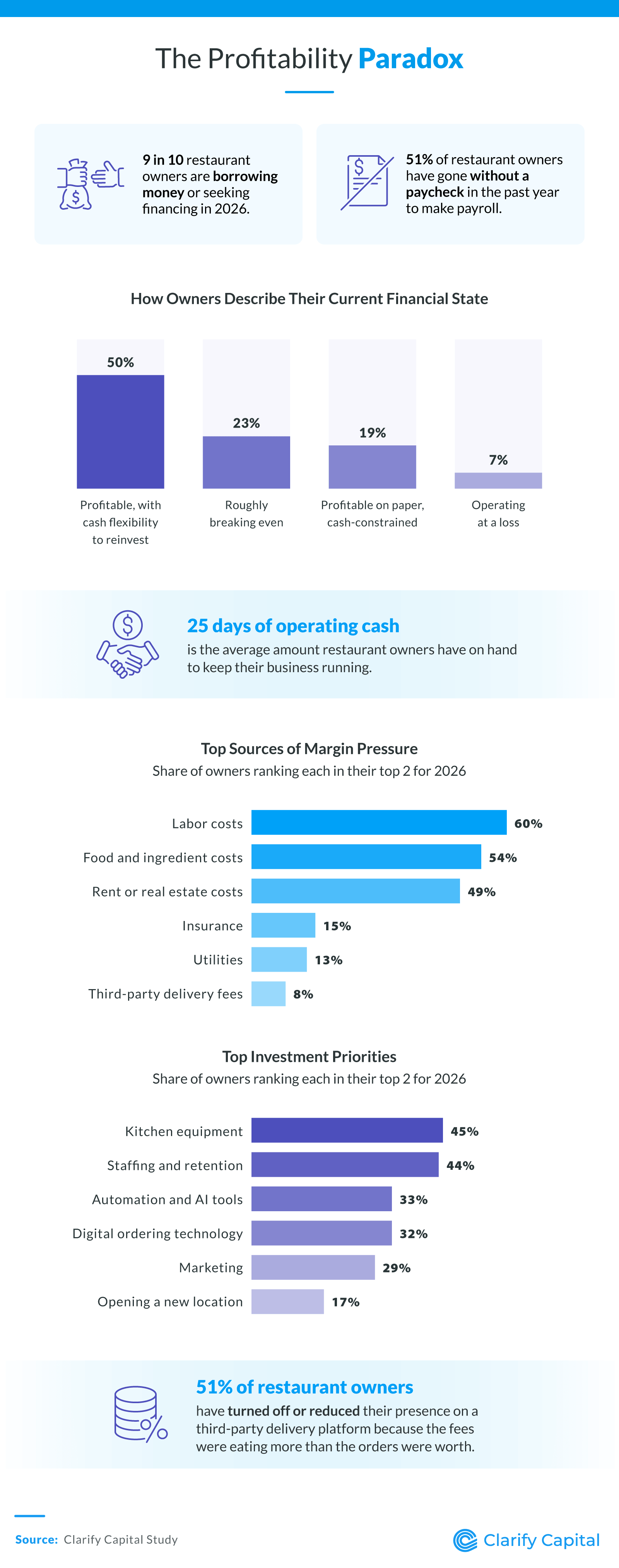
Restaurant owners were widely turning to financing in 2026, with 90% borrowing or seeking financing. Most of that funding was going toward operational reinvestment or reflected the day-to-day needs of running a restaurant. Owners most often said this financing went toward:
Purchasing kitchen equipment (35%)
Investing in technology like POS, online ordering, and automation (34%)
Renovating or repairing the existing space (30%)
Marketing or customer acquisition (29%)
Nearly 1 in 4 owners (24%) borrowed money just to cover payroll or other operating expenses, showing how tight cash flow can become even when restaurants are still open and serving customers.
Strong sales didn't always make the business feel stable. Nearly three-fourths of restaurant owners (72%) said they had their most profitable month and their most stressful month at the same time, reflecting how quickly revenue can be offset by rising expenses and operational demands.
The pressure of managing cash flow also showed up personally for restaurant owners. Just over half (51%) had gone without a paycheck in the past 12 months so they could make payroll for staff, and owners whose restaurants made under $550,000 annually were the most likely to say so (56%).
Half of restaurant owners (50%) said they were profitable with cash flexibility to reinvest in 2026. Owners making $2.5 million or more annually were the most likely to say so (80%), while those making under $500,000 were the least likely (38%).
What Restaurant Owners Are Considering for 2026 and Beyond
The future of restaurant ownership looks complicated, with many operators feeling both cautious and committed. Owners are weighing growth opportunities against burnout, industry uncertainty, and the financial strain of staying competitive.
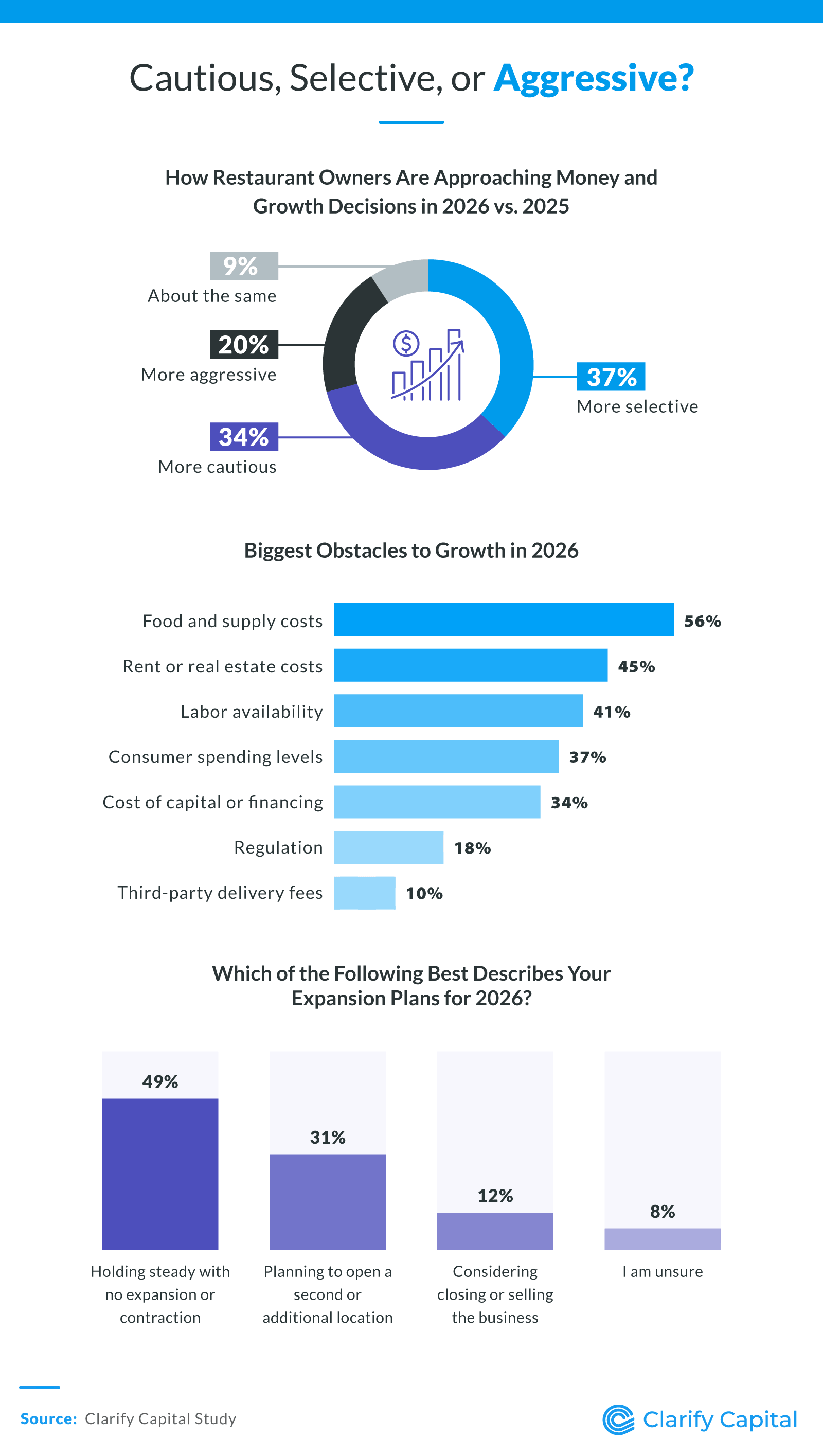
Many restaurant owners still saw room to grow under the right conditions. Two-thirds of owners (67%) said they would take a perfect second location at below-market rent today if a landlord offered, more than double the 31% who were actively planning to open a second or additional location in 2026.
Confidence was more limited when owners looked ahead. Only 31% felt very positive about their own restaurant's 2026 outlook, and even fewer (16%) felt very positive about the broader restaurant industry.
The emotional toll of ownership was also clear. More than 2 in 5 owners (41%) had considered selling in the past 12 months because the stress no longer felt worth the margin. Owners with smaller restaurants were more likely to feel that strain. Those making under $500,000 annually were the most likely to have considered selling at 34%, while owners making $2.5 million or more were the least likely at 30%.
Even with those pressures, most owners had not given up on the long-term picture: 75% of restaurant owners expected to still own their restaurant five years from now.
What Restaurant Owners Can Do Now
Margins are tight, stress is high, and most restaurant owners are still showing up anyway. Understanding where costs are hitting hardest in your market (wages, rent, or both) is a good starting point for making smarter calls about staffing, pricing, and financing. For the restaurant owners seeking financing in 2026, matching the right funding to the right need (equipment, payroll, renovations) can make the difference between a loan that helps and one that just adds pressure.
Methodology
We analyzed national restaurant wage growth using the BLS Current Employment Statistics (CES), comparing average hourly earnings in restaurants (NAICS 722) against total private-sector wages from January 2019 through March 2026.
We measured state-level wage growth using the BLS Quarterly Census of Employment and Wages (QCEW), which covers all private restaurant and bar workers (NAICS 722). State figures compare 2019 and 2024 annual averages.
For the metro comparisons, we used the BLS Occupational Employment and Wage Statistics (OEWS) to track mean hourly wages for food-service workers in the 50 largest U.S. metros between May 2019 and May 2024. Rent figures come from the Zillow Observed Rent Index for the same months.
We also surveyed 391 unique restaurant owners across the United States, fielded in May of 2026. Respondents include independent owners (77%), franchisees (15%), and multi-unit operators (9%), with operations spanning full-service (29%), fast-casual (23%), quick-service (16%), cafes or bakeries (14%), fine dining (9%), and food trucks or ghost kitchens (8%). The respondent base reflects a mix of revenue tiers ranging from under $500,000 (57%) to mid-size operations of $500,000 to $2.49 million (36%) and larger restaurants of $2.5 million or more (8%).
About Clarify Capital
Clarify Capital helps small and midsize business owners access the financing they need to grow with confidence. If you're a restaurant owner navigating tight margins and unpredictable revenue, our restaurant business loans are designed around how food and beverage businesses actually operate, with funding in as little as 24 hours.
Fair Use Statement
You may share the information in this article for noncommercial purposes only. If you reference or republish any findings, please include proper attribution and a link back to Clarify Capital.

Michael Baynes
Co-founder, Clarify
Michael has over 15 years of experience in the business finance industry working directly with entrepreneurs. He co-founded Clarify Capital with the mission to cut through the noise in the finance industry by providing fast funding and clear answers. He holds dual degrees in Accounting and Finance from the Kelley School of Business at Indiana University. More about the Clarify team →
Related Posts