
 Reviewed by
Key Takeaways:
84% of small business owners have delayed, reduced, or gone without their own pay in the past year to keep their business running.
Among SBOs with employees, 69% have gone without their own pay to ensure their employees were paid.
41% of SBOs say they pay employee payroll before themselves when cash is tight.
SBOs forgave an average of $12,745 in personal income in the past 12 months to support their business; 31% gave up $1,000 to $4,999, and 17% forwent $10,000 to $24,999.
SBOs who cut their pay reduced it by an average of 38% at its largest reduction.
During a sustained cash-flow shortage, 44% of SBOs say their business could operate for less than 1 month before they would need to reduce or stop paying themselves.
40% of SBOs have used personal savings to cover business expenses in the past year.
Despite personal financial sacrifices, 66% of SBOs say they would still start their business today knowing what they know now.
How Small Business Owners Put Themselves at the Back of the Line
When cash runs short, most SBOs have a clear order of operations, and they're rarely at the top of it. Paying themselves comes after nearly every other obligation, from utilities to vendors.
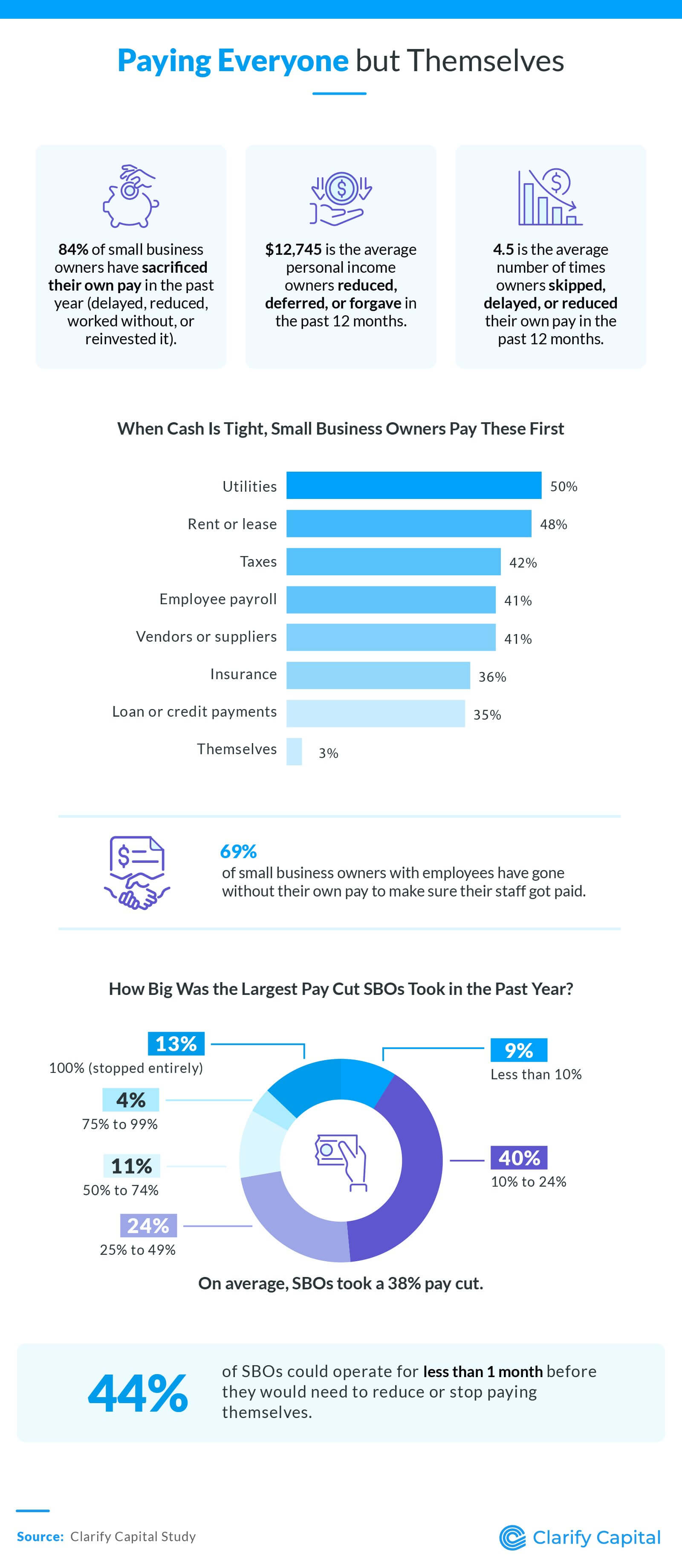
84% of SBOs have delayed, reduced, or skipped their own pay in the past year.
When cash is tight, they pay utilities (50%), rent (48%), and taxes (42%) before themselves. Only 3% pay themselves first.
Those who cut their pay reduced it by an average of 38%, and 13% stopped paying themselves entirely.
SBOs who cut their pay did so an average of 4.5 times in the past year.
69% of SBOs with employees went without pay to ensure their staff was paid.
If their business experienced a sustained cash-flow shortage, 44% of SBOs could operate for less than 1 month before needing to reduce or stop paying themselves, and 6% say it would be less than a week.
Arts and entertainment SBOs took the biggest cuts, averaging 54% at their largest reduction.
When Business Challenges Become Personal Financial Burdens
The sacrifice doesn't stop at a smaller paycheck. To keep operations running, many SBOs reach into their own savings, lean on personal credit, and absorb the financial stress.
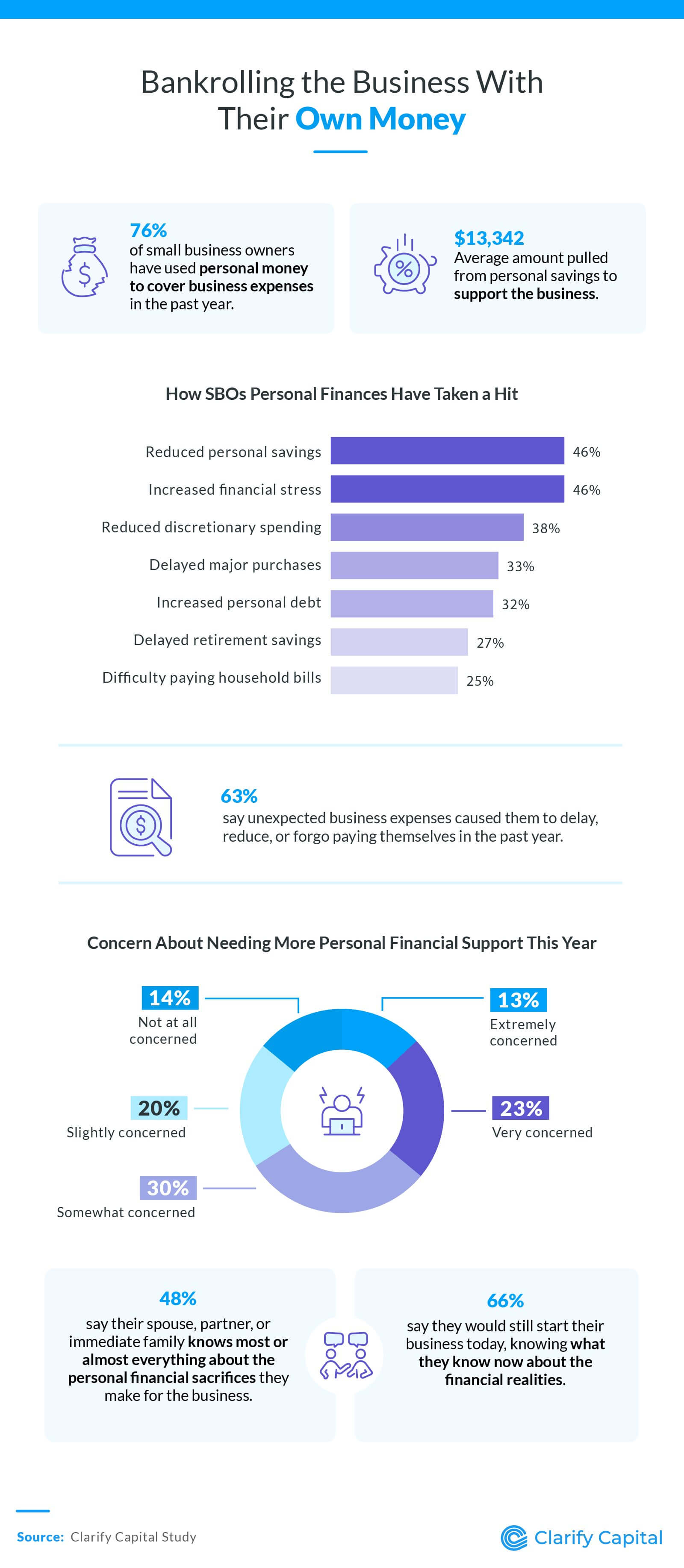
76% of SBOs used personal money to cover business expenses in the past year.
40% dipped into personal savings, 19% used personal credit cards, and 6% took a personal loan or line of credit.
SBOs pulled an average of $13,342 from personal savings to keep their business running.
The most common effects were reduced personal savings (46%), higher financial stress (46%), and less discretionary spending (38%). Women were more likely than men to report reduced savings (51% vs. 39%) and higher stress (49% vs. 41%).
63% say an unexpected expense has caused them to delay, reduce, or skip their own pay.
66% are at least somewhat concerned that their business will need more personal financial support this year.
48% say their family knows "most" or "almost everything" about the sacrifices they make.
70% of arts and entertainment SBOs report reduced personal savings, the heaviest hit of any industry.
Which unexpected costs push SBOs hardest varies by industry, but one thing remains constant: an unplanned expense is often what pushes them to skip their own pay.
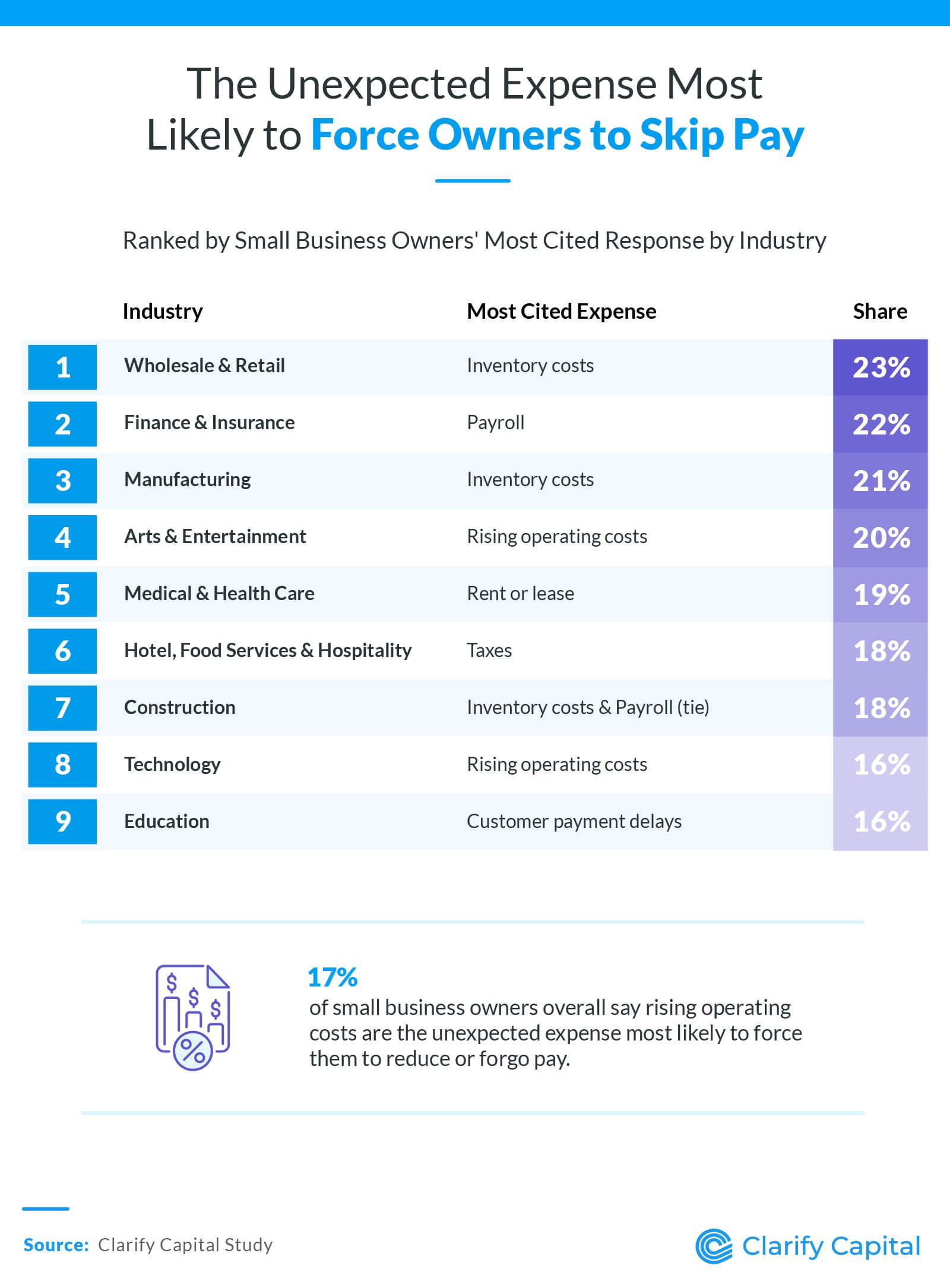
Rising operating costs (17%) are the expense most likely to force SBOs to skip pay, followed by equipment failure (13%).
Only 10% say no unexpected expense would affect their pay.
The Real Cost of Keeping the Doors Open
For most small business owners, putting themselves last isn't a one-time decision. It's a habit built into how they run the business. The paycheck they skip and the savings they spend rarely make the story of running a company, but they're a big part of what keeps it alive. What stands out is that after all of it, 2 in 3 say they would do it again.
The takeaway is to build in a cushion so covering an unexpected expense doesn't have to come out of your own pocket. A line of credit or the right financing can also help absorb the shock, so paying yourself doesn't become the thing that gives.
Methodology
We surveyed 664 U.S. small business owners in July 2026 to understand how often entrepreneurs delay, reduce, or forgo their own pay in order to keep their businesses running. For the purposes of this study, we defined a "small business" as any company with fewer than 500 employees, in line with the U.S. Small Business Administration's general size standard.
Most respondents run micro businesses with 1 to 9 employees (67%), followed by small businesses with 10 to 49 employees (20%), medium businesses with 50 to 249 employees (9%), and large businesses with 250 or more employees (5%). The most common industries represented were wholesale and retail (15%), arts, entertainment, and recreation (14%), and technology (11%).
The average age of respondents was 40. The gender breakdown was 53% women, 46% men, and 2% nonbinary or not listed. Millennials made up the largest share of respondents (54%), followed by Gen X (27%), Gen Z (14%), and baby boomers (5%).
About Clarify Capital
Clarify Capital helps small and midsize business owners access the financing they need to grow with confidence. If you're prioritizing payroll over your own income, our working capital loans can help stabilize cash flow so your business stops depending on you to absorb the shortfall.
Fair Use Statement
The findings and data in this article are available for noncommercial reuse. If you reference this study, please link back to this page so readers can view the full results and so Clarify Capital receives proper credit.

Michael Baynes
Co-founder, Clarify
Michael has over 15 years of experience in the business finance industry working directly with entrepreneurs. He co-founded Clarify Capital with the mission to cut through the noise in the finance industry by providing fast funding and clear answers. He holds dual degrees in Accounting and Finance from the Kelley School of Business at Indiana University. More about the Clarify team →
Related Posts