
 Reviewed by
Key Takeaways:
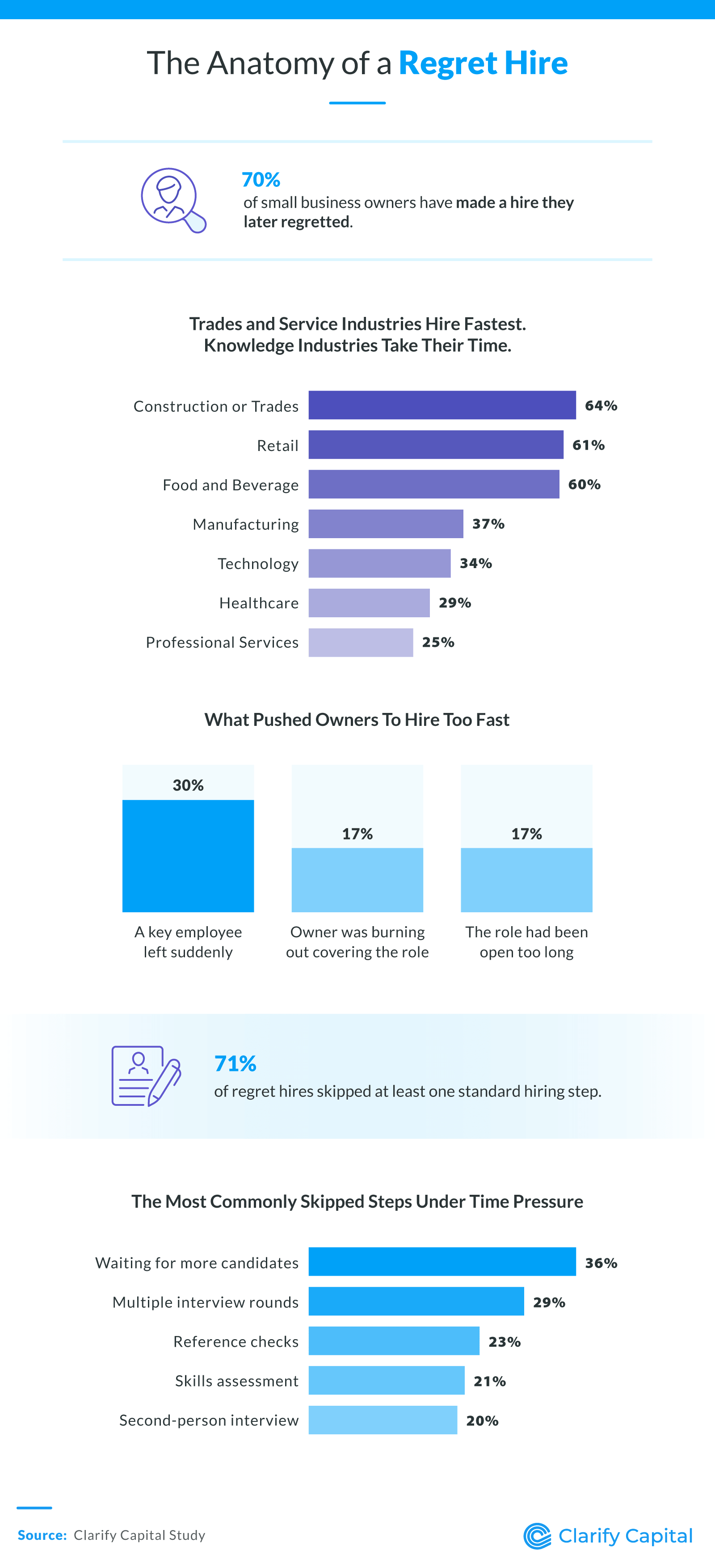
70% of small business owners have made a hire they later regretted.
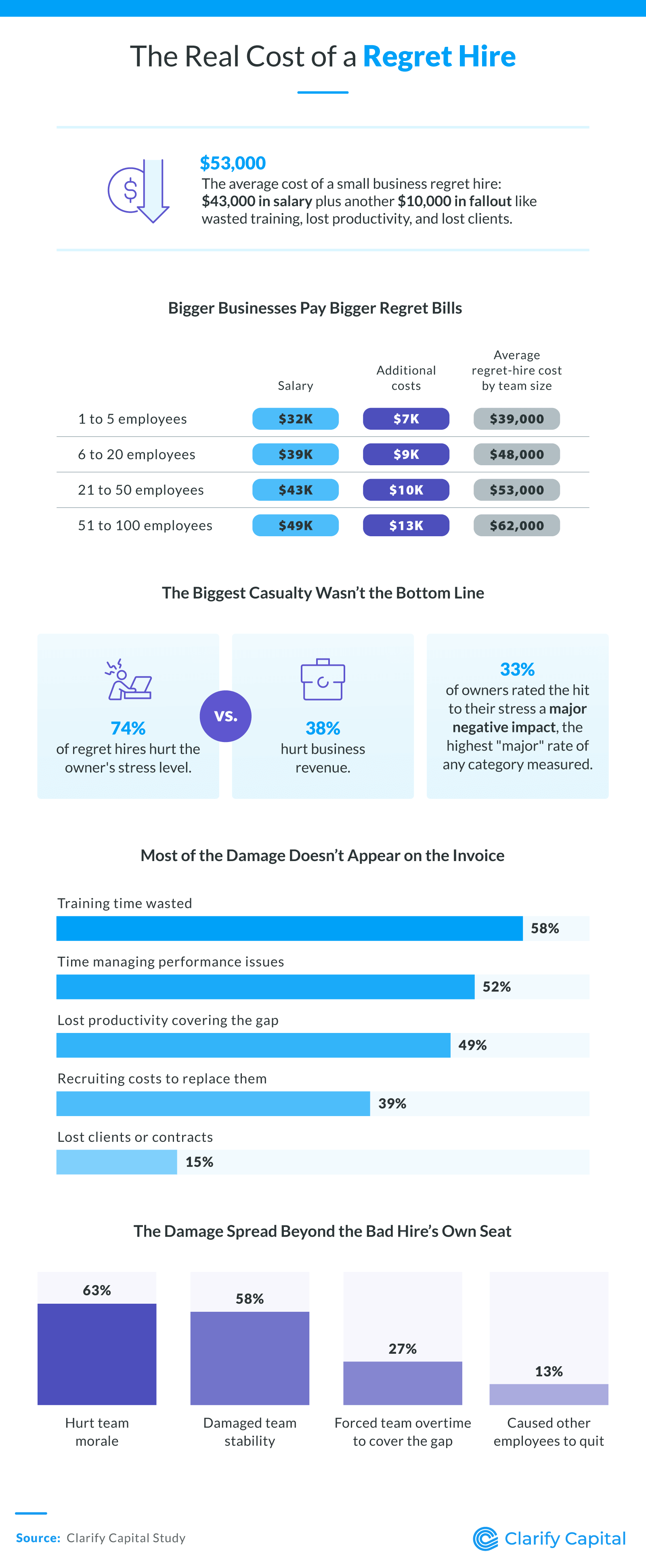
The average regret hire costs $53,000: $43,000 in salary plus another $10,000 in fallout like wasted training, lost productivity, and lost clients.
More than 1 in 10 hires (13%) that employers regret cause other employees to quit, 58% damage team stability, and 63% hurt team morale.
74% of regret hires hurt the owner's stress level vs. just 38% that hurt business revenue.
88% of owners rewrite their hiring process after a regretful hire, and 87% say they'd rather leave a role open than fill it with the wrong person.
The Anatomy of a Regret Hire
Hiring mistakes rarely happen in a vacuum. Most regret hires came from pressure-filled situations where business owners needed help quickly and felt forced to make decisions before they were fully ready.
Smaller Businesses Felt the Most Pressure To Hire Fast
Smaller businesses moved especially quickly when filling roles that later became regret hires. Among businesses with 1 to 5 employees, 56% of regret hires were made within two weeks, compared to 32% at companies with 51 to 100 employees.
Hiring speed also varied sharply by industry. Trades and customer-facing industries tended to move the fastest:
Construction or Trades: 64%
Retail: 61%
Food and Beverage: 60%
Manufacturing: 37%
Technology: 34%
Healthcare: 29%
Professional Services: 25%
Food and Beverage businesses also reported the highest overall regret-hire rate at 83%, followed by Manufacturing at 77% and Professional Services at 75%.
Sudden Staff Departures Drove Most Regret Hires
Unexpected departures created the biggest hiring pressure for owners. A sudden employee exit triggered 30% of regret hires, while owner burnout covering the role and positions sitting open too long each accounted for 17%.
Veteran businesses reported regret hires more often than newer companies. About 74% of businesses operating for more than 10 years said they had made a regret hire, compared to 53% of businesses under two years old.
Time Pressure Made Owners Skip Key Hiring Steps
Rushing the process caused many business leaders to abandon standard hiring safeguards. Nearly three-quarters (71%) skipped at least one traditional hiring step because they felt pressured to fill the role quickly.
The most commonly skipped steps included:
Waiting for more candidates: 36%
Multiple interview rounds: 29%
Reference checks: 23%
Skills assessments: 21%
Having a second person interview the candidate: 20%
Smaller businesses were especially likely to skip reference checks and stop searching for additional candidates.
Many Owners Saw Hiring Red Flags and Hired Anyway
Some owners recognized warning signs during the hiring process but moved forward regardless. About 21% admitted they saw red flags before making the hire.
Their reasons were often emotional rather than strategic:
42% said they had no better options available
20% convinced themselves the issues were not serious
16% said someone else pushed for the hire
13% felt too invested in the process to restart
Professional Services leaders reported the highest rate of knowingly hiring despite concerns, with 29% acknowledging they ignored warning signs.
Hiring Someone You Already Knew Cost Less
One in six regret hires involved someone the owner already knew, including friends, former colleagues, or family members. Gen Z leaders were especially likely to hire from their personal network, with 32% of Gen Z regret hires involving a prior relationship.
Interestingly, relationship hires ended up costing less on average. Those hires averaged $44,000 in losses compared to $55,000 for regret hires involving someone the owner did not know personally.
What a Regret Hire Actually Costs
The financial impact of a bad hire extended far beyond salary costs. Many small business owners found the biggest damage came from lost time, team disruption, and operational strain that continued even after the employee left.
Bigger Businesses Paid Bigger Regret Bills
The average regret hire cost small businesses $53,000 overall, including $43,000 in salary expenses and another $10,000 tied to indirect fallout like wasted onboarding, lost productivity, and client issues.
Costs climbed steadily alongside company size. Businesses with 51 to 100 employees reported average regret-hire costs of $62,000, while businesses with 1 to 5 employees averaged $39,000.
Some industries absorbed especially steep losses, including:
Manufacturing: $63,000
Technology: $63,000
Professional Services: $59,000
Food and Beverage: $42,000
Professional Services businesses stood out for combining high regret rates with expensive consequences, including the highest client-loss rate at 18%.
The Biggest Costs Don't Show Up on the Invoice
Many of the most damaging effects were operational problems rather than direct expenses. Owners said the hidden costs added up quickly through lost time and strained resources.
The most common fallout included:
Training time wasted: 58%
Time managing performance issues: 52%
Lost productivity covering the gap: 49%
Recruiting costs to replace the employee: 39%
Lost clients or contracts: 15%
Veteran businesses also paid more overall, averaging $57,000 per regret hire compared to $44,000 among businesses operating for 2 to 5 years.
Most Teams Took Months to Recover
Nearly half of regret hires (48%) were gone within three months, including 18% who left within a single month. But even after the employee exited, the disruption often lingered. Teams needed an average of three months to fully recover, while 4% of owners said their business never completely bounced back from the experience.
The Damage Spread Beyond the Bad Hire's Seat
The damage spread well beyond the employee who was hired. More than 1 in 4 regret hires (27%) forced the rest of the team into overtime to cover the gap, and many businesses reported broader strain that affected existing staff and company culture for months afterward.
Other team-level fallout included hurt morale (63%), damaged team stability (58%), and other employees quitting outright (13%). Across business size, teams with 1 to 5 employees felt the cascade most sharply because there was nowhere for the work to go.
Some leaders avoided confronting the issue altogether. About 14% of Gen X owners said they never formally addressed the mistake, compared to 7% of millennials and just 2% of Gen Z leaders.
Women and Younger Owners Felt the Stress Most
For many business owners, the emotional toll outweighed the financial damage from a bad hire. Seventy-four percent of regret hires negatively impacted the owner's stress level, compared to just 38% that hurt business revenue.
Women were especially likely to report severe impacts: 38% called the hit to their stress a major negative, compared to 28% of men. Among generations, Gen Z owners felt it hardest, with 38% rating the stress impact a major negative, the highest of any generation surveyed.
How Small Business Owners Bounce Back
Many owners treated regret hires as expensive learning experiences rather than permanent setbacks. After seeing the impact firsthand, business leaders across industries reevaluated how they hire and what they prioritize during the process.
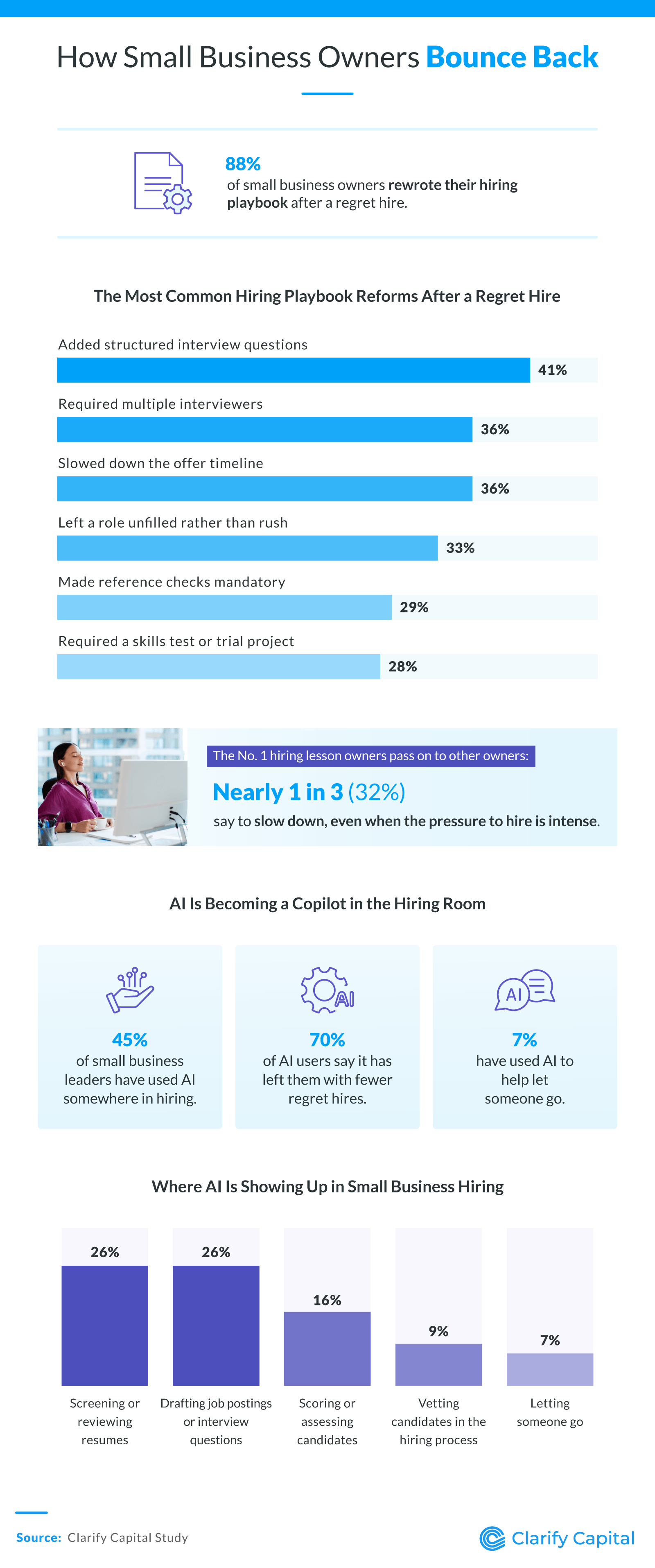
Most Owners Rebuilt Their Hiring Process
Nearly nine in 10 owners (88%) changed their hiring process after experiencing a regret hire.
The most common reforms included:
Added more structured interview questions: 41%
Required multiple interviewers: 36%
Slowed down the offer timeline: 36%
Left a role unfilled rather than hire out of desperation: 33%
Made reference checks mandatory: 29%
Required a skills test or trial project: 28%
The smallest businesses were the least likely to make changes, with 15% of businesses with 1 to 5 employees saying they made no hiring-process reforms afterward.
"Slow Down" Was the No. 1 Lesson Owners Passed On
About 32% of business leaders said the most important hiring lesson they learned was to slow down, even under pressure. That response ranked twice as high as any other takeaway.
Other common lessons included:
Trust your gut over a polished interview: 19%
Always check references: 19%
Get a second opinion: 12%
Define the role clearly: 9%
Never hire out of guilt: 8%
The mindset shift appeared to stick as 87% of business owners said they would rather leave a role open than fill it with the wrong person. Another 60% said they now take longer making hiring decisions than they used to, and 79% said their peers underestimate the true cost of a bad hire.
The Trust Paradox: Instinct vs. Structured Hiring
Even after a regret hire, many leaders continued relying heavily on intuition. About 61% said they trust their instincts more than any formal hiring process. At the same time, 83% also agreed that structured hiring systems make a measurable difference. The findings showed that many owners still blend gut instinct with formal processes rather than choosing one over the other.
AI Became a Hiring Copilot
Artificial intelligence has become an increasingly common part of small business hiring. Nearly half of small business leaders (45%) said they have used AI somewhere in the hiring process, and seven in 10 AI users said it has left them with fewer regret hires.
The most common AI uses included:
Resume screening: 26%
Drafting job postings or interview questions: 26%
Candidate scoring: 16%
Assisting with employee termination decisions: 7%
Adoption varied sharply across generations and industries. Gen Z business leaders led by a wide margin at 67%, compared to 47% of millennials, 35% of baby boomers, and 34% of Gen X business owners. Technology businesses also stood out as the industry leader in AI hiring adoption at 67%, while Retail businesses reported the lowest adoption rate at 35%.
Hard Lessons, Smarter Hiring
Hiring mistakes may be common among small businesses, but many owners walked away from the experience with stronger systems and clearer priorities. The findings showed that rushing to fill a role often created bigger long-term costs than leaving the position open temporarily. Business leaders also increasingly turned to structured hiring practices and AI tools to reduce future risks. For growing companies, the lesson was clear: slowing down today can protect your business from much larger setbacks tomorrow.
Methodology
Clarify Capital surveyed 923 U.S. small business leaders in 2026 via Cloudresearch Connect and Prolific to understand the prevalence, cost, and impact of hiring mistakes at small businesses. Respondents were owners, founders, partners, C-suite executives, hiring managers, or other senior leaders with hiring authority at businesses with 1 to 100 employees, and had to have been personally involved in at least one hiring decision.
The sample was 53% men and 46% women, with 54% millennials, 29% Gen X, 11% Gen Z, and 6% baby boomers, spanning Professional Services, Technology, Retail, Healthcare, Food and Beverage, Manufacturing, and other industries. The margin of error is plus or minus 3.2 percentage points at a 95% confidence level. Average dollar figures were calculated after applying an IQR-based outlier filter (n=529). Percentages are rounded to the nearest whole number.
About Clarify Capital
Clarify Capital helps small and midsize business owners access the financing they need to grow with confidence. Rushing to fill a role often means settling. Our fast business loans give business owners the financial flexibility to take the time to hire right, not just hire fast.
Fair Use Statement
This information may be shared for noncommercial purposes only. If you reference or republish these findings, please provide proper attribution with a link back to Clarify Capital.

Michael Baynes
Co-founder, Clarify
Michael has over 15 years of experience in the business finance industry working directly with entrepreneurs. He co-founded Clarify Capital with the mission to cut through the noise in the finance industry by providing fast funding and clear answers. He holds dual degrees in Accounting and Finance from the Kelley School of Business at Indiana University. More about the Clarify team →
Related Posts