
 Reviewed by
Key Takeaways:
80% of knowledge workers have used AI before asking a coworker or manager for help.
ChatGPT is the No. 1 go-to AI tool for director/manager (70%), mid-level (80%), and entry-level (62%) employees who turn to AI before a human for help at work.
1 in 5 knowledge workers (21%) have pasted a boss's message into AI to "translate the tone."
66% of knowledge workers turn to AI first because they don't want to sound unskilled, 57% are afraid of asking "dumb" questions, and 43% feel more emotionally safe with AI.
64% of knowledge workers now use AI to learn tools and processes instead of asking a teammate, and nearly half (46%) say AI has replaced a go-to colleague for quick questions.
The average knowledge worker saves nearly 2 hours per week using AI.
Nearly 1 in 5 of the heaviest users (18%) credit AI with helping them earn a raise or promotion.
Which Employees Turn to AI First at Work?
AI has quickly become a quiet first stop for many professionals before they loop in another human.
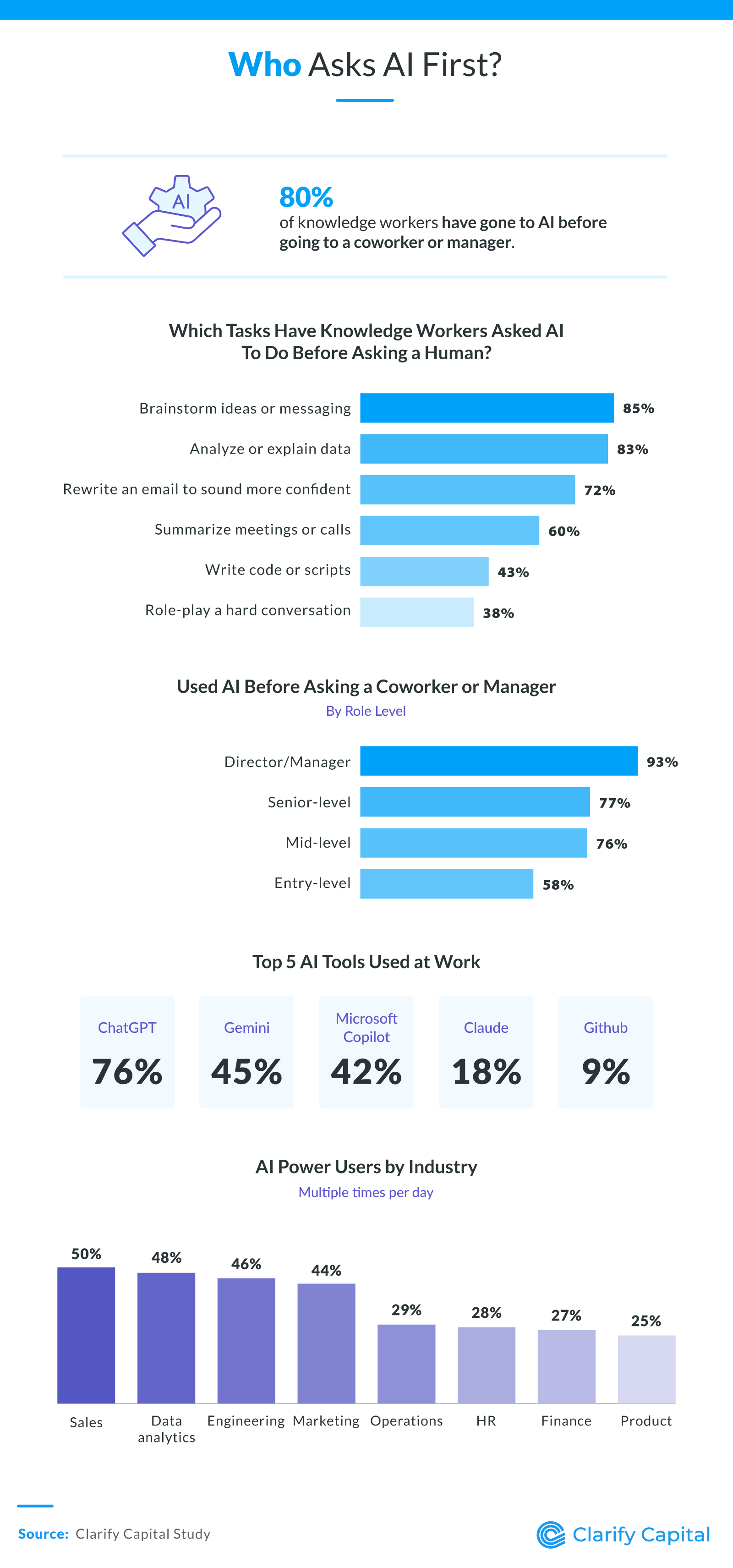
Most knowledge workers didn't hesitate to say they've gone to AI before a coworker or manager. Eighty percent of those surveyed had done so, and 85% had used AI to brainstorm before asking a human for ideas. The other most common tasks included:
Analyzing or explaining data (83%)
Rewriting an email (72%)
Summarizing meetings or calls (60%)
Writing code or scripts (43%)
Role-playing a hard conversation (38%)
Leadership wasn't sitting on the sidelines. Directors and managers (93%) were the most likely to go to AI first, followed by senior-level (77%) and mid-level employees (76%). Entry-level employees were the least likely at 58%.
Usage also varied by team and environment. Sales (50%), data analytics (48%), and engineering (46%) led daily AI adoption. Hybrid (85%) and in-person (83%) workers were more likely to use AI first than fully remote workers (69%).
AI is also affecting how employees interpret leadership. Twenty-one percent of knowledge workers said they've pasted a boss's message into AI to "translate the tone," demonstrating that people are using AI to decode what their manager means.
AI Tool Use in the Workplace
More than half of workers (53%) said they used ChatGPT before asking a human, compared to 23% for Gemini and 22% for Microsoft Copilot. ChatGPT was also the No. 1 go-to AI tool for directors and management (70%), mid-level (80%), and entry-level (62%) knowledge workers.
Overall, ChatGPT was the most common AI tool used at work, with 76% using it for a variety of tasks. The next most popular tools were:
Gemini (45%)
Microsoft Copilot (42%)
Claude (18%)
GitHub Copilot (9%)
In specialized teams, function-specific tools stood out, with engineering using GitHub Copilot at 3.6 times the overall rate.
Why Employees Turn to AI Instead of Their Boss
Behind every AI prompt is a reason, and for most professionals, it goes beyond convenience.
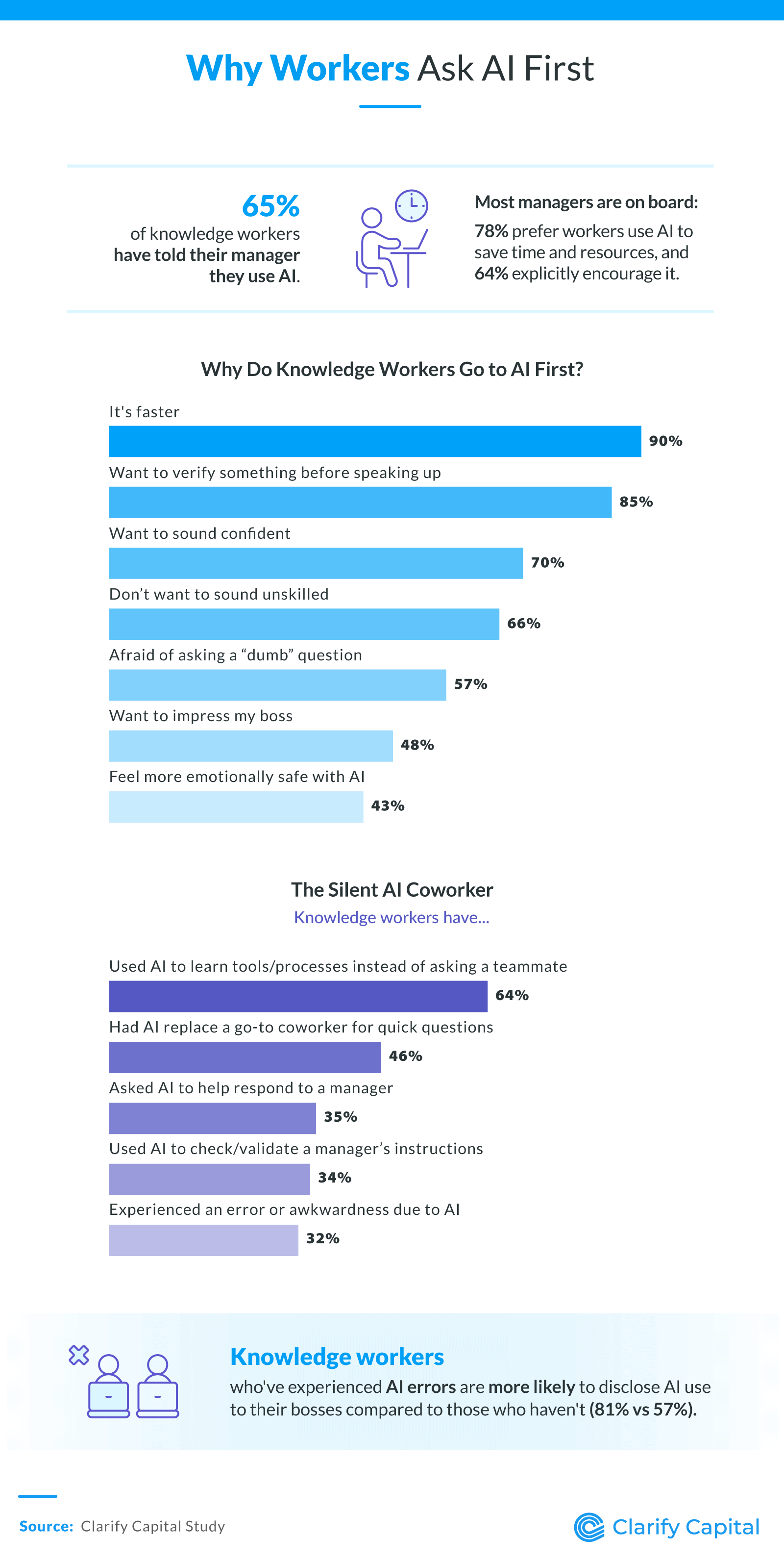
A majority of workers (64%) used AI to learn tools and processes instead of asking a teammate, and 46% said AI has replaced a go-to coworker for quick questions. Speed topped the list of why people use AI, with 90% saying it was faster than reaching out to a person. But emotional factors were close behind:
85% wanted to verify something before speaking up.
70% wanted to sound more confident.
66% didn't want to sound unskilled.
57% were afraid of asking a "dumb" question.
48% wanted to impress their boss.
43% felt more emotionally safe with AI.
Younger workers felt this pressure more intensely, with 64% of those under 30 afraid of asking a dumb question compared to 48% of workers 50 and older.
Entry-level employees offered an interesting contrast. They were the most likely to use AI to impress their boss (53%), yet the least likely to use it before asking a colleague (58% compared to 83% of all other roles). The ambition was there, but adoption lagged behind.
Another 35% of workers overall asked AI to help them respond to a manager, and 34% used it to check or validate a manager's instructions. But only 5% said they would prefer to be managed by AI, showing that most people still value human leadership.
AI Error and Disclosure Issues
Not every experience was smooth: 32% experienced an error or awkward moment from AI-generated content. Workers who had AI errors were more likely to have told their manager they used AI (81%) compared to those who hadn't experienced issues (57%).
Disclosure remains complicated. Thirty-five percent had not told their manager that they use AI. Among those who kept it quiet, 66% cited not wanting to sound unskilled, and 62% said they were afraid of asking dumb questions.
AI at Work: Performance Gains, Promotions, and Company Policies
AI is changing workflows and also influencing performance reviews, raises, and company policies.
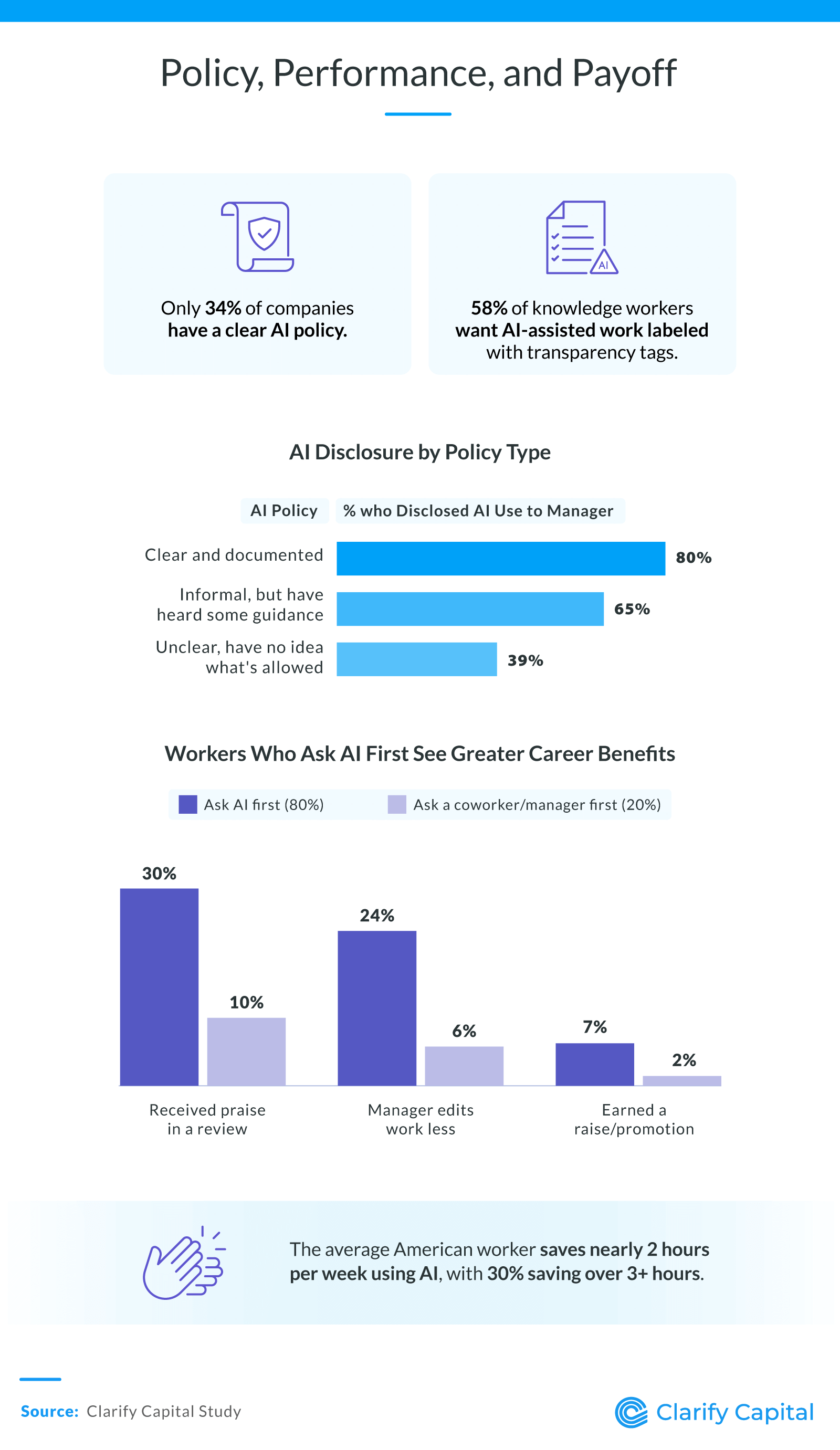
Knowledge workers who asked AI before a colleague for help were 3 times more likely to receive praise in a performance review (30% vs. 10%). They were also 4 times more likely to have their manager edit their work less (24% vs. 6%) and more likely to receive a raise or promotion (7% vs. 2%).
The average worker saved nearly 2 hours per week using AI. The breakdown was as follows:
8% percent saved no time at all.
26% saved less than 1 hour.
37% saved 1–2 hours.
21% saved 3–4 hours.
9% saved 5 or more hours per week.
The longer time gains came with measurable rewards. Workers who saved 3-4 hours per week had a 49% praise rate in performance reviews, and those saving 5 or more hours reached 50%, compared to 8% among those saving less than an hour each week.
Raise and promotion results followed a similar pattern:
5% among those saving 1–2 hours.
10% among those saving 3–4 hours.
18% among those saving 5 or more hours.
How Company AI Policies Influence Transparency and Trust
Company rules around AI made a bigger difference than you might expect. Only 34% of workers said their employer had a clear, formal AI policy. When those guardrails were in place, 80% told their boss they were using AI. At companies with unclear policies, that number fell to 39%. Businesses that offered informal guidance landed in between, with 65% choosing to disclose.
Large companies with more than 1,000 employees were the most likely to have defined AI policies, at 44%. Smaller businesses with fewer than 100 employees lagged behind, with just 18% saying they had a clear policy, and 32% admitting they had no idea what the company's stance was. That level of uncertainty can make employees think twice before speaking up.
There was also a strong interest in broader transparency. More than half of workers (58%) said they wanted AI-assisted work to include a label or tag showing it was used. Another 19% opposed labeling, and 23% were unsure.
The Rise of the AI-First Workplace
AI has become more than a productivity hack. It's now a first-draft partner, a confidence booster, and, in some cases, a career accelerator. Many knowledge workers turn to AI to move faster, avoid embarrassment, and sharpen their thinking before speaking up. For leaders, the message is clear: AI use is already embedded in daily work, whether or not policies have caught up.
As businesses navigate this shift, the opportunity isn't to replace human collaboration, but to guide it. The workplaces that set clear expectations, encourage smart use, and keep communication open may be the ones that benefit most from this new "ask AI before you ask your boss" culture.
Methodology
Clarify Capital surveyed 329 Americans who use computers most workdays to explore how professionals use AI tools in their daily work and how it impacts collaboration, communication, and confidence in the workplace. Respondents ranged in age from 18 to 74. Among them, 58% were men, 41% were women, and 1% were non-binary.
By role level, 12% were entry-level, 42% were mid-level, 13% were senior individual contributors, 27% were managers, and 5% were director-level or above. By work setup, 39% were hybrid, 32% in-person, and 29% fully remote. The margin of error for this study is +/– 5.4 percentage points at a 95% confidence level. As with all survey data, responses are self-reported and may be subject to biases such as recency bias or social desirability bias.
About Clarify Capital
Clarify Capital helps small and midsize business owners access the financing they need to grow with confidence. As AI becomes central to how businesses research and make decisions, our technology business loans help business owners fund the tools at the center of that shift.
Fair Use Statement
This content may be shared for noncommercial purposes only. If you reference or use these findings, please provide proper attribution with a link back to Clarify Capital.

Michael Baynes
Co-founder, Clarify
Michael has over 15 years of experience in the business finance industry working directly with entrepreneurs. He co-founded Clarify Capital with the mission to cut through the noise in the finance industry by providing fast funding and clear answers. He holds dual degrees in Accounting and Finance from the Kelley School of Business at Indiana University. More about the Clarify team →
Related Posts