
 Reviewed by
Key Takeaways:
Florida ranks No. 1 overall for business acquisition, leading the nation in GDP growth (3.1%) and placing in the top 5 for population growth (8.7%).
West Virginia ranks No. 50 overall for business acquisition, posting the worst population growth in the country (−1.4%), one of the lowest GDP growth rates (0.5%), and the second-worst lending access at just $626 per small business.
Rhode Island leads the nation in the share of business owners 55 and older (62.2%), meaning nearly two-thirds of businesses there could change hands in the coming decade.
Utah ranks No. 1 for SBA lending access with $2,461 approved per small business, more than 4x higher than Hawaii at the bottom ($561).
Pennsylvania has the highest 5-year business survival rate in the country at 57.1%, while Washington ranks last at 42.2%.
How All 50 States Rank for Business Acquisition
Not every state is equally ready for a wave of takeovers. Below, you can explore how every state stacks up across all 6 factors in our full Business Acquisition Readiness rankings.
The top 10 best states for buying a business in 2026 are:
Florida: 82.7
South Carolina: 81.0
Utah: 80.4
Texas: 79.3
North Carolina: 79.2
Idaho: 75.1
Arizona: 74.8
New Hampshire: 74.7
Montana: 73.9
South Dakota: 73.1
The 10 worst states for business acquisition in 2026 are:
West Virginia: 54.0
Louisiana: 57.2
Wyoming: 57.4
Maryland: 57.5
Oregon: 58.4
Vermont: 58.6
Iowa: 60.5
Kentucky: 61.1
Mississippi: 61.4
Kansas: 61.5
Sun Belt and Mountain West states dominate the top of the list, driven by strong population and GDP growth. The bottom of the rankings skews toward states with shrinking populations, weaker economies, and limited access to acquisition financing.
A Closer Look at Each Acquisition Factor
The overall rankings tell part of the story, but each factor reveals something different about what buying a business in a given state actually means for an acquirer. Here's what the data shows across each category.
Retiring Owner Share
One of the most important signals in the business acquisition process is how many existing business owners are approaching retirement age. When a large share of business owners are 55 or older, more businesses are likely to hit the market in the near future, giving buyers more options to choose from and more sellers who are motivated to close a deal.
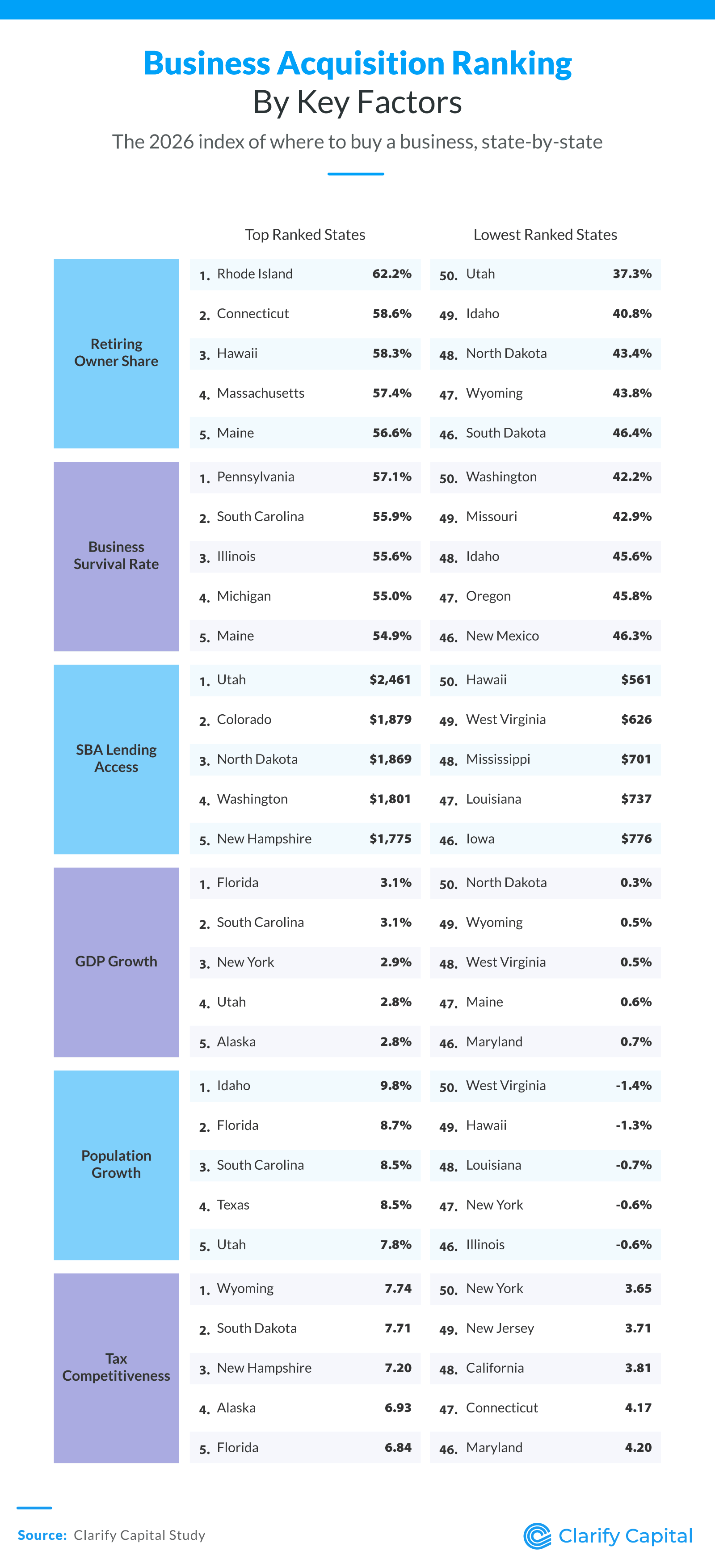
Rhode Island leads the nation here, with 62.2% of business owners at or near retirement age. Connecticut (58.6%), Hawaii (58.3%), Massachusetts (57.4%), and Maine (56.6%) follow. These are states where the acquisition process could be especially active over the next decade as owners look to exit.
On the other end, Utah (37.3%), Idaho (40.8%), North Dakota (43.4%), Wyoming (43.8%), and South Dakota (46.4%) have younger owner populations. This means fewer businesses are likely to come up for sale in the near term.
Business Survival Rate
Before you acquire an existing business, you want to know whether businesses in that state tend to survive. A higher five-year survival rate means the target business you're evaluating is operating in an environment where companies tend to stay viable. Lower survival rates point to tougher local conditions that could affect long-term profitability.
Pennsylvania tops this category with a 57.1% five-year survival rate. South Carolina (55.9%), Illinois (55.6%), Michigan (55.0%), and Maine (54.9%) follow. These states offer a more stable operating environment for the acquired business post-close.
Washington ranks last at 42.2%, followed by Missouri (42.9%), Idaho (45.6%), Oregon (45.8%), and New Mexico (46.3%). An acquirer evaluating a target company in these states should factor business sustainability risk into their due diligence process.
SBA Lending Access
Access to acquisition financing is a practical constraint for most buyers. The more SBA loan dollars approved per small business in a state, the easier it tends to be to get funded for an acquisition there. This matters whether you're structuring a leveraged buyout, negotiating a purchase price, or trying to close without depleting your reserves.
Utah leads all 50 states with $2,461 in SBA lending approved per small business. That's more than four times the bottom-ranked Hawaii ($561). Colorado ($1,879), North Dakota ($1,869), Washington ($1,801), and New Hampshire ($1,775) round out the top 5 for lending access.
Hawaii's low lending access figure stands out, given its otherwise strong retiring owner share (No. 3). For buyers targeting the Hawaiian market, limited SBA financing availability means acquisition financing may need to come from other sources. West Virginia ($626), Louisiana ($737), Mississippi ($701), and Iowa ($776) also fall near the bottom, which could complicate the purchase agreement process for buyers in those markets.
GDP Growth
Buying into a growing economy gives the business you acquire a better chance to grow with it. GDP growth reflects rising demand, expanding business operations, and a stronger environment for building market share after a deal closes.
Florida and South Carolina both clocked 3.1% GDP growth in 2025, tying for the top spot. They're followed by New York (2.9%), Utah (2.8%), and Alaska (2.8%). These are states where an acquiring company can reasonably expect economic tailwinds.
North Dakota (0.3%), Wyoming (0.5%), West Virginia (0.5%), Maine (0.6%), and Maryland (0.7%) sit at the bottom. Slow GDP growth doesn't make a deal impossible, but it does mean an acquirer will be working harder to grow revenue in a market that isn't naturally expanding.
Population Growth
A growing population means a growing customer base, and that's one of the clearest signs of long-term demand for a business's product lines and services. Population decline, on the other hand, means the existing company you buy could face shrinking demand over time, even with a strong management team in place.
Idaho leads the nation in population growth at 9.8% between 2020 and 2025. Florida (8.7%), South Carolina (8.5%), Texas (8.5%), and Utah (7.8%) follow. All of these states appear in the overall top 10, which reflects just how much population momentum contributes to an acquisition-friendly environment.
West Virginia (−1.4%), Hawaii (−1.3%), Louisiana (−0.7%), New York (−0.6%), and Illinois (−0.6%) all lost population over the same period. For any acquirer focused on new markets and long-term customer base growth, population decline is a meaningful headwind to account for in business valuation.
Tax Competitiveness
After an acquisition closes, taxes shape how much of the business's earnings stay in the business. A more tax-competitive state means better cost savings over time and more of the purchase price effectively working for you year after year.
Wyoming leads tax competitiveness with a score of 7.74 from the Tax Foundation's 2026 State Tax Competitiveness Index, followed by South Dakota (7.71), New Hampshire (7.20), Alaska (6.93), and Florida (6.84). Several of these states have no income tax, which creates meaningful advantages for business owners and acquirers alike.
New York ranks last (3.65), followed by New Jersey (3.71), California (3.81), Connecticut (4.17), and Maryland (4.20). High tax burdens in these states can erode the economies of scale and synergies an acquirer is counting on to justify the deal.
Where To Focus Your Business Acquisition Search
The best state to buy a business isn't just the one with the lowest purchase price or the most familiar market. It's the one where the fundamentals like owner availability, business survival, lending access, economic growth, population trends, and tax environment line up in your favor.
Florida, South Carolina, and Utah lead the 2026 rankings because they score well across multiple categories, not just one. If you're beginning the due diligence process on a potential acquisition, use this data as a starting point for narrowing your geographic focus before diving deeper into individual target companies.
FAQs About Business Acquisitions
You have questions, and we have the answers.
What Is Business Acquisition?
Business acquisition is the process by which one company (the acquirer) purchases an existing business or a controlling interest in one. The goal is typically to gain access to new markets, expand a customer base, add product lines, or achieve economies of scale that wouldn't be possible by building a new business from scratch.
Acquisitions can involve purchasing a company's shares, its assets, or both, depending on how the deal is structured. Unlike startups, an existing business comes with established revenue, an existing customer base, and an existing management team, which is part of what makes acquisition an attractive path to business ownership.
What Are the Four Types of Acquisitions?
The four main types of business acquisitions are horizontal, vertical, congeneric, and conglomerate. A horizontal acquisition is when an acquiring company buys a competitor in the same industry to grow market share. A vertical acquisition targets a business in the same supply chain (either a supplier or a distributor) to improve business operations and reduce costs.
A congeneric acquisition (also called a concentric acquisition) involves buying a company in a related but different industry, often to expand product lines or reach new customers. A conglomerate acquisition is when a parent company acquires a business in a completely different industry, diversifying its holdings across sectors. Each type carries different synergies, risks, and strategic rationale for the acquirer.
What Is the Due Diligence Process When Buying a Business?
The due diligence process is the investigation a buyer conducts before finalizing a purchase agreement. It covers a thorough review of the target business's financials, liabilities, legal entity structure, intellectual property, supply chain relationships, and existing contracts.
The goal is to verify that the business is what the seller says it is, and to uncover any risks that could affect the purchase price or post-acquisition profitability. Skipping or rushing due diligence is one of the most common and costly mistakes in any acquisition process, so buyers should budget enough time to do it thoroughly.
How Do You Finance a Business Acquisition?
There are several ways to finance a business acquisition. The most common include SBA loans, conventional business loans, a leveraged buyout (where the acquired business's own assets are used as collateral), seller financing, and joint venture arrangements where multiple acquirers share the purchase. Some deals involve purchasing a company's shares directly, while others are structured as asset purchases.
The right financing approach depends on the size of the deal, the legal entity structure of the target business, and what terms are available to the acquirer. States with stronger SBA lending access (like Utah, Colorado, and New Hampshire) make it easier to secure acquisition financing than states where capital is more limited.
Methodology
To identify the best states for buyers in 2026, we scored all 50 states across six factors that matter to anyone acquiring an existing business. Each factor was scaled to its weight below, then summed into a final score out of 100. The state that led each factor received the full weight; every other state scaled proportionally.
Scoring Categories and Weights
Retiring Owner Share — 25 Points
The share of business owners who are 55 or older in each state. States with more aging owners have more businesses likely to hit the market in the next few years.
Source: U.S. Census Bureau, Annual Business Survey 2024.
Business Survival Rate — 20 Points
The percentage of businesses still operating five years after opening. A higher survival rate means the businesses you're looking to buy in that state are more likely to still be standing and profitable. Less risk for the buyer.
Source: U.S. Bureau of Labor Statistics, Business Employment Dynamics, 2025.
SBA Lending Access — 15 Points
Total SBA loan dollars approved in the most recent fiscal year, divided by the number of small businesses in the state. A higher number means it's easier to get financed to acquire a business there. More capital available per potential buyer.
Source: U.S. Small Business Administration, FY2025 Year-End Approvals Report.
GDP Growth — 15 Points
How fast the state's economy grew in 2025. Faster growth means the business you buy is operating in a rising tide.
Source: U.S. Bureau of Economic Analysis, State Annual Real GDP, 2025.
Population Growth — 15 Points
How much the state's population changed between 2020 and 2025. Growing populations mean growing demand. Shrinking populations mean the customer base you're inheriting is shrinking too.
Source: U.S. Census Bureau, Vintage 2025 State Population Estimates.
Tax Competitiveness — 10 Points
The state's overall tax competitiveness score from the Tax Foundation. Lower taxes mean more of your post-acquisition profit stays in your pocket, and the business you buy keeps more of its earnings year after year.
Source: Tax Foundation, 2026 State Tax Competitiveness Index.
About Clarify Capital
Clarify Capital helps small and midsize business owners access the financing they need to grow with confidence. If this list has you seriously considering buying a business, our SBA loans are one of the most competitive financing options available for acquisitions.
Fair Use Statement
Feel free to share these findings for noncommercial purposes. Please link back to Clarify Capital and credit us appropriately so readers can access the full methodology and rankings.

Michael Baynes
Co-founder, Clarify
Michael has over 15 years of experience in the business finance industry working directly with entrepreneurs. He co-founded Clarify Capital with the mission to cut through the noise in the finance industry by providing fast funding and clear answers. He holds dual degrees in Accounting and Finance from the Kelley School of Business at Indiana University. More about the Clarify team →
Related Posts