
 Reviewed by
A merchant cash advance (MCA) gives a business a lump sum of funding in exchange for a share of its future sales. Unlike traditional loans, MCAs are structured as purchases of future receivables, meaning the MCA provider collects repayment through daily or weekly withdrawals directly from the business's bank account.
That speed and accessibility come at a steep price. MCA debt carries some of the highest costs in business financing, and the aggressive repayment structure can drain cash flow within weeks. For small business owners already stretched thin, one advance can spiral into stacking obligations that threaten the business itself.
Below, I'll cover how merchant cash advance debt accumulates, the red flags to watch for before signing an MCA contract, what debt relief options exist if you're already in it, and safer alternatives worth considering instead.
| MCA Debt Options | ||||
|---|---|---|---|---|
| Relief option | How it works | Typical cost | Timeline | Best for |
| Restructuring | Renegotiating existing MCA terms for lower payments or an extended timeline | Varies by provider | 1 to 6 months | Businesses that want to maintain their MCA provider relationship |
| Debt consolidation | Combining multiple MCAs into one lower-cost payment | Depends on new financing terms | 1 to 3 months to arrange | Businesses juggling multiple stacked advances |
| Debt settlement | Negotiating a lump-sum payoff for less than the total owed | Often 30 to 60% of balance | 1 to 6 months | Businesses with cash reserves to negotiate |
| Refinancing | Replacing MCAs with a lower-cost loan or line of credit | Depends on new loan terms | 2 to 8 weeks | Businesses with credit scores strong enough to qualify |
| Bankruptcy | Court-supervised reorganization or discharge of debt | $5,000 to $15,000+ in legal fees | 3 to 18 months | Businesses with insurmountable debt and no other path forward |
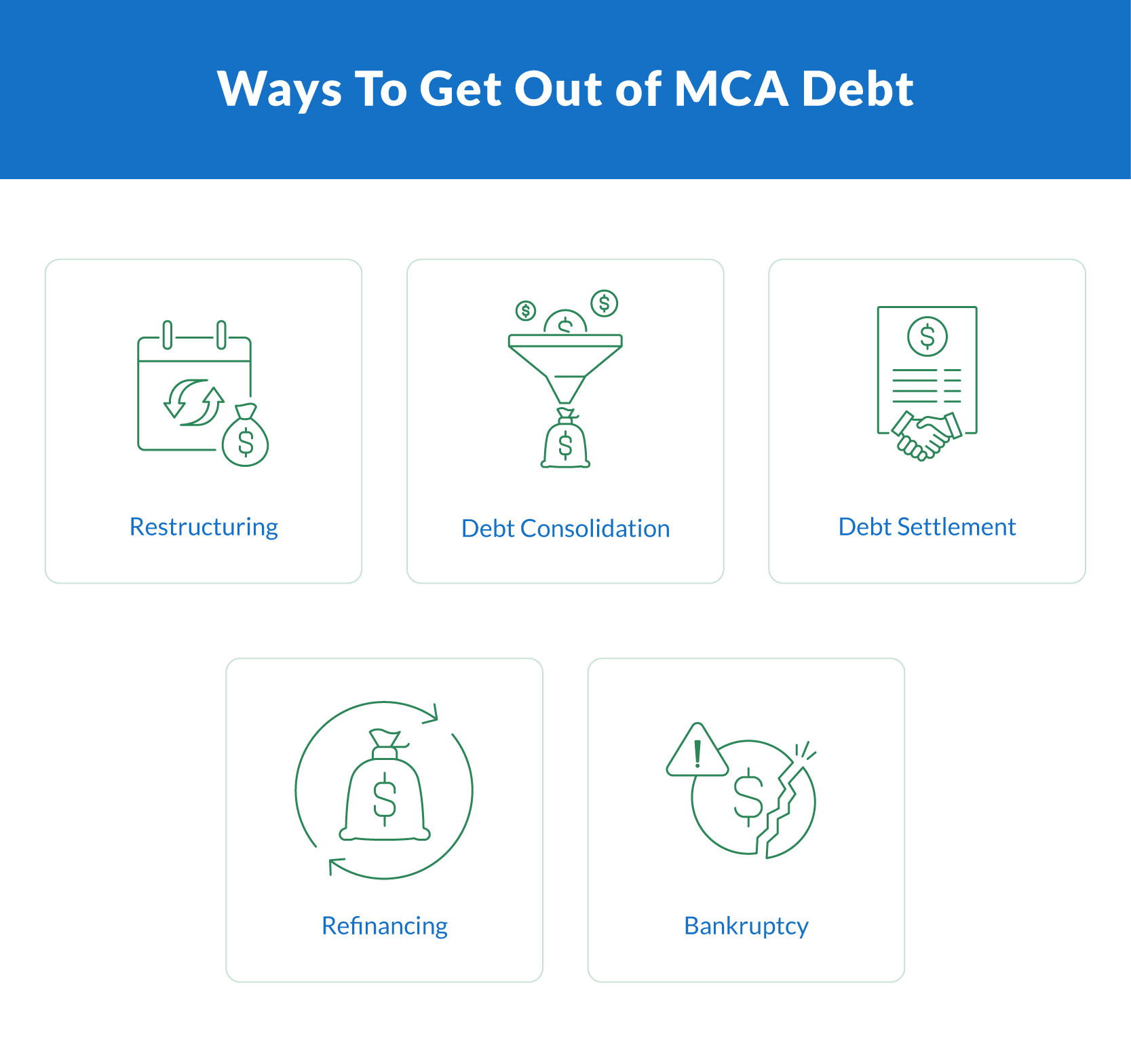
How To Get Out of MCA Debt
If you're looking for MCA debt relief, the right approach depends on your financial situation, how many advances you're carrying, and whether your goal is to keep the business running or wind down. Here's a closer look at each business debt relief option (see the comparison table at the top of this article for a quick side-by-side overview).
Restructuring
MCA debt restructuring involves renegotiating the terms of your existing MCA agreements to reduce daily or weekly payments, extend the repayment timeline, or lower the total payback amount.
Restructuring preserves your relationship with the MCA provider and avoids legal action, making it one of the lower-stakes paths out of MCA debt. The trade-off is that you're still repaying the obligation (in full or close to it), just on more manageable terms and a more predictable repayment schedule.
Debt Consolidation
Debt consolidation means combining multiple MCA obligations into a single payment, ideally through a lower-cost financing product like a term loan or line of credit. Instead of juggling several daily or weekly withdrawals, you make one monthly payment at a lower overall cost. This approach works best when the business qualifies for traditional financing to pay off the existing MCAs.
One thing to watch for: some products marketed as "MCA consolidation" are themselves high-cost advances with similar cost structures. Always verify the financing type and total cost before signing.
Debt Settlement
Debt settlement involves negotiating with the MCA company to accept a lump-sum payoff for less than the total amount owed. This typically requires having cash on hand (or access to a separate funding source), and the MCA provider has no obligation to accept the offer.
Settlement can work when the provider would rather recover some capital quickly than pursue collection. Keep in mind that settled debt may have tax implications (the forgiven amount could be treated as taxable income), and settling can damage your relationship with that funder.
Refinancing
Refinancing replaces one or more high-cost MCAs with a lower-cost financing product. SBA 7(a) loans, for example, cap interest rates at base rate plus 3.0% to 6.5% with terms up to 25 years for real estate or 10 years for working capital, a dramatic improvement over MCA costs.
The challenge is qualifying. Traditional lenders typically require a stronger credit score and more thorough underwriting documentation than MCA providers do. If your credit has taken a hit from the MCA debt itself, refinancing may not be immediately available, but it's worth pursuing as your financial position stabilizes.
Bankruptcy
Bankruptcy is a last resort, but it can provide a path forward when MCA debt is truly insurmountable. The three most relevant options for small business owners are:
Chapter 7. Liquidation of business assets to discharge debts. This option is best for businesses that are closing.
Chapter 11 (including Subchapter V). Court-supervised reorganization that lets the business continue operating while restructuring its debts. Subchapter V is designed specifically for small businesses.
Chapter 13. A repayment plan for individual business owners (sole proprietors) based on income.
Whether MCA obligations can be discharged depends on how the court classifies them (as debt or as a purchase of receivables). Consulting a bankruptcy attorney is essential to evaluate your specific situation.
How Merchant Cash Advances Work
To understand MCA debt, you first need to understand the product itself. Merchant cash advances aren't technically loans. They're structured as purchases of your business's future receivables, which means they sidestep most lending regulations. That distinction matters when it comes to cost, repayment structure, and what protections you do (and don't) have as a borrower.
Factor Rates vs. Interest Rates
Traditional loans charge interest on a declining balance. As you pay down the principal, the amount of interest you owe each month decreases. MCAs work differently.
Instead of an interest rate, MCA providers use a factor rate (a fixed multiplier, typically 1.1 to 1.5) applied to the full advance amount. A $50,000 advance at a 1.35 factor rate means you'll repay $67,500 regardless of how quickly you pay it back. That's $17,500 in fees on a short-term advance that could be repaid in as little as three to six months.
Because the cost is fixed and the repayment window is compressed, the effective annual percentage rate on an MCA can be staggering. Borrowing fees on merchant cash advances range from 50% to well over 100%, which translates to effective APRs between 40% and 350% or higher, depending on the term.
| MCA Factor Rate Cost Examples | ||||
|---|---|---|---|---|
| Advance amount | Factor rate | Total repayment | Fees paid | Term |
| $25,000 | 1.2 | $30,000 | $5,000 | 6 months |
| $50,000 | 1.35 | $67,500 | $17,500 | 6 months |
| $50,000 | 1.4 | $70,000 | $20,000 | 4 months |
| $100,000 | 1.5 | $150,000 | $50,000 | 12 months |
How MCA Repayment Works
MCA providers collect repayment in one of two ways:
Percentage-based withdrawals. The provider takes a fixed percentage of your daily credit card sales. If business is slow, payments go down, but so does your available cash flow.
Fixed ACH withdrawals. The provider debits a set dollar amount from your bank account on a daily or weekly basis, regardless of how much revenue you bring in.
Fixed withdrawals are the more common (and more dangerous) structure. Because the payment amount doesn't adjust to your revenue, a slow week can leave your account drained before you've covered payroll, rent, or inventory.
Most MCA repayment schedules are compressed. Where a traditional business loan might spread payments over five to 10 years with monthly installments, an MCA typically demands full repayment within three to 18 months through daily or weekly payments. That compressed timeline is what makes the effective cost so high and what makes MCA debt so difficult to manage alongside normal operating expenses.
Your MCA agreements may also include payment terms that give the MCA lender priority over other creditors, meaning they collect before you pay anyone else.
The True Cost of MCA Debt
The factor rate on an MCA contract can make the cost look manageable at first glance. A 1.3 factor rate sounds like a 30% fee. But when that fee is charged on a three-to-six-month advance and collected daily, the annualized cost is dramatically higher than most business loans or traditional financing.
The 2025 Federal Reserve Small Business Credit Survey found that applicants at online lenders were significantly more likely to report challenges with high interest rates and unfavorable repayment terms. Net satisfaction with online lenders dropped to just 2% that year, down from 15% the prior year.
Here's how MCA costs compare to more conventional options:
| MCA vs. Conventional Loan Costs | |||
|---|---|---|---|
| Financing type | Typical cost | Repayment term | Total repayment on $50,000 |
| MCA (1.3 factor rate) | 60 to 200%+ effective APR | 6 to 24 months | $65,000 |
| SBA 7(a) loan | Base rate + 3.0% to 6.5% (roughly 10 to 14% APR) | Up to 25 years (real estate) or 10 years (equipment/working capital) | ~$57,000 to $62,000 over full term |
| Business term loan | 6% to 12% APR | 3 to 10 years (long-term); 6 to 24 months (short-term) | $57,000 to $62,000 |
| Business line of credit | 6% to 14% APR | Revolving | Interest only on drawn amount |
Red Flags in MCA Contracts
Not every merchant cash advance is predatory, but certain contract terms should raise immediate concerns. Before signing any MCA agreement, watch for these warning signs:
No APR or total cost disclosure. If the provider won't show you the annualized cost of the advance, that's a problem. California now requires commercial financing providers to disclose annualized rates under SB 1235, but many states still don't.
Confession of judgment clause. A confession of judgment is a pre-signed agreement that waives your right to defend yourself in court if the MCA provider claims you defaulted. New York restricted the use of confessions of judgment against out-of-state debtors in 2019, but they're still enforceable in many other jurisdictions.
Personal guarantee. Some MCA contracts require the business owner to pledge personal assets (home, savings, vehicles) as collateral. This means your personal finances are on the line if the business can't keep up with payments.
No reconciliation rights. Reconciliation is the right to have your payments adjusted when revenue drops. Without it, you're locked into fixed withdrawals even during your slowest months.
Excessive up-front fees. Some MCA providers charge origination fees, processing fees, or administrative costs that get deducted from your advance before you receive it, reducing the actual amount of working capital you get while you still repay the full factored amount.
Vague or missing underwriting criteria. Legitimate lenders explain how they evaluate your application. If an MCA provider approves you with no questions about your financials, that's a red flag, not a convenience.
Pressure to sign immediately. Any provider that pushes you to close the deal without giving you time to review MCA contracts with an advisor is prioritizing their timeline over your interests.
MCA Stacking and the Debt Spiral
High costs and fast repayment timelines create conditions where one advance often leads to another. For small business owners already short on cash, an MCA can temporarily fill the gap, only to create a bigger one a few months later.
MCA stacking happens when a business takes out a second or third advance to cover cash flow shortages caused by the first. It's more common than most borrowers realize, partly because MCA companies actively target businesses with existing advances. Those borrowers have already shown a willingness to use the product, and their cash flow strain makes them more likely to say yes to another.
Each additional advance compounds the problem. A business repaying $500 per day on one MCA might take a second advance that adds another $400 in daily withdrawals. That $900 daily burden can consume a significant share of revenue, destroying financial stability and pulling the business deeper into business debt with no clear path out.
The 2025 Federal Reserve survey found that 41% of firms with too much existing debt were denied additional financing from traditional lenders. When banks say no, business owners often turn to the only source that will still fund them (another MCA provider), deepening the cycle of debt.
What Happens if You Default on MCA Payments
Defaulting on an MCA can trigger serious consequences, and the provider's options are often broader than what a traditional lender would have. Here's what you may face:
Confession of judgment enforcement. If your contract includes a COJ and you're in a state that allows it, the MCA provider can obtain a judgment against you without a trial, potentially freezing your bank accounts and seizing business assets with little warning.
UCC lien on business assets. Many MCA companies file UCC-1 financing statements when the advance is issued, establishing a security interest in your receivables, equipment, and inventory. This lien makes it extremely difficult to obtain other financing, since new lenders will see the existing claim on your assets.
Aggressive collection tactics. MCA providers (or the third-party collectors they hire) may contact you repeatedly, threaten legal action, or attempt to withdraw funds from your bank account even after you've asked them to stop.
Personal asset exposure. If you signed a personal guarantee, the MCA lender's claim isn't limited to the business. Your home, savings accounts, and other personal assets may be at risk.
Alternatives to Merchant Cash Advances
If you're looking at financing options beyond MCAs (or searching for a way to refinance out of one), several lower-cost products may be a better fit:
SBA loans. Government-backed loans with some of the lowest rates available to small businesses. Interest rate caps and terms up to 25 years make them far more affordable than MCAs, though the application process takes longer.
Business lines of credit. A flexible draw-and-repay structure where you only pay interest on the amount you've actually used. A strong option for managing cash flow gaps without committing to a fixed lump-sum advance.
Term loans. Fixed rates and predictable monthly payments from banks or credit unions. The repayment schedule is transparent, and the total cost is typically a fraction of what an MCA would charge.
Invoice factoring. Selling outstanding invoices for immediate cash. There are costs involved, but the fee structure is more transparent than an MCA, and repayment is tied to your clients paying their invoices rather than to daily debit withdrawals from your account.
Business credit cards. For smaller, short-term needs, credit cards offer clearly disclosed APRs and revolving credit. They won't replace large funding needs, but they're a more regulated and predictable option.
Many of these alternatives require a credit score of 650 or higher and at least one to two years in business, which is partly why business owners with lower scores and shorter track records end up turning to MCA providers. The 2025 Federal Reserve survey found that 37% of employer firms applied for a loan, line of credit, or merchant cash advance in the prior 12 months, a sign that demand for accessible funding isn't slowing down.
Protect Your Business From MCA Debt
MCA debt is manageable when caught early, but the best strategy is avoiding predatory terms in the first place. Before signing any advance, calculate the true annualized cost, read every clause in the contract, and compare the offer against traditional loans and lower-cost financing options.
If you're already dealing with MCA debt, the relief options I've explained here can help you regain control, but acting sooner gives you more leverage and more choices. Compare your financing options today with Clarify Capital to find a lower-cost path forward for your business.
Frequently Asked Questions
What does MCA mean in loans?
MCA stands for merchant cash advance. Despite the name, it's technically not a loan but a purchase of your business's future sales or receivables. The MCA provider gives you a lump sum up front, and you repay it (plus fees) through a percentage of daily credit card sales or fixed withdrawals from your bank account.
How do you get out of MCA debt?
The five main options are restructuring (renegotiating terms), debt consolidation (combining MCAs into one payment), debt settlement (negotiating a reduced payoff), refinancing (replacing MCAs with a lower-cost loan), and bankruptcy. The best path depends on how many advances you're carrying and your business's overall financial health.
Are MCA loans illegal?
MCAs are legal, but they're largely unregulated at the federal level because they're classified as commercial transactions rather than loans. That said, enforcement is increasing. The FTC permanently banned the owner of RCG Advances in 2023 for deceiving small businesses and seizing assets, and banned Seek Capital's CEO in 2025 for similar practices. At the state level, New York restricted confessions of judgment against out-of-state debtors in 2019, and California now requires MCA providers to disclose annualized rates under SB 1235.
What happens if you don't pay MCA?
Defaulting on an MCA can trigger confession of judgment enforcement (allowing the provider to freeze your accounts without a trial), seizure of business assets through UCC liens, aggressive collection tactics from third-party collectors, and personal liability if you signed a personal guarantee pledging personal assets.
How is an MCA different from a traditional business loan?
The key differences: MCAs use factor rates instead of interest rates, collect repayment daily or weekly instead of monthly, aren't subject to federal lending regulations like the Truth in Lending Act, and typically cost significantly more. A traditional business loan charges interest on a declining balance, offers longer repayment terms, and provides clearer cost disclosures.

Michael Baynes
Co-founder, Clarify
Michael has over 15 years of experience in the business finance industry working directly with entrepreneurs. He co-founded Clarify Capital with the mission to cut through the noise in the finance industry by providing fast funding and clear answers. He holds dual degrees in Accounting and Finance from the Kelley School of Business at Indiana University. More about the Clarify team →
Related Posts