


 Reviewed by
![Average Small Business Profit Margins by Industry [2026]](/assets/blog/average-profit-margin-by-industry/average-profit-margin-by-industry-dfed899f9d7696015f112da46cb91018a6ecee0a5af5cfe0c0e064be5a1d9cb3.webp)
You've pulled the numbers, calculated your net margin, and now you want to know how it stacks up against other businesses.
But there's just one problem: all of the industry benchmarks available were put together using financial metrics from large, publicly traded companies. Public companies have enormous purchasing power, and if you're like most Americans running a small business, these figures aren't helpful.
I'm Michael Baynes, co-founder of Clarify Capital, and I've spent more than 15 years helping small to midsize businesses secure financing. To address this gap, I dug into real Internal Revenue Service (IRS) small business data to explain the types of profit margins and how revenue shakes out across industries.
Minimum Qualifications
For Financing Through Clarify Capital

$10,000 in monthly revenue
Your business must earn at least $10K per month in a business bank account.

500+ credit score
You can get approved with any credit score. But the better your credit rating, the better interest rates lenders offer. Your FICO score should be above 500.

Minimum six months in business
Your company should be operational for a minimum of six months. This shows business lenders that your company is sustainable and won't go out of business.

Have a business bank account
Your Clarify advisor will need three or four months of your most recent bank statements to verify income. This is just to see you're actually making $10K+ month in revenue.
What Counts as Profit When You're the Owner and Operator
Profit is calculated differently depending on the type of small business you're operating.
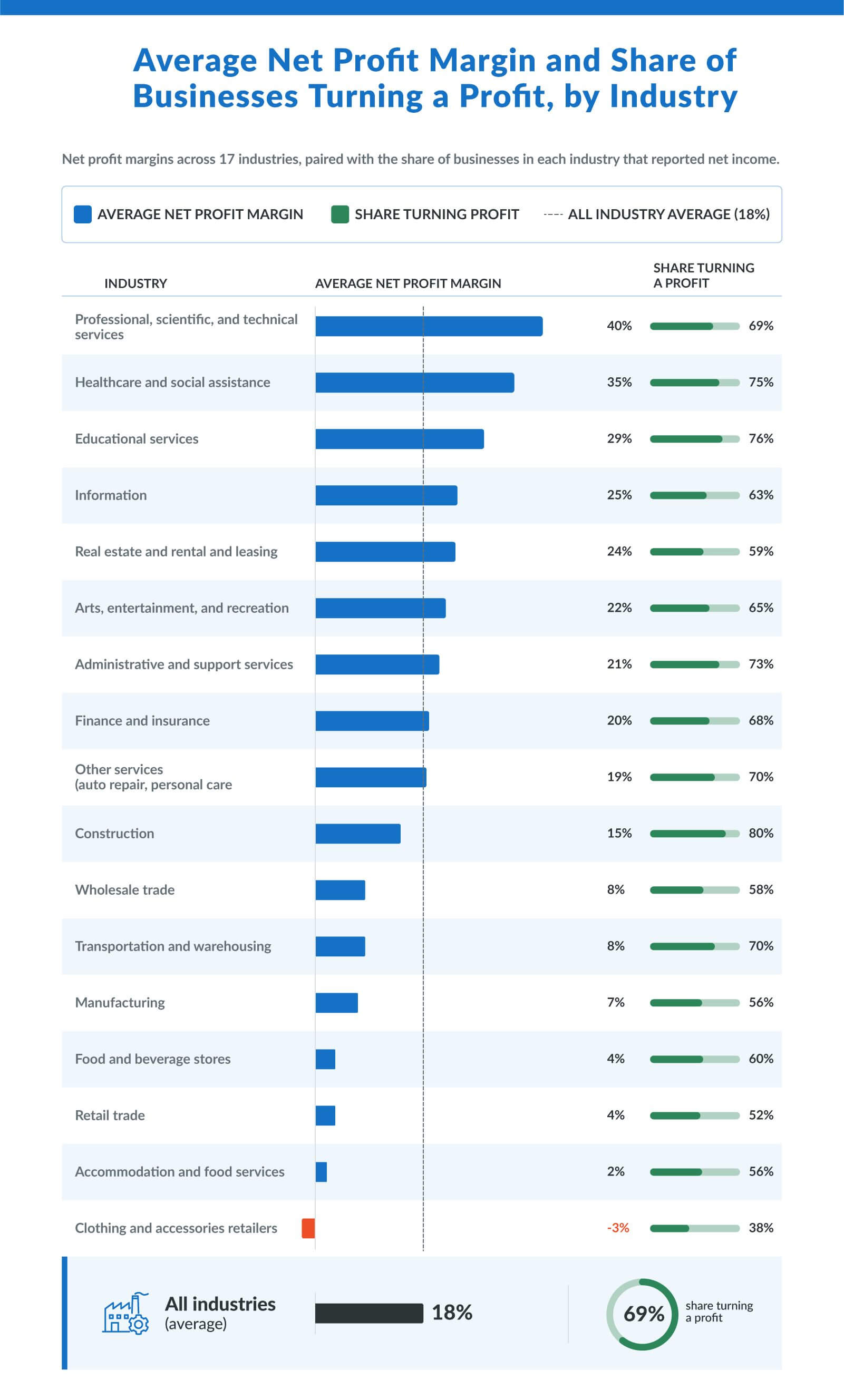
For a sole proprietor, net income is the amount remaining after you pay your expenses. The average net profit margin for professional services is 40%. That doesn't mean consultants are taking home $0.40 for each dollar as profit. Rather, it represents both the consultant's pay and the money they'll need to reinvest into the practice.
At an S Corporation, the owner receives a W-2 salary that is deducted from their net income, so it often reads lower than a sole proprietor in the same industry. This affects how your revenue translates into net profit.
Three Profit Margins, Explained
Together, these three financial metrics provide a complete picture of your business's financial health.
These are the three types of profit margins and what they mean for your business.
Gross profit margin. This is revenue minus the cost of goods sold (COGS), divided by revenue. It measures the money left over after what it costs to make or buy the product you sell, before any overhead.
Operating profit margin. This is what's left over once you subtract operating expenses like payroll, rent, and utilities, divided by revenue. It measures how well your business runs day to day, before interest and taxes.
Net profit margin. This is the money that's yours. It's what's left after everything (COGS, operating expenses, interest, and taxes) is deducted.
These margins work independently. A high gross profit margin doesn't mean you'll also have a high net profit margin. Conversely, a high net profit margin doesn't necessarily translate into a high gross profit margin. That said, disparities between these margins can indicate a problem. More on that later.
Which Industries Run the Highest and Lowest Margins
Net profit margins differ across industries. There are a few factors that contribute to this, including industry competition, sales repeatability, labor costs, and regulatory burden.
First, let's dig into the businesses with good profit margins.
Professional services have a high profit margin at 40%. This includes technical services, like computer services and scientific consulting, in addition to other types of professional services.
These businesses are selling knowledge rather than inventory. They have virtually zero COGS, and their primary expense will always be their owners' time. Healthcare operates on the same principle of selling knowledge with a net profit margin of 35%.
At the opposite end of the spectrum are businesses with thin margins.
The accommodation and food services sector had an overall net profit margin of 2%. This is likely due to the high cost of labor and rent, and losses from food spoilage. Retail faces similarly thin margins at 4%, due to high operating costs and intense competition.
Clothing and accessories retailers were the only category to land below zero, posting an average net loss of 3%. Just 38% of them reported net income, the lowest share of any industry.
I tell my clients to read these averages as a starting point for your industry, but remember they aren't the whole story. It's important to calculate your own margins to understand your individual business health.
How Margins Move With Business Size
The size of your company influences your profit margins, but often not in the way you'd expect.
Gross profits for small companies generally range from near to exactly the same as their larger counterparts, since the cost per product sold is relatively equivalent to what the large company pays.
The discrepancy shows up in the net profit. Your company pays for the same fixed costs like rent and insurance whether you do $200,000 in sales or $2 million, so a smaller company bears a much greater burden of overhead for each dollar earned, which ultimately results in a thinner net profit margin.
This is why larger companies generally retain a higher percentage of each dollar. Once your revenue exceeds the amount needed to cover your fixed costs, a larger portion of what remains drops to the bottom line. Essentially, the same sale is simply more valuable to a company large enough to absorb the overhead that comes with it.
What a Below-Benchmark Margin Is Telling You
If your margins are below the industry average, it's usually related to one of three problems. Here's what I tell my clients to consider first.
Pricing problem
If your gross margins are trailing, you may have priced your products or services too low, or you have seen an increase in your COGS while your prices remained static. The solution is to reevaluate your pricing strategy or negotiate better deals with suppliers.
Cost or overhead problem
If high overhead costs are eating away at your profit, explore ways to reduce the cost of rent, payroll, insurance, or other operating costs.
Financing cost problem
If your operating margins are fine but net margin is behind, that could point to a financing issue. Explore ways to reduce the amount or cost of any business debt.
To understand what your specific challenge is, I recommend starting by calculating your gross profit margin, then moving to operating profit margin. Conclude with net profit margin and your outstanding debt.
Where you trail industry benchmarks should give you a better sense of your issue and allow you to identify where you can save money.

When a Thin Margin Is Really a Financing Question
When cash is tight, borrowing might seem like a good option. And it can be, in some situations.
If you're dealing with a large pile of debt, some small business owners choose to explore refinancing. This can combine several payments into one more manageable monthly payment at a lower rate.
For small, seasonal gaps, some owners reach for business lines of credit that allow them to borrow, repay, and then borrow again. You only pay interest on what you use, so these are good options for businesses that experience ups and downs throughout the year.
Clarify Capital matches your application across our network of 75+ vetted, reputable lenders to ensure you find financing that fits. When you're ready to see what you qualify for, apply today. Checking your options won't affect your credit score.
Frequently Asked Questions
Here are the most common questions I hear from business owners about profit margins.
What Industry Has the Highest Profit Margins?
The industry with the largest net profit margin is professional, scientific and technical services. The average net profit margin for this industry was 40% for the tax year 2023.
This is because professional, scientific and technical services don't have a COGS because the primary service is their experience. So the majority of their costs are the owners' time and labor.
Is a 40% Profit Margin Good?
It depends on the industry. Businesses in the service sector that have very low costs of goods are able to achieve a 40% profit margin or better easily. But in the restaurant industry, a margin this high would be considered exceptional and very difficult to achieve when you factor in operating costs.
Is Operating at a 20% Profit Margin Healthy for a Company?
Yes, a 20% net profit margin is considered a good net margin for most industries. While this might be considered low for a consulting business, a 20% profit margin is very high for a grocery store or retail business.
Is 30% a High Profit Margin?
A 30% net profit margin is high for most industries. It's common in service industries such as real estate brokerages, consulting firms, and healthcare, but is considered rare in industries like retail, wholesale, and food service.
How Do I Calculate My Own Profit Margin?
To calculate your own profit margin, divide your profit by your revenue, then multiply that number by 100. To get your gross profit margin, subtract the COGS from the top line. Net profit margin is revenue minus all costs.
Why Is My Margin Lower Than My Industry's Average?
If there is a problem with your gross profit margin, you either have a price issue or a cost-of-goods issue. If your gross profit margin is good but your operating profit margin is low, it is likely an overhead issue. If your gross and operating margins are good, but your net profit margin is poor, it may be an issue with your debt.
How Does Clarify Capital Protect My Financial Data?
Clarify follows SOC 2 security principles, and your information stays protected throughout the process. Read more about how we protect your data before you share anything.

Michael Baynes
Co-founder, Clarify
Michael has over 15 years of experience in the business finance industry working directly with entrepreneurs. He co-founded Clarify Capital with the mission to cut through the noise in the finance industry by providing fast funding and clear answers. He holds dual degrees in Accounting and Finance from the Kelley School of Business at Indiana University. More about the Clarify team →
Related Posts