

 Reviewed by
As a co-founder of a small-business lending platform, I get asked a lot about whether “no-money-down” business loans are real.
My answer is always yes, with a few caveats and clarifications.
There are some loan and financing options that don't require a traditional down payment. That is, you don't have to put up cash first thing to get started. Those options (which I'll flesh out in more detail shortly) include some SBA Express loans, SBA Microloans, business lines of credit, merchant cash advances, equipment financing, invoice factoring, business credit cards, and some online term loans.
But “no money down” does not mean the funding is free, cheap, or easy to get.
Lenders will almost always offset the lack of down payment somewhere else. It often shows up via high interest rates, short repayment terms, and/or a requirement that you put up some sort of collateral.
That brings up another common confusion: the difference between “no collateral” and “no money down.” They're not the same. “No collateral” means you don't have to pledge an asset to get financing, but you can have a business loan with no down payment that still requires collateral, or a loan with no collateral that still requires a down payment.
No-Down-Payment Business Loan Options
These options offer financing without a down payment. Some are more directly suitable for no-money-down needs than others, and not all of them are technically loans; rather, they are other ways to access working capital, which I note.
| Financing type | Down payment required? | Typical rates | Funding speed | Typical credit requirements | Main trade-offs |
|---|---|---|---|---|---|
| Business line of credit | No down payment | Can start as low as 6%, but typically about 10% to 60%+ APR | Can be same day to a few days for some lenders | Often 600+ credit score, though some lenders go lower | Not ideal for long-term expenses; lower-credit borrowers may face high rates and lower limits |
| Merchant cash advance (MCA) | No down payment | Uses factor rates instead of APRs; typically 1.08% to 1.45%; varies by risk and sales volume | Can be same day to a few days for some lenders | Often available to borrowers with low credit if revenue is strong | Usually one of the most expensive financing options; often repaid daily or weekly |
| Online term loan | No down payment with certain online and alternative lenders | Can start as low as 6% and go up to 30%+ APR, depending on whether secured or unsecured | Can be same day to a few weeks; online lenders are often faster | Commonly 500–650+, depending on lender | Rates are often materially higher than bank term loans |
| Equipment financing | No down payment; equipment = collateral | Can start as low as 6%, but typically about 8% to 30% APR | Usually 1 to 5 days | Usually 600+, though stronger revenue can matter more | Financing can only be used for equipment purchases |
| Invoice factoring | No down payment; invoices = collateral | Uses discount fee, not APR; usually about 0.5% to 5% per 30 days | Up to 1 to 2 weeks | More dependent on customer invoice quality than credit | Only works for businesses with invoices |
| SBA Express loans | Sometimes available with little or no down payment, depending on lender; can vary significantly | Can start as low as 6.75%, but usually about 10% to 15% APR | As quickly as two weeks, but typically 30 to 90 days | Often 650+ credit score with stronger business financials | Approval can be more difficult than alternative financing; still may require guarantees or collateral |
| SBA Microloans | Sometimes available with little or no down payment, depending on lender; can vary significantly | Can start at 6.75%; typically about 8% to 13% APR | As quickly as two weeks, but typically 30 to 90 days | More flexible than many bank loans, especially for newer businesses | Approval can be more difficult than alternative financing; smaller loan amounts (up to $50,000); still may require guarantees or collateral |
| Business credit cards | No down payment | Often about 18% to 30%+ APR if balances carry | Sometimes same-day to several days | Often 650+ personal credit score | Carrying balances long-term can become expensive |
The Types of Business Loans That Usually Do Require a Down Payment
You should also be aware of some of the loan options that do require down payments, so that you can understand what you're trading for getting the perk of putting no money down.
SBA 7(a) and 504 Loans
The Small Business Administration (SBA) is a federal agency that helps administer SBA loans, which are offered through participating lenders. These loans are highly sought after because they offer good rates, favorable terms, and the security of a partial government guarantee. That also means they're harder to qualify for and come with fairly significant down payment requirements.
SBA 7(a) loans are the most common and flexible of the SBA loans. They can be as much as $5 million and can be used for business needs like:
Acquiring, refinancing, or improving real estate and buildings
Short- and long-term working capital
Refinancing current business debt
Purchasing and installation of machinery and equipment
Purchasing furniture, fixtures, and supplies
Changes of ownership (complete or partial)
These typically require a down payment of about 10% to 20% of the loan amount.
SBA 504 loans can reach up to $5.5 million and are long-term, fixed-rate loans. They're meant to be used for things that promote business growth and job creation, like:
Building construction
Long-term use machinery or equipment
Facility improvement
Streets, parking lots, land, utilities
These typically require a down payment of about 10% of the loan amount.
Traditional Bank Term Loans
Bank term loans are provided by lenders as a lump sum and repaid with a set APR over a set period of time. They're quite flexible and can be used for a variety of business expenses.
There are short-term loans, which are paid back in a shorter window (usually anywhere from six to 36 months) and are typically more expensive. There are also long-term loans, which are harder to qualify for but offer better rates, higher loan amounts, and longer terms.
These typically require a down payment of about 10% to 30% of the loan amount.
Commercial Real Estate Loans
Commercial real estate loans are loans specifically for buying, building, refinancing, or renovating commercial property. Commercial real estate loans work similarly to residential mortgages, but usually involve larger loan amounts, shorter terms, and more business-focused underwriting. Repayment terms are usually on the longer side, from five to 25 years, and rates are usually lower than unsecured business financing because the property acts as the collateral.
These typically require a down payment of about 20% to 30% of the loan amount.
When No-Money-Down Financing Actually Makes Sense
There are a few scenarios that come to my mind where I'd advise a would-be borrower to opt for a zero-down financing or loan option:
Your business needs money fast and can't wait to save up for a down payment
Your business has a strong cash flow but very limited savings
Your business needs money to cover a short-term gap (like seasonal inventory or an emergency repair)
If you find yourself in one of these situations, skipping a down payment may be the right decision. But just expect the trade-offs could include:
Higher interest rates
Shorter repayment terms
More frequent payments
Personal guarantees
Higher cost of borrowing
Lower loan amounts
When Putting Money Down Is the Better Move
If you can afford to put 10% to 20% down on a loan or financing option, it's likely going to save you money in the long run. That's because loans with down payments often have better rates, longer payment terms, and lower overall costs.
How To Boost Approval Odds Without a Down Payment
If you want to give your business the best possible chance of qualifying for financing that doesn't require a down payment, you'll need to demonstrate that it has strengths in other areas. These are some things to try to have or to work on before applying:
Demonstrate strong and consistent cash flow
Build a solid credit score (both personal and business)
Offer collateral or a personal guarantee
Show that you’ve been in business for a while (at least six months)
Have clean financial statements
Minimum Qualifications

$10,000 in monthly revenue
Your business must earn at least $10K per month in a business bank account.

500+ credit score
You can get approved with any credit score. But the better your credit rating, the better interest rates lenders offer. Your FICO score should be above 500.

Minimum six months in business
Your company should be operational for a minimum of six months. This shows business lenders that your company is sustainable and won't go out of business.

Have a business bank account
Your Clarify advisor will need three or four months of your most recent bank statements to verify income. This is just to see you're actually making $10K+ month in revenue.
Learn About Small Business Financing Through Clarify Capital
You deserve low rates and an honest lender who has your back.
From our humble beginnings in 2018, we remain committed to helping businesses achieve success regardless of their credit score. We keep things simple, convenient and transparent Read our manifesto →
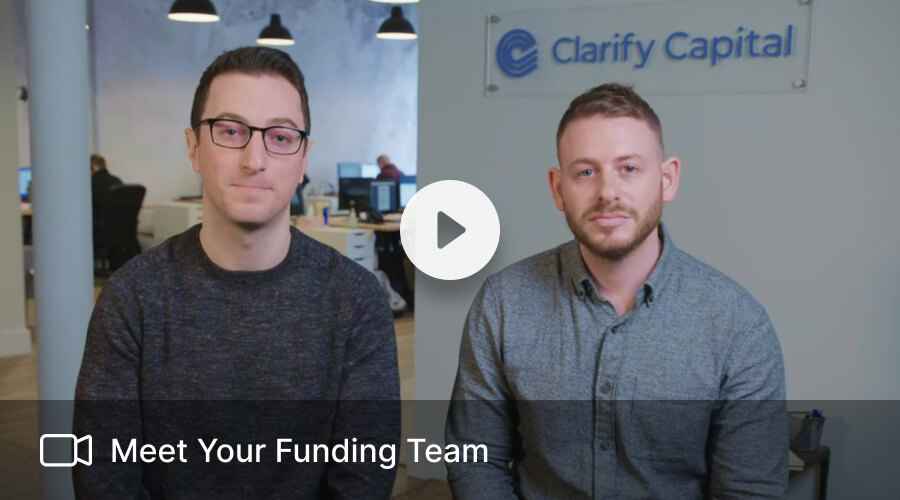
If you want to explore funding options for your small business with a two-minute application process, a dedicated advisor, and a network of more than 75 lenders, start your application with Clarify Capital. It won't impact your credit score.
The Reality of Buying a Business With No Money Down
Buying a business with no money down is sometimes possible, but not common, and quite rare. Almost all business acquisitions require some kind of buyer investment at the outset, especially for large and more established companies.
It can actually be a red flag if an opportunity to buy a business comes with a snazzy-sounding deal to acquire it for no money down. As a general rule of thumb: if it sounds too good to be true, it probably is.
That said, there are a few creative solutions that reduce or partially eliminate a down payment:
| Strategy | How it works | Where it's most realistic |
|---|---|---|
| Seller financing | The seller agrees to finance part of the purchase price instead of requiring all cash up front; the buyer then repays the seller over time | Smaller business sales, retiring owners, or businesses struggling to find buyers |
| Earn-out agreements | Part of the purchase price is tied to future business performance after the sale closes | Businesses with uncertain future revenue or performance-based negotiations |
| SBA acquisition loans | SBA-backed loans sometimes allow lower down payments than conventional acquisition financing, though lenders still often expect some equity | Established businesses with strong financials and predictable cash flow |
| Partner or investor capital | Another investor contributes the down payment or startup capital in exchange for ownership | Growth-focused acquisitions or operators with industry experience but limited cash |
| Asset-backed financing | Some acquisitions involve valuable equipment, inventory, or receivables that help support financing approval | Asset-heavy businesses like manufacturing, logistics, or certain service companies |
Grants, Crowdfunding, and Other Financing Supplements

These other options are good to be aware of, but are complements, not replacements, for loans and financing.
Small Business Grants
Any business would love to have a grant, because they're essentially free money. You don't have to pay them back. For this obvious reason, they attract a lot of interest and competition. Grants are commonly offered through government agencies, corporations, nonprofits, local economic development organizations, or industry-specific programs.
They're also often only for very specific types of businesses, industries, demographics, or economic initiatives. Many programs also have relatively small funding pools compared to traditional business loans, which is why they're better as a nice-to-have rather than a replacement for financing and loans.
Crowdfunding Platforms
Crowdfunding enables businesses to raise funds directly from individual supporters via online platforms such as Kickstarter, GoFundMe, and Indiegogo. This approach tends to work best for:
Creative projects
Startups with strong personal stories behind them
Consumer-facing products
Businesses that already have an engaged audience online
Some crowdfunding campaigns offer rewards or early product access, while equity crowdfunding platforms allow supporters to invest in exchange for ownership stakes. Most successful campaigns require significant time and effort in marketing, audience building, and promotion before they raise meaningful capital.
Microloans From Nonprofits
Nonprofit lenders often provide small-business loans to borrowers who may not fully qualify with traditional banks. These microloan programs are commonly used by startups, minority-owned businesses, and businesses with thinner credit profiles.
Compared to large bank loans, nonprofit microloans may offer more flexible underwriting, smaller minimum revenue requirements, and more hands-on borrower support. The trade-off is that loan amounts are usually much smaller, which means they often work better for short-term working capital, smaller purchases, inventory, or early-stage business expenses rather than large-scale expansion financing.
FAQs About No-Money-Down Loans
Here are answers to questions I often get about no-money-down loans.
How Hard Is It To Get a Business Loan With No Money Down?
It's definitely possible, but not necessarily easy. There are plenty of options if you need to avoid putting money down, but they tend to be more expensive in the long run. The lower your credit score and the worse your business's financial history, the harder it will be to get any type of financing.
Can a Startup LLC Get a Loan?
As always, it depends on your scenario. Newer limited liability companies (LLCs) can qualify for business loans, but options will likely be more limited. Most lenders will look at a combination of your personal credit, business revenue, and time in business. Online and alternative lenders are usually more flexible.
Can You Get a Loan To Buy a Business Without a Down Payment?
Buying a business with no money down is sometimes possible, but quite rare. Almost all business acquisitions require some initial investment from the buyer, especially for large, more established companies.
It can actually be a red flag if an opportunity to buy a business comes with an overly aggressive-sounding deal to acquire it for no money down. As a general rule of thumb: if it sounds too good to be true, it probably is.
What Is the $10,000 SBA Grant?
When people ask about this, it usually refers to COVID-19-era EIDL Advance programs, which provided emergency funding that businesses didn't have to repay. They're no longer widely available, and most SBA funding today comes through loan programs rather than grants.
What Credit Score Do I Need for a No-Down-Payment Business Loan?
It depends. Every lender has different requirements, and different financing options have differing requirements, too. Your best shot for getting a no-down-payment loan with a lower credit score is likely going to be through an online lender. But for more traditional loans, like through a bank or the SBA, you'll need a solid score.
Are No-Money-Down Business Loans More Expensive?
Yes, they often can be. When you secure a financing option that doesn't require a down payment, you usually have to pay for that perk somewhere else. It often is a trade-off for higher interest rates and shorter terms. Those factors usually make loans more expensive in the long run.
Can I Get an SBA Loan With No Down Payment?
Yes, sometimes certain SBA loans can come without down payment requirements (such as with Clarify Capital). For example, Express loans and Microloans. But it depends on the specific lender you get the SBA loan through.
How Does Clarify Capital Protect My Business and Financial Information?
Clarify Capital follows SOC 2 (Service Organization Control 2) security principles designed to protect sensitive business and financial information. This includes safeguards such as secure data handling practices, controlled access to information, and ongoing monitoring to help protect your data throughout the application and funding process.

Michael Baynes
Co-founder, Clarify
Michael has over 15 years of experience in the business finance industry working directly with entrepreneurs. He co-founded Clarify Capital with the mission to cut through the noise in the finance industry by providing fast funding and clear answers. He holds dual degrees in Accounting and Finance from the Kelley School of Business at Indiana University. More about the Clarify team →
Related Posts