


 Reviewed by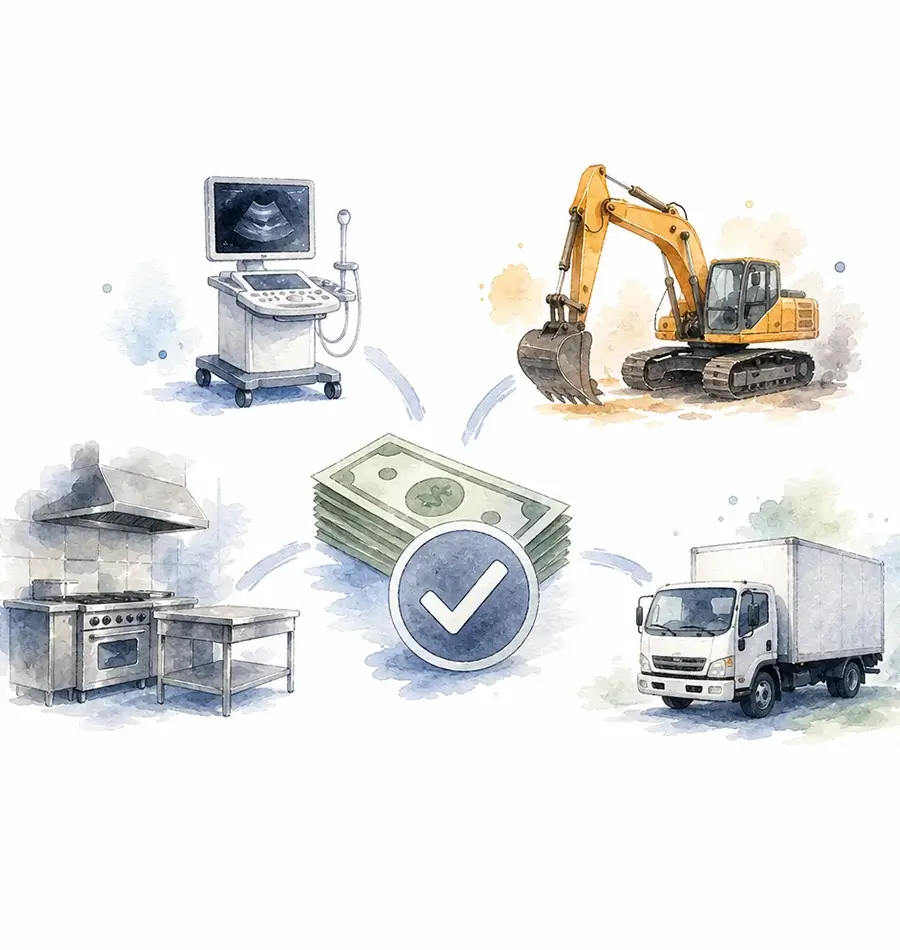
An equipment loan helps you buy the machinery, vehicles, and tools your business runs on, from commercial trucks and kitchen equipment to farm equipment and medical devices. Because it uses the equipment itself as collateral, I've found it's usually easier to qualify for than unsecured financing. Below, I'll show you how to estimate your payment by equipment type, explain how equipment loans work, compare a loan to a lease, and walk through what it takes to qualify.
This equipment loan calculator, sometimes called an equipment financing calculator or payment calculator, turns your equipment cost and down payment into a loan amount, then estimates your payment, total interest, and total cost of the loan.
How Equipment Loans Work
With equipment financing, the equipment you're buying serves as collateral for the loan. That lowers the lender's risk, which is why fixed rates and credit approval are often easier to land than with unsecured financing, and why the same works for used equipment as well as new. Repayment terms usually run 12 to 72 months, roughly matching how long you'll use the equipment, and Clarify Capital's APRs start at 6%. Financing the purchase instead of paying cash also keeps your working capital free for payroll, inventory, and day-to-day cash flow.
Estimate Payments by Equipment Type
Different equipment carries different price tags and useful lives, so the calculator includes presets for four common categories. Each sets a typical equipment price and term you can adjust:


Construction
Excavators, loaders, and other heavy equipment are long-lived and high-cost, so they carry longer terms.


Transportation
Commercial trucks and vans hold value over years of use, so they support longer terms.
What Affects Your Equipment Loan Payment
Four things move your estimated monthly payment the most:
Equipment price and down payment: A larger down payment lowers the amount financed, and with it your payment and total interest paid.
Interest rate: Your annual percentage rate depends on your credit score, time in business, and the equipment itself; stronger credit earns lower loan rates.
Loan term: A longer term drops the monthly payment but raises the total cost of the loan, while a shorter term does the reverse.
Payment frequency: Monthly is standard, but some lenders offer quarterly or semiannual schedules to match seasonal revenue.
Map out your payment schedule and amortization schedule to break each payment into principal and interest. Before you sign, also check for an origination fee or prepayment penalties, since both change what the financing actually costs beyond the rate.
Equipment Loan vs. Lease
A loan builds toward ownership; an equipment lease keeps payments low and flexibility high. The two differ on a few key points:
| Feature | Equipment loan | Equipment lease |
|---|---|---|
| Ownership | You own it once it's paid off | Return or buy at lease end |
| Up-front cost | Often a down payment | Usually lower or none |
| Payment | Fixed by loan and term | Often lower than a loan payment |
| Tax treatment | May qualify for the Section 179 deduction | Lease payments may be deductible |
| Best for | Long-term use of the equipment | Short-term needs or fast-depreciating gear |
A loan usually costs less over time and lets you claim the equipment as your own asset, which is why it's the better fit when you plan to keep the equipment for years.
About the Section 179 deduction: This deduction can let you write off the cost of qualifying equipment the year you put it in service, instead of depreciating it slowly over time.
Minimum Qualifications

$10,000 in monthly revenue
Your business must earn at least $10K per month in a business bank account.

500+ credit score
You can get approved with any credit score. But the better your credit rating, the better interest rates lenders offer. Your FICO score should be above 500.

Minimum six months in business
Your company should be operational for a minimum of six months. This shows business lenders that your company is sustainable and won't go out of business.

Have a business bank account
Your Clarify advisor will need three or four months of your most recent bank statements to verify income. This is just to see you're actually making $10K+ month in revenue.

Plan Ahead With a Solid Estimate
In my experience, running the numbers before you buy is what turns a big purchase into a predictable monthly line item instead of a surprise. Once you know the payment that fits your budget, the financing is the easy part, and you can apply online in about two minutes. Apply today to get matched with equipment financing without a ding to your credit.
Equipment Loan Calculator FAQ
These are answers to a few questions business owners often ask me about equipment loans.
How Do You Calculate an Equipment Loan Payment?
Start with the equipment price, subtract your down payment to get the amount financed, then apply your interest rate across the loan term. The calculator above runs that math for you and shows the payment, total interest, and total cost of the loan.
What Is the Average Interest Rate on an Equipment Loan?
Rates vary with your credit, time in business, and the equipment, but Clarify Capital's APRs start at 6%. Newer equipment and stronger credit generally earn the lowest loan rates.
What Credit Score Do You Need for Equipment Financing?
At Clarify Capital, a credit score of 550 or higher can qualify, since the equipment itself secures the loan. A higher score widens your options and lowers your rate.
How Long Are Equipment Loan Terms?
Most equipment loan terms run 12 to 72 months, set to roughly match how long you'll use the equipment. Longer-lived assets like medical or construction equipment support the longest terms.

Michael Baynes
Co-founder, Clarify
Michael has over 15 years of experience in the business finance industry working directly with entrepreneurs. He co-founded Clarify Capital with the mission to cut through the noise in the finance industry by providing fast funding and clear answers. He holds dual degrees in Accounting and Finance from the Kelley School of Business at Indiana University. More about the Clarify team →
Related Posts



![Average Small Business Debt by Industry and Revenue [2026]](/assets/blog/average-small-business-debt/average-small-business-debt-small-d36955ffc6d6cf255b2b2d2d92c993f0654c42e6934e96b34bcf58a74e38da26.jpg)