

 Reviewed by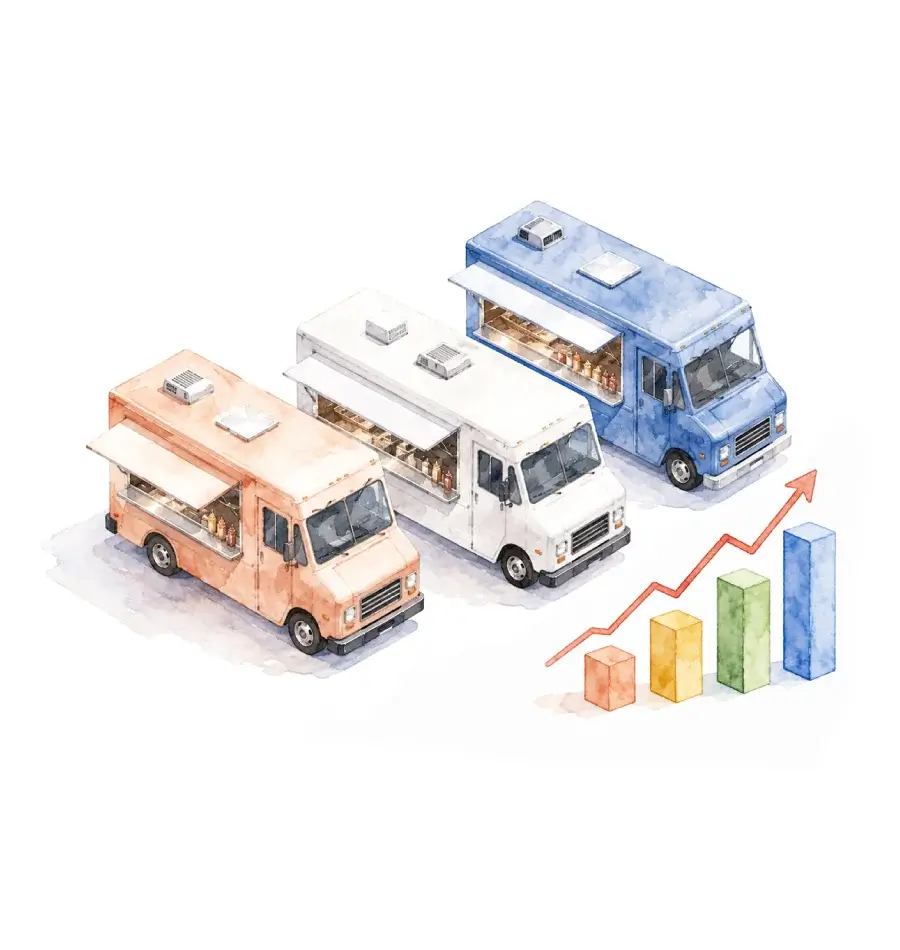
The U.S. food truck industry is expanding fast. In 2025, the industry generated $2.8 billion, with 92,257 active food truck businesses operating across the country. The number of active food truck businesses also grew at a 23.7% annual rate between 2020 and 2025, and demand for tailored loans has followed. Most operators start with someone else's money (at least in part): a business loan, a line of credit, or an equipment lease that bridges the gap between concept and curbside.
Here, I'll walk you through how food truck financing works in 2026: what lenders care about, which loan options fit which needs (a new food truck for first-time operators, a second truck for expansion, a ghost kitchen prep space for delivery), what current Small Business Administration (SBA) terms look like, and how to compare leasing against purchasing when the truck itself is the biggest line on your budget.
I've spent the last 15 years arranging financing for food businesses, and the food truck owners who get financed fastest are usually the ones who walk in with a clear use of funds and the right financing fit already in mind.
Key Takeaways
A new food truck typically costs $50,000 to $200,000, and a used food truck or food trailer runs $20,000 to $80,000. Many food truck owners finance the truck rather than pay up front in cash.
Clarify Capital's short-term business loans, equipment loans, and business lines of credit fund as fast as same-day for established food truck businesses with a 550+ credit score and $10,000 in monthly revenue.
SBA Microloans top out at $50,000 with longer repayment terms and lower interest rates than most alternative loans, which makes them a strong fit for startup costs on a first food truck.
SBA 7(a) loans go up to $5 million for expansion, with current 2026 rates in the high single digits to mid-teens.
Equipment financing uses the truck itself as collateral, which often means lower down payments and easier eligibility for borrowers with bad credit or a thin credit history.
Best Food Truck Financing Options for 2026
Food truck owners typically choose from seven main loan options in 2026. The right financing fit for your business needs depends on whether you're buying your first truck, expanding to a second, replacing equipment, or smoothing cash flow during a slow season.
| Loan type | Loan amount | APR or rate | Financing speed |
|---|---|---|---|
| Short-term business loan | $10,000 to $5 million | Starting at 6% APR | As fast as same-day |
| Business line of credit | Up to $5 million | Starting at 6% APR | As fast as same-day |
| Equipment financing | Up to 100% of equipment value | Starting at 6% APR | 1 to 5 days |
| Merchant cash advance | Up to $5 million | Factor rates 1.08 to 1.45 | As fast as same-day |
| Invoice factoring | Up to 100% of invoice value | Fees 0.5% to 5% per invoice per month | 1 to 2 weeks |
| SBA 7(a) loan | Up to $5 million | Starting at 6.75% APR | 30 to 90 days typical |
| SBA Microloan | Up to $50,000 | 8% to 13% | Varies by intermediary lender |
Short-Term Business Loans
A short-term business loan is a lump-sum loan repaid on a fixed schedule over six to 36 months. Monthly payments are predictable, which makes short-term loans a clean fit when you need cash for a mix of expenses (truck plus working capital plus first-month inventory) and don't want to lock collateral.
Clarify Capital offers short-term business loan amounts from $10,000 to $5 million, with annual percentage rates (APRs) starting at 6% and funding as fast as same-day for credit scores over 550. Qualification needs $10,000 in monthly revenue and six months in business.
Business Lines of Credit
A business line of credit gives borrowers access to a revolving credit pool up to a set limit. You only pay interest on what you draw, which makes lines of credit a strong fit for seasonal food truck operations where revenue dips in winter and rebounds in spring.
Clarify Capital's business line of credit goes up to $5 million with APRs starting at 6%. The eligibility floor is slightly higher than short-term loans: 600 credit score minimum and one year in business.
Equipment Financing
Equipment financing (also called an equipment loan) uses the truck or kitchen equipment inside it as collateral. That collateral lowers risk for the lender, which means food truck owners with bad credit or a thinner credit history can often qualify, sometimes with a higher loan amount than they'd see on an unsecured option.
Clarify Capital's equipment financing funds up to 100% of equipment value, with APRs starting at 6%, repayment terms of 12 to 72 months, and approval as quick as one to five days. Qualification matches the short-term loan: $10,000 monthly revenue, 550+ credit, six months in business.
Merchant Cash Advances
A merchant cash advance (MCA) gives you a lump sum up front, repaid as a percentage of your daily or weekly credit card sales. Repayment scales with revenue, so slow days cost less, but the effective cost is high.
Clarify Capital offers MCAs up to $5 million with factor rates from 1.08 to 1.45. MCAs fund as fast as same-day and require only a 500 FICO score with $10,000 in monthly revenue. They work best when speed matters more than total cost.
Invoice Factoring for Catering Contracts
If you book catering events or supply meals to corporate clients on net-30 or net-60 terms, invoice factoring advances the invoice value up front. You get cash now; the factor collects from your client later.
Clarify Capital's invoice factoring advances up to 100% of the invoice value with fees from 0.5% to 5% per invoice per month. It's useful for food truck businesses with significant business-to-business catering revenue.
Best Options for Bad Credit
Bad credit doesn't block you from a food truck loan, but it does narrow the menu. Equipment loans, MCAs, and revenue-based short-term loans all weigh recent revenue more heavily than FICO score. Clarify Capital accepts scores as low as 500. Expect higher interest rates than you'd see with good credit, and use a paid-on-time loan to rebuild credit history for a better rate at the next renewal.

SBA Loans for Food Trucks
SBA loans, guaranteed by the U.S. Small Business Administration (SBA), are the lowest-rate loan option food truck owners usually qualify for, but they take the longest to fund. If you can wait 30 to 90 days and you've been in business at least two years with a 640+ FICO score, an SBA loan often beats every other loan type on total cost.
SBA 7(a) Loans
SBA 7(a) loans go up to $5 million and work for almost any business purpose: buying a truck, refurbishing one, buying inventory, refinancing existing debt, or buying out a partner. Repayment terms run up to 25 years for real estate purchases and shorter for equipment and working capital uses.
Clarify Capital's SBA loans start at 6.75% APR with no down payment required. Term lengths run 10 to 25 years.
SBA 504 Loans
SBA 504 loans cap at $5.5 million and finance fixed-asset purchases (real estate, large equipment). They fit when you're buying a commissary kitchen or commercial property to house multiple trucks, less so for the truck itself.
SBA Microloans
SBA Microloans top out at $50,000, with repayment terms up to seven years and lower interest rates than most alternative loans. Rates run 8% to 13%. Intermediary nonprofit lenders administer the program (not the SBA directly), which is why approval criteria vary. SBA Microloans are great for newer food truck businesses and entrepreneurs with a thinner credit history, which makes them one of the few SBA paths that fit first-time food truck purchases.
What Food Truck Financing Covers
Food truck financing is funding you borrow to buy, build out, or operate a mobile food business. The money covers:

Truck/food trailer purchase

Kitchen equipment

Generators

Refrigeration

Point-of-sale systems

Initial inventory

Permits

Insurance

Working capital
Startup costs can run higher than most first-time food truck owners expect. A new food truck typically costs $50,000 to $200,000, depending on size, equipment, and customization. Used food trucks and food trailers come in cheaper, between $20,000 and $80,000, but often need refit work that adds to the real all-in cost.
Minimum Qualifications

$10,000 in monthly revenue
Your business must earn at least $10K per month in a business bank account.

500+ credit score
You can get approved with any credit score. But the better your credit rating, the better interest rates lenders offer. Your FICO score should be above 500.

Minimum six months in business
Your company should be operational for a minimum of six months. This shows business lenders that your company is sustainable and won't go out of business.

Have a business bank account
Your Clarify advisor will need three or four months of your most recent bank statements to verify income. This is just to see you're actually making $10K+ month in revenue.
Equipment Leasing vs. Purchasing for Food Trucks
Purchasing the truck means you own it at the end of the loan. Leasing means lower monthly payments now and a decision at the end of the term about whether to buy, return, or upgrade. The right call depends on cash flow, tax treatment, and how long you plan to keep the truck.
Lower down payment
Usually 5% to 10% of equipment value, sometimes nothing down with strong credit.
Higher down payment
Often 10% to 20% on equipment loans; Clarify Capital can finance up to 100% of the value.
Lower monthly payments
Spread over the lease term, often 24 to 60 months.
Higher monthly payments
Equipment loans run 12 to 72 months at Clarify Capital.
Decision at term end
Buy the truck, return it, or upgrade to new equipment.
You own the truck outright
The asset stays on your balance sheet after final payment.
Operating lease payments are typically deductible as a business expense
Treated as operating expense on the books.
Equipment qualifies for Section 179 deduction
Up to the annual limit, often the full purchase price in the first year.
Easier to upgrade every few years
Useful when truck tech (POS, refrigeration, electric drivetrains) changes fast.
Harder to upgrade
You've absorbed the depreciation, and resale value drops with mileage and use.
Higher total cost over time
Cumulative lease payments often exceed the purchase price.
Lower total cost when held long-term
Once the loan is paid off, you only carry operating costs.
Most food truck owners with steady revenue and a multi-year plan come out ahead in purchasing. Operators expecting to upgrade equipment in three to five years, or those whose cash flow can't absorb a higher up-front payment, usually do better with leasing.
Financing for Food Hall Stalls and Ghost Kitchen Expansion
Food hall stalls and ghost kitchens are an increasingly common second move for established food truck owners. The buildout costs are smaller (typically $25,000 to $75,000 versus $50,000 to $200,000 for a new food truck), which changes the financing math.
A business line of credit usually fits ghost kitchen buildouts better than an equipment loan, since costs are spread across permits, leasehold improvements, equipment, and the first few months of operating capital. None of those pieces individually qualifies as a single piece of equipment that could secure an equipment loan.
Ghost kitchens sit between food trucks and brick-and-mortar restaurants in terms of cost and complexity. For food truck owners making the full leap to a fixed location, restaurant business loans are the natural next-stage option.
How To Apply for Food Truck Financing
The application process moves faster when your paperwork is ready before you apply. Here's the order I recommend for business owners applying for food truck financing for the first time:
Check your credit history. Know where you stand on credit before talking to a lender. Pull a free report at annualcreditreport.com.
Pull three to four months of business bank statements. Most online lenders want recent statements to verify revenue and cash flow.
If you're applying for an SBA loan or bank loan, pull two years of business tax returns and your latest financial statements (profit and loss, balance sheet).
Write a short use of funds and a one-page business plan. "Buy a 2022 used truck for $65,000, plus $20,000 in equipment upgrades, plus $15,000 in working capital" is enough for short-term lenders. SBA wants more details.
Compare three or four lenders on rate, term, financing speed, and total cost. Don't compare on monthly payment alone.
Submit your loan application. Online applications with lenders like Clarify Capital take about two minutes.
Respond fast to lender follow-up. The difference between funding in two days and funding in two weeks is usually how quickly borrowers return verification documents.
Eligibility Tips
Keep the following in mind when you apply:
Don't apply with multiple lenders the same week unless you understand how soft pulls and hard pulls affect your FICO score. Some lenders soft-pull at application; others hard-pull early.
If your credit is below 600, lead with equipment financing or a merchant cash advance, where collateral or revenue history offsets weaker credit.
Disclose any existing Uniform Commercial Code (UCC) filing from a previous lender up front. Surprise liens kill deals at underwriting.
A business credit card can supplement (not replace) a primary loan, especially for small inventory and fuel purchases that are easier to charge than to finance.

Finance Your Food Truck With Clarify Capital
Food truck owners have more financing options in 2026 than ever before, and the right financing fit comes down to where you're at in the food truck business: first truck, second location, equipment refresh, or seasonal cash flow gap. Get a clear use of funds, check your numbers against the lender's eligibility floor, and pick the loan options that match your timeline.
When you're ready to compare offers, apply today, and a Clarify Capital adviser will walk you through which loan type fits your situation.
Frequently Asked Questions
The following questions come up most often when I discuss financing options with food truck owners.
How Much Does It Cost To Finance a Food Truck?
A new food truck typically runs $50,000 to $200,000, and a used food truck or food trailer runs $20,000 to $80,000. Financing costs depend on the loan type: APRs range from 6% on short-term business loans and a factor rate of up to 1.45% on high-cost MCAs. SBA Microloans typically have APRs of 8% to 13%; SBA 7(a) loans run in the high single digits to mid-teens, tied to the prime rate plus a lender spread.
Can You Get an SBA Loan for a Food Truck?
Yes. SBA 7(a) loans up to $5 million and SBA Microloans up to $50,000 both work for food truck purchases. The 7(a) program wants at least two years in business and a 640+ FICO score for the strongest approval odds. SBA Microloans have lower thresholds, which makes them one of the most accessible paths for startup costs on a first food truck.
What Credit Score Do You Need for Food Truck Financing?
Minimums vary by loan type. Merchant cash advances accept FICO scores as low as 500. Short-term loans and equipment loans typically require 550 or higher. Lines of credit want 600. SBA programs want 640+. Good credit gets you lower interest rates within every loan type, so improving your score before applying often pays for itself.
How Long Can Food Truck Loan Terms Be?
Term lengths run from six months on short-term business loans up to 25 years on real-estate-secured SBA loans. Equipment financing typically runs 12 to 72 months, matched to the useful life of the truck. SBA Microloans run up to seven years. SBA 7(a) loans run up to 25 years on real estate, with shorter terms for equipment and working capital matched to the useful life of what's being financed.

Bryan Gerson
Co-founder, Clarify
Bryan has personally arranged over $900 million in funding for businesses across trucking, restaurants, retail, construction, and healthcare. Since graduating from the University of Arizona in 2011, Bryan has spent his entire career in alternative finance, helping business owners secure capital when traditional banks turn them away. He specializes in bad credit funding, no doc lending, invoice factoring, and working capital solutions. More about the Clarify team →
Related Posts