


 Reviewed by
![What Percentage of Businesses Fail? [2026]](/assets/blog/what-percentage-of-businesses-fail/what-percentage-of-businesses-fail-79405e77f637c5a50857c0e1ad4e4cfaf0d5ea39659ba1598bf61a9f22f998f1.webp)
Starting a business comes with plenty of uncertainty, and one of the biggest questions is how likely it is to succeed. Established businesses can look at failure rates to get a better idea of what to expect and how those odds change over time. Below, I break down the numbers and what they mean for small and midsize business owners.
Based on businesses that opened in 2005, 19.9% of businesses fail within the first year, according to the Bureau of Labor Statistics. Nearly two-fifths of businesses (39.8%) fail within the first three years and nearly 81% within 20 years.
A big source of anxiety for new business owners is whether or not your business will survive. Fortunately, the stat you've probably heard, that 90% of businesses fail, isn't supported by the data. The truth is much less scary, especially since understanding business failure rates can help you make better business decisions, such as taking out a small business loan or whether to risk expanding your business.
Small Business Failure Rates
In this study, business failure refers to establishments that were no longer operating at each benchmark, based on Bureau of Labor Statistics survival data from 2025. We looked at businesses that opened in 2005 to give us 20 years of trend data for the most accurate look at business failure rates.
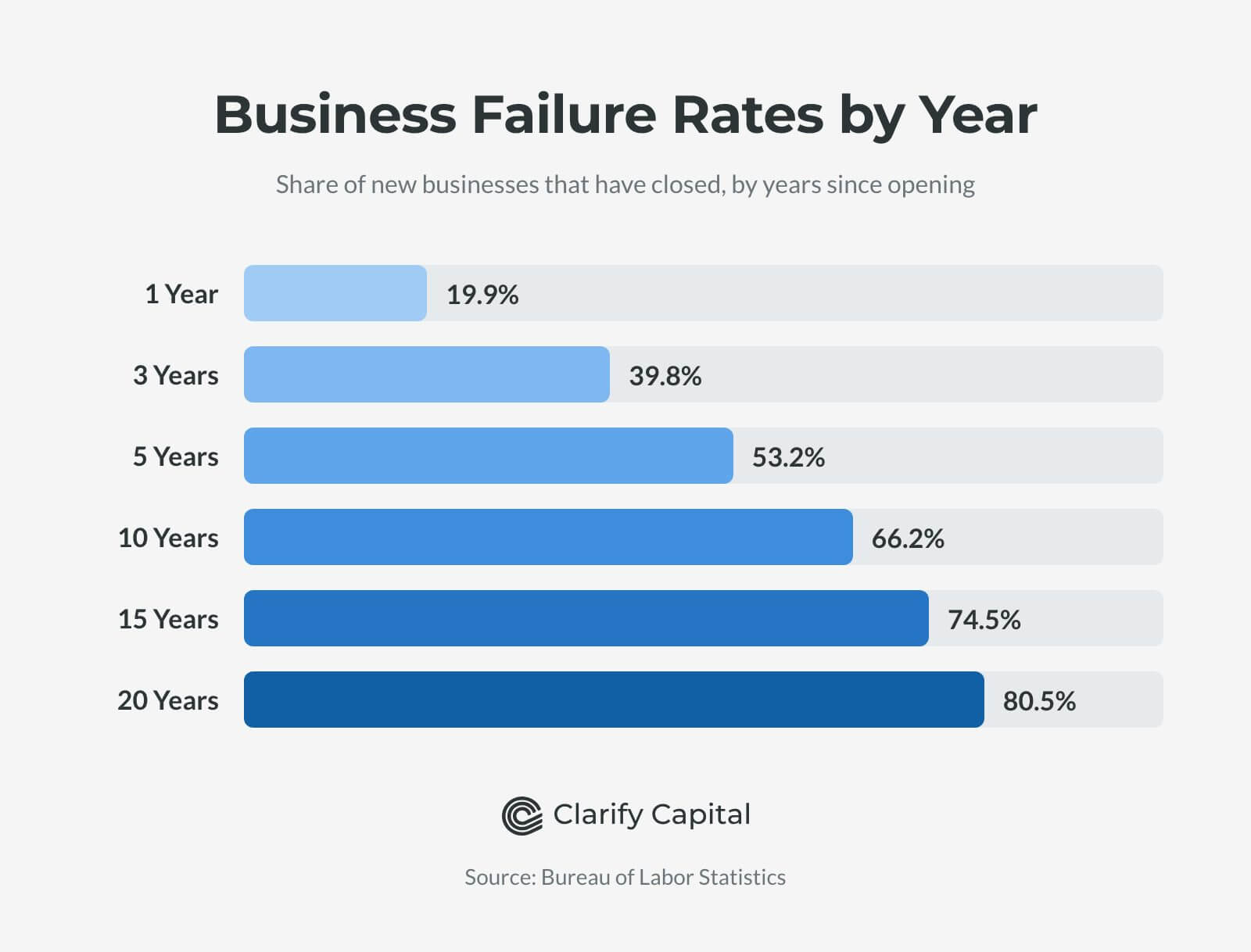
19.9% of businesses established in 2005 failed after the first year.
39.8% of businesses established in 2005 failed during the first three years of business.
53.2% of businesses established in 2005 failed within five years.
66.2% of businesses established in 2005 failed within 10 years.
By the end of year 15, 74.5% of businesses established in 2005 failed.
80.5% of businesses established in 2005 failed before they celebrated their 20th anniversary.
While more businesses fail as the years go on, these numbers don't mean yours has to be one of them. If you've already been in business for several years, you have experience you can use to make better decisions moving forward (especially when it comes to cash flow and growth).
Small Business Failure Rates by Industry
Some industries have historically had higher survival rates than others, as the data below shows.
| Business Failure Rates by Industry | ||||||
|---|---|---|---|---|---|---|
| Industry | One-year failure rate | Three-year failure rate | Five-year failure rate | 10-year failure rate | 15-year failure rate | 20-year failure rate |
| Agriculture, forestry, fishing and hunting | 16.1% | 30.5% | 42.6% | 54.8% | 63.7% | 70.2% |
| Mining, quarrying, and oil and gas extraction | 14.0% | 31.5% | 44.3% | 61.2% | 75.6% | 82.3% |
| Utilities | 17.2% | 29.0% | 43.5% | 56.4% | 62.1% | 66.9% |
| Construction | 21.7% | 44.8% | 63.6% | 74.1% | 79.7% | 83.9% |
| Manufacturing | 16.2% | 34.3% | 48.8% | 61.3% | 68.7% | 74.0% |
| Wholesale trade | 21.1% | 41.9% | 55.4% | 70.1% | 78.8% | 83.8% |
| Retail trade | 16.3% | 34.3% | 47.0% | 59.9% | 68.3% | 74.9% |
| Transportation and warehousing | 21.3% | 42.9% | 57.6% | 70.8% | 78.5% | 83.4% |
| Information | 23.2% | 46.2% | 59.1% | 75.0% | 82.6% | 86.5% |
| Finance and insurance | 19.2% | 40.2% | 54.1% | 66.3% | 74.0% | 80.1% |
| Real estate and rental and leasing | 17.7% | 41.7% | 56.8% | 68.8% | 76.2% | 82.0% |
| Professional, scientific, and technical services | 20.7% | 40.8% | 54.6% | 69.2% | 77.6% | 83.0% |
| Management of companies and enterprises | 15.3% | 31.8% | 45.0% | 57.7% | 68.8% | 74.2% |
| Administrative and waste services | 21.3% | 40.2% | 54.1% | 67.4% | 75.4% | 80.7% |
| Educational services | 17.7% | 35.2% | 46.6% | 61.4% | 71.6% | 76.9% |
| Health care and social assistance | 16.0% | 33.3% | 42.9% | 56.6% | 68.0% | 77.7% |
| Arts, entertainment, and recreation | 20.8% | 44.0% | 58.0% | 72.1% | 79.9% | 83.7% |
| Accommodation and food services | 18.5% | 37.5% | 49.3% | 63.3% | 71.5% | 77.6% |
| Other services (except public administration) | 18.0% | 35.9% | 48.3% | 62.2% | 72.3% | 78.4% |
Source: Bureau of Labor Statistics
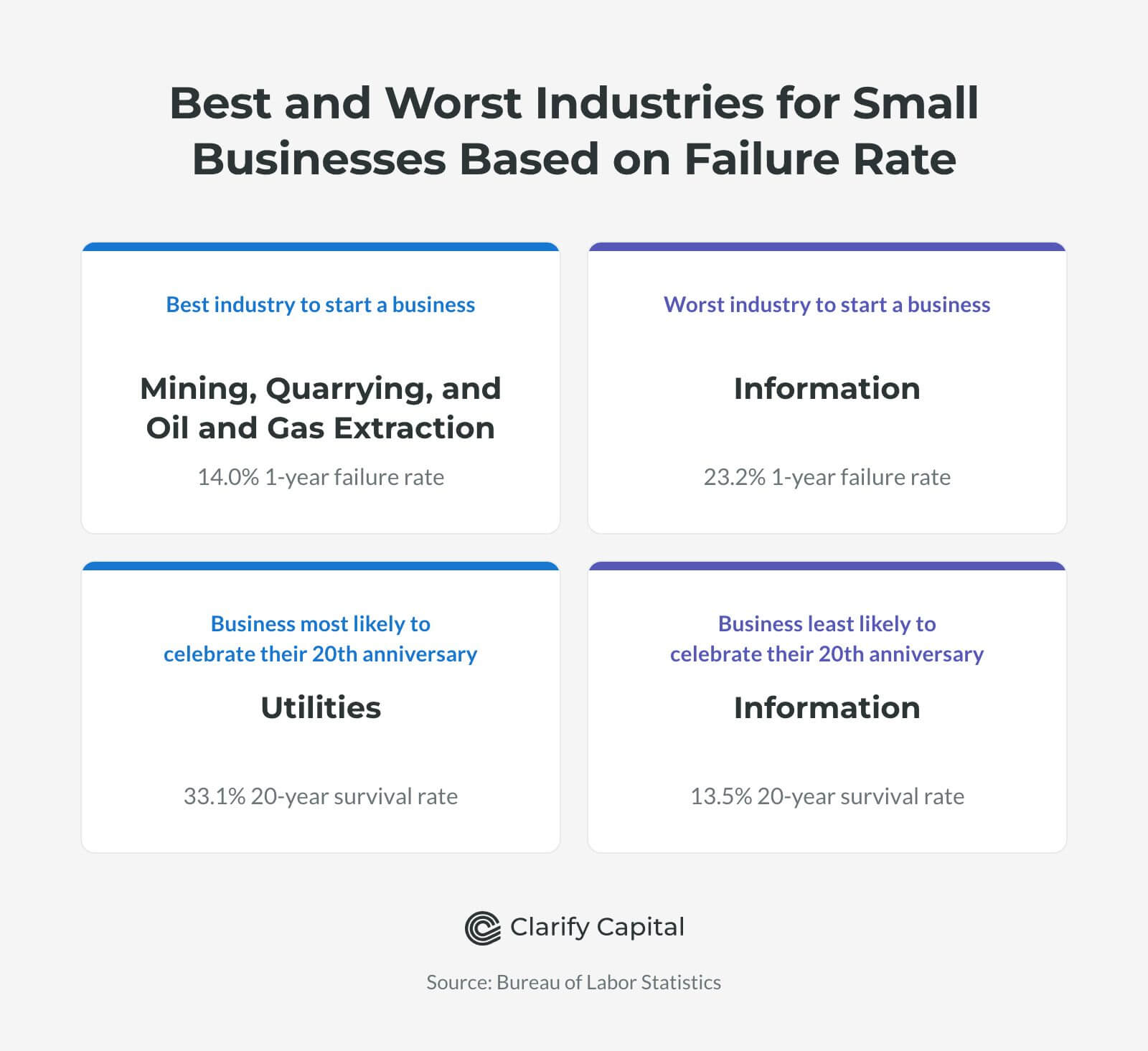
The Mining, Quarrying, and Oil and Gas Extraction Industries Have the Lowest One-Year Failure Rate
Businesses in the mining, quarrying, and oil and gas extraction industry had the lowest one-year failure rate among the industries analyzed. Of the businesses in this industry established in 2005, 86.0% were still in business one year later, resulting in a 14.0% failure rate. That's below the 2005 cohort's overall one-year failure rate of 19.9%.
Businesses in this industry include:
Oil and gas extraction
Coal mining
Metal ore mining
Nonmetallic mineral mining and quarrying
Businesses that provide support activities for mining
Other industries with low one-year failure rates are:
Healthcare and social assistance (16.0%)
Information-Based Industries Have the Worst Survival Rates
Businesses established in the information industry have a one-year failure rate of 23.2%, just over three percentage points higher than the average of all private sector businesses. They also have the highest failure rate at nearly every benchmark we looked at:
One-year failure rate: 23.2%
Three-year failure rate: 46.2%
Five-year failure rate: 59.1%
10-year failure rate: 75.0%
15-year failure rate: 82.6%
20-year failure rate: 86.5%
The information industry is a subcategory of the service industry that includes businesses that produce and distribute information and media products. Some businesses in this industry include:
Publishing
Broadcasting
Film
Telecommunications
Data processing
Data communications
Other industries with high one-year failure rates are:
Construction (21.7%)
Transportation and warehousing (21.3%)
Small Business Failure Rates by State
Where you start your business also matters. Some states have better business survival rates than others.
| Business Failure Rates by State | ||||||
|---|---|---|---|---|---|---|
| State | One-year failure rate | Three-year failure rate | Five-year failure rate | 10-year failure rate | 15-year failure rate | 20-year failure rate |
| Alabama | 19.6% | 38.0% | 50.8% | 65.3% | 72.6% | 78.7% |
| Alaska | 23.8% | 44.0% | 53.3% | 66.4% | 75.9% | 79.9% |
| Arizona | 19.3% | 40.7% | 55.1% | 68.9% | 76.3% | 81.1% |
| Arkansas | 20.7% | 39.9% | 52.5% | 66.1% | 72.9% | 78.3% |
| California | 19.5% | 40.3% | 53.6% | 65.9% | 75.5% | 82.8% |
| Colorado | 21.8% | 41.4% | 55.5% | 68.6% | 77.2% | 82.9% |
| Connecticut | 19.4% | 40.3% | 57.9% | 67.5% | 77.1% | 82.2% |
| Delaware | 21.7% | 40.3% | 55.5% | 69.2% | 77.8% | 82.4% |
| District of Columbia | 24.3% | 47.2% | 58.1% | 72.3% | 81.3% | 85.4% |
| Florida | 21.9% | 45.8% | 62.2% | 73.2% | 79.9% | 84.7% |
| Georgia | 20.0% | 37.1% | 51.8% | 65.2% | 74.4% | 79.7% |
| Hawaii | 17.7% | 34.9% | 48.2% | 60.1% | 70.8% | 77.0% |
| Idaho | 18.4% | 38.9% | 53.4% | 68.1% | 75.5% | 80.3% |
| Illinois | 21.4% | 39.6% | 52.0% | 65.1% | 74.3% | 80.1% |
| Indiana | 20.8% | 40.6% | 53.3% | 66.1% | 73.3% | 78.6% |
| Iowa | 17.3% | 34.8% | 46.1% | 58.8% | 67.7% | 74.0% |
| Kansas | 19.0% | 40.0% | 50.5% | 63.7% | 71.6% | 77.8% |
| Kentucky | 20.3% | 39.5% | 51.6% | 65.0% | 73.0% | 77.5% |
| Louisiana | 24.8% | 40.1% | 51.1% | 63.7% | 71.5% | 77.4% |
| Maine | 21.5% | 40.1% | 53.3% | 65.8% | 73.7% | 79.9% |
| Maryland | 20.7% | 40.3% | 53.3% | 67.7% | 76.2% | 82.4% |
| Massachusetts | 17.1% | 34.8% | 46.4% | 60.0% | 69.8% | 77.0% |
| Michigan | 22.2% | 42.9% | 56.1% | 66.1% | 75.3% | 80.0% |
| Minnesota | 8.4% | 39.3% | 54.4% | 64.4% | 71.9% | 78.0% |
| Mississippi | 22.5% | 40.0% | 53.1% | 65.2% | 73.1% | 79.3% |
| Missouri | 19.8% | 36.0% | 49.0% | 64.0% | 73.8% | 79.2% |
| Montana | 18.2% | 35.0% | 50.8% | 62.9% | 70.3% | 77.2% |
| Nebraska | 18.7% | 35.5% | 46.1% | 58.1% | 66.5% | 74.5% |
| Nevada | 20.3% | 41.4% | 55.7% | 67.7% | 74.9% | 78.7% |
| New Hampshire | 24.3% | 44.3% | 56.6% | 70.1% | 76.7% | 81.4% |
| New Jersey | 19.2% | 41.7% | 55.4% | 70.7% | 78.6% | 83.5% |
| New Mexico | 21.5% | 41.7% | 54.2% | 67.8% | 75.4% | 80.7% |
| New York | 18.1% | 36.6% | 49.7% | 65.3% | 74.8% | 80.2% |
| North Carolina | 17.5% | 35.6% | 50.4% | 64.3% | 72.3% | 77.9% |
| North Dakota | 18.9% | 31.9% | 41.7% | 55.6% | 64.6% | 70.4% |
| Ohio | 18.4% | 39.0% | 50.3% | 63.8% | 72.0% | 77.5% |
| Oklahoma | 19.5% | 37.8% | 49.7% | 62.1% | 70.9% | 78.2% |
| Oregon | 20.2% | 39.4% | 54.1% | 66.9% | 72.2% | 78.7% |
| Pennsylvania | 15.2% | 32.6% | 44.3% | 60.5% | 69.3% | 75.3% |
| Rhode Island | 26.0% | 44.4% | 56.7% | 69.4% | 76.4% | 82.0% |
| South Carolina | 21.3% | 40.5% | 54.8% | 66.9% | 74.5% | 79.9% |
| South Dakota | 18.1% | 34.4% | 46.1% | 58.9% | 66.5% | 73.0% |
| Tennessee | 20.4% | 40.8% | 54.5% | 68.0% | 74.7% | 80.6% |
| Texas | 20.1% | 38.1% | 49.4% | 62.7% | 71.0% | 76.7% |
| Utah | 19.6% | 38.7% | 53.3% | 64.8% | 71.3% | 77.5% |
| Vermont | 18.7% | 39.7% | 52.5% | 63.7% | 71.9% | 79.0% |
| Virginia | 21.0% | 41.1% | 54.9% | 68.3% | 75.6% | 81.5% |
| Washington | 27.4% | 46.8% | 58.2% | 71.6% | 78.0% | 86.9% |
| West Virginia | 19.4% | 39.0% | 50.0% | 64.4% | 74.6% | 79.2% |
| Wisconsin | 17.5% | 34.7% | 47.1% | 60.3% | 67.4% | 73.7% |
| Wyoming | 19.5% | 35.2% | 50.5% | 64.7% | 76.0% | 81.5% |
Source: Bureau of Labor Statistics (BLS)
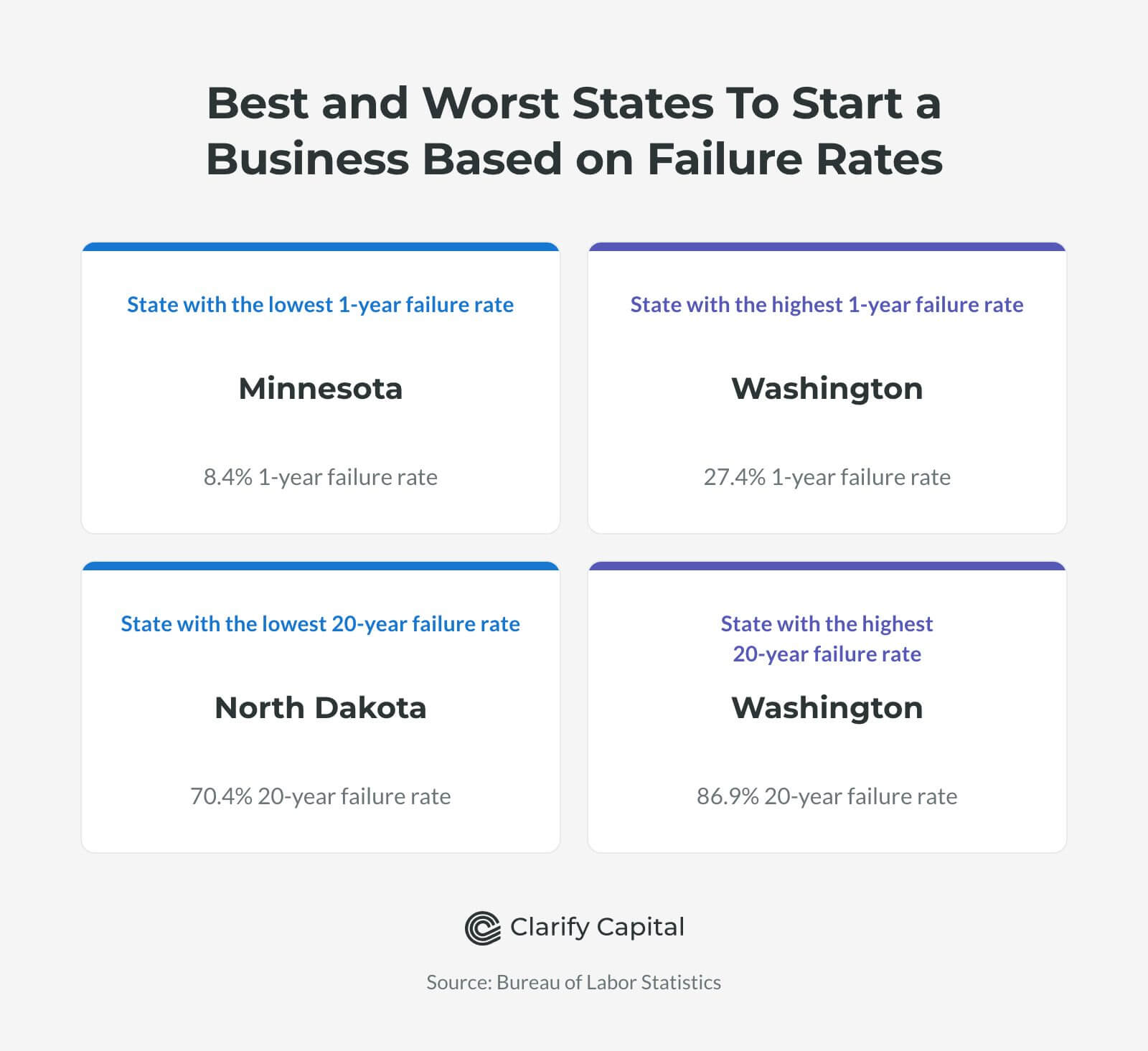
Minnesota Is the Best State To Start a Business Based on one-year Failure Rates
Minnesota has the lowest one-year failure rate at 8.4%, over 11 percentage points lower than the nationwide average of 19.9%. This may be due in part to the state's recently passed infrastructure bills, which make owning a business easier.
Other states with low one-year failure rates are:
Pennsylvania (15.2%)
Massachusetts (17.1%)
Iowa (17.3%)
North Dakota Has the Lowest 20-Year Failure Rate
North Dakota has the lowest 20-year failure rate at 70.4%. One factor that may support businesses in the state is its relatively low tax and operating costs. Corporate income tax rates range from 1.41% to 4.31%, and most business personal property, including office equipment and inventory, is exempt from property tax.
Other states with low 20-year failure rates include:
South Dakota (73.0%)
Wisconsin (73.7%)
Iowa (74.0%)
Washington Is the Worst State To Start a Business Based on Failure Rates
The state of Washington has the highest one-year failure rate at 27.4% and the highest 20-year failure rate. Of the businesses established in Washington in 2005, 86.9% failed by 2025.
This may be partly due to state laws and regulations, including an increasing minimum wage and a business and occupation tax on gross receipts. These policies can add to operating costs for some businesses.
Other states with high one-year failure rates include:
Rhode Island (26.0%)
Louisiana (24.8%)
District of Columbia (24.3%)
New Hampshire (24.3%)
Other states with high 20-year failure rates include:
District of Columbia (85.4%)
Florida (84.7%)
New Jersey (83.5%)
Why Do Small Businesses Fail?
Small business ownership isn't easy, and you will make mistakes along the way. The key is to avoid the big ones that can cause your business to fail.
Here are a few of the biggest reasons small businesses fail.

1. Running Out of Cash
As companies expand their operations, purchase more inventory, do repairs, or hire new workers, cash flow inevitably fluctuates. You'll need to cover expenses like payroll or debt payments regardless of the state of your company. According to an analysis of 431 VC-backed companies that shut down since 2023, 70% of those companies stated that running out of capital was the reason for the shutdown.
No matter where you are in your business, Clarify Capital offers financing options that can help established businesses manage cash flow and invest in growth.
2. No Market Need
Even with a great product, a lack of market need can leave you struggling. In fact, 43% of businesses cited poor product-market fit as a reason for failure. When launching a product or service, spend time researching your target audience by:
Doing market research of the competitors in your industry
Conducting polls to gather customer feedback
Testing your product or service with a small group of people before launching.
3. Weak Margins
Let's say you sell a physical product that costs $20 to produce for only a few dollars more. You could make plenty of sales without being very profitable. There may not be enough left over to cover overhead expenses, such as rent, utilities, insurance, and employee wages. In an analysis, 19% of failed startups had unsustainable unit economics. Review your margins before making a major investment or introducing a new offering.
4. Poor Planning
Businesses that survive tend to have a plan and stick to it. These plans include your business plan, marketing plan, or budget. Make sure to put the work into researching your business plan. Then put it into practice and only deviate if you have a good reason; changing priorities on the fly or based on limited data may lead to failure.
5. Failing to Differentiate
To survive, you need to ensure your customers understand why you are better than the competition. Maybe your product has a feature your competitors' products don't. Maybe your customer service is better, or your product is cheaper. Find what makes your company unique early and make sure people know it.
How To Improve Your Odds
Knowing why businesses fail is half the battle. You can use that information to improve your chances of long-term success. Here are some ways to protect your business:

Manage your cash flow
Manage the cash flow in your business by keeping a close track of what's coming in and out. You can do this using a simple spreadsheet, or if you have many expenses, then consider using accounting software or working with a bookkeeper to review your cash flow and find discrepancies right away.

Keep a capital cushion
Businesses can have unexpected expenses or a change in sales that leads to a gap in cash flow. These disruptions make it necessary to have some working capital set aside for these times, and this can be done through cash reserves or access to a business line of credit.

Match financing to the need
If you do choose to seek financing to cover cash flow problems, then consider the types of financing to choose from. A business line of credit is great for inventory purchases, whereas a small business loan might be better for long-term investments like renovations.

Focus on marketing and customer acquisition
Develop a marketing plan with a budget to consistently attract new customers. Focus on channels where your audience is active, such as social media, online reviews, local media, podcasts, and PPC advertising.

Watch your margins
Regularly review your overhead costs and compare them to the revenue generated. This task makes sure you can quickly identify areas of improvement.

Adapt when something isn't working
No matter how well you plan, your business will experience unexpected twists and turns. Always watch your competitors, trends, customers, and prices to pivot when needed.
The Keys to Survival: Innovation and Differentiation
To be one of the 19.5% of businesses that celebrate their 20th anniversary, you need to innovate and differentiate yourself from your competitors.
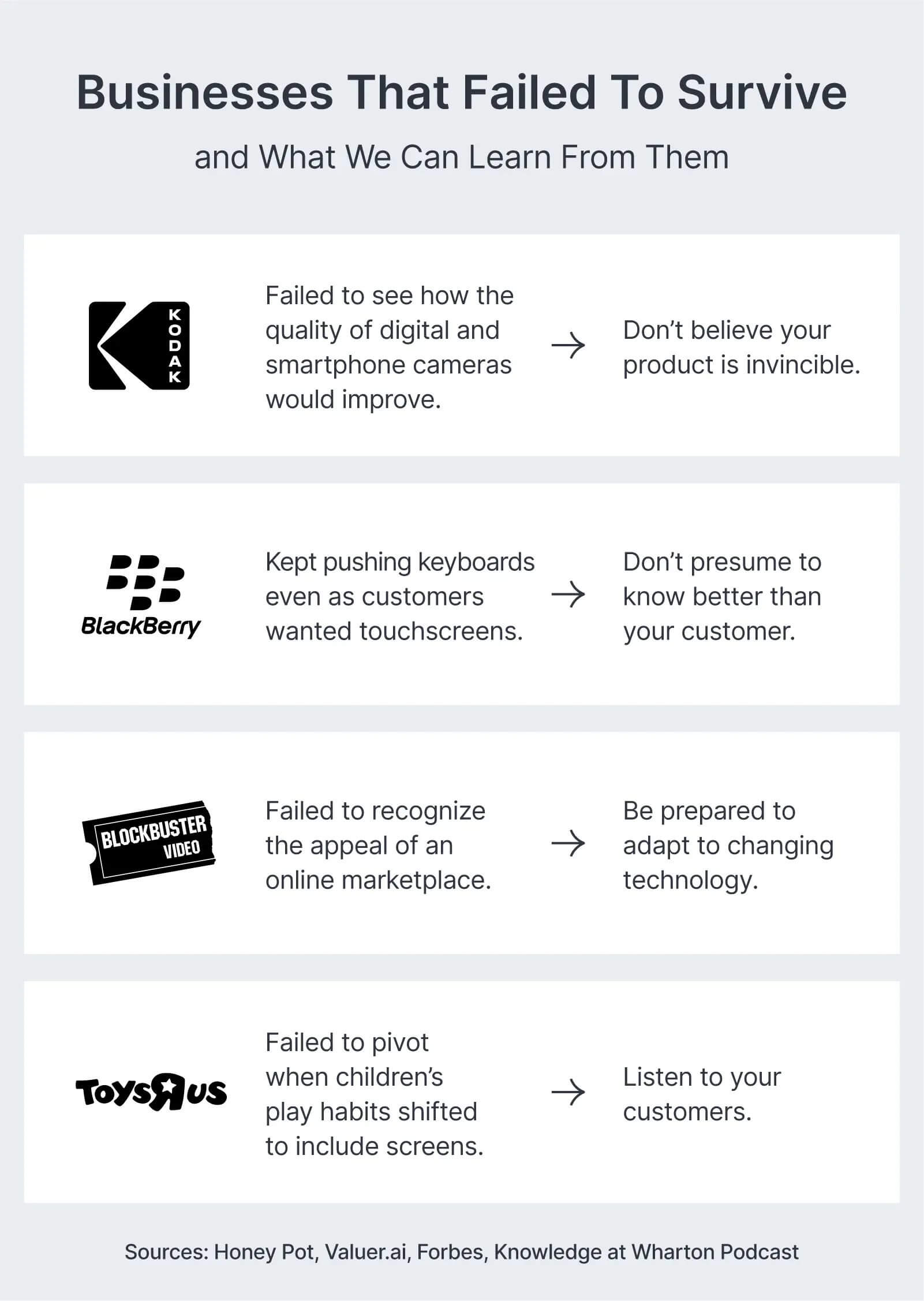
Innovation is implementing creative and useful ideas to propel your business forward. Innovation could mean:
Creating a new product that the market hasn't seen before
Improving what's already out there
Finding a new way to stand out from the competition
Innovation needs to happen thoughtfully. JCPenney learned this when it eliminated sales coupons and clearance sales. Customers felt the company got rid of crucial deals and started shopping at other stores, where there were better coupons and clearance sales. The company filed for bankruptcy in 2020.
Strengthen Your Business With the Right Financing
Established businesses may need access to capital to cover unexpected expenses or payroll. Loans like term loans or lines of credit can provide financing to help manage these costs while your business continues to run. Learn more about how Clarify Capital can support cash flow, and apply now to see your financing opportunities.
Methodology
To calculate what percentage of businesses fail, Clarify Capital analyzed data from the U.S. Bureau of Labor Statistics on business survival rates. We looked at survival rates to determine the percentage of businesses that failed each year and compared those rates over 20 years across industries and states.
Business Failure Rates FAQ
Here are answers to questions you may have about the failure and success rates of businesses.
Why Do 90% of Businesses Fail?
The idea that 90% of businesses fail is a myth when applied to businesses as a whole. Our analysis of businesses established in 2005 found that failure rates reach only 80.5%, and that's after 20 years of business. Many factors can contribute to failure, and strategies like managing cash flow, watching your margins, and adapting to changing market conditions can help your business address some of these risks.
What Are the Odds of a Business Failing?
Based on businesses opened in 2005, here are the failure rates we found:
After the first year: 19.9%
After three years: 39.8%
After five years: 53.2%
After 10 years: 66.2%
After 15 years: 74.5%
After 20 years: 80.5%
These failure rates are over a long timeline. Understanding common reasons for failure, including running out of cash, having no market need, weak margins, and poor planning, can help you identify problems in your own business earlier.
What Is the Survival Rate of Small Businesses?
Based on businesses opened in 2005, 80.1% survived their first year of operations, and 60.2% survived their first three years. The survival rate gradually decreases as more time passes, with 46.8% still operating after five years and 19.5% after 20 years. This makes the first few years important for building a strong financial foundation.
What Percentage of Businesses Make $500,000 a Year?
Revenue figures vary between employer and nonemployer businesses. For nonemployer businesses, such as independent contractors or freelancers, 1.4% of establishments have annual revenue between $500,000 and $999,999. There are many factors that go into the success of a small business, but having access to enough working capital can help businesses continue investing in growth.

Bryan Gerson
Co-founder, Clarify
Bryan has personally arranged over $900 million in funding for businesses across trucking, restaurants, retail, construction, and healthcare. Since graduating from the University of Arizona in 2011, Bryan has spent his entire career in alternative finance, helping business owners secure capital when traditional banks turn them away. He specializes in bad credit funding, no doc lending, invoice factoring, and working capital solutions. More about the Clarify team →
Related Posts

![86% of Small Business Owners Are Using AI to Find Financing in 2026 [Survey]](/assets/study/ai-lending-journey-report/ai-lending-journey-report-small-1f3feb9d64cd090acfd3bd3dfde9745acd75533acf4827d669faa0f19362d01e.jpg)