

 Reviewed by
Key Takeaways:
Workers with flexible schedules are more likely than 9 to 5 workers to say that their work arrangement has improved their focus (78% vs. 72%), creative thinking (73% vs. 66%), and motivation (66% vs. 58%).
67% of workers with flexible schedules rate their mental health as good or very good, compared to 59% of workers with a standard schedule.
Traditional 9 to 5 workers are split: 50% say they would give up some pay for more control over when they work, while the other 50% would not.
36% of traditional workers would part with up to 10% of their pay to work fewer total days or hours per week.
57% of managers said their company has implemented flexible daily schedules in the past 5 years, while 31% have stuck to traditional schedules.
42% of managers said revenue has increased since offering flexible work, and 47% haven't noticed an impact.
40% of managers said offering reduced hours or flexible schedules has created no major operational challenges.
How Employees Define Productivity When Hours Are Reduced
For many workers, productivity is no longer tied to sitting at a desk for a fixed block of time. It's about output, quality, and whether they're meeting or exceeding expectations.
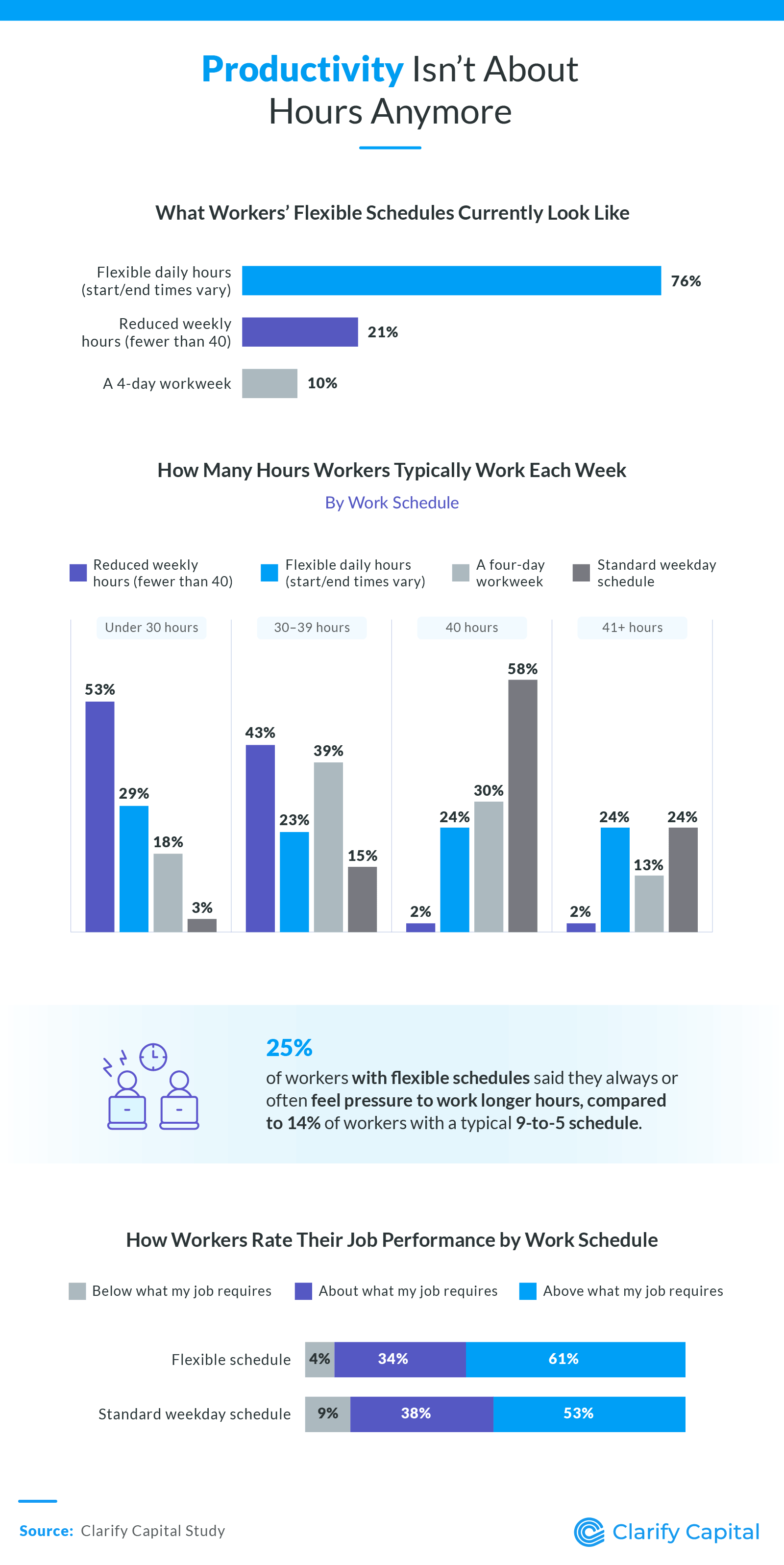
Flexible daily hours were the most common arrangement, reported by 76% of workers with flexible setups. Another 21% said they had reduced weekly hours, and 10% reported working a four-day week. Even with different schedules, many flexible workers felt confident in their performance. A majority (61%) said they performed above what their job required, compared to 53% of workers on a standard 9 to 5 schedule.
Among traditional weekday workers, 58% said they worked exactly 40 hours per week. That figure dropped to 30% for four-day workers, 24% among those with flexible daily hours, and just 2% for those with reduced weekly hours. However, 25% of flexible workers said they always or often feel pressured to work longer hours, compared with only 14% of traditional workers.
AI has helped some people work less. Overall, 75% of workers reported using AI tools or automation in their workflow. More than half (58%) said it didn't meaningfully change the number of hours they worked, while 11% said it reduced their working hours.
How Reduced Hours and Firmer Boundaries Impact Mental Health and Motivation
Flexible schedules are positively affecting focus, creativity, and how people feel about their jobs.
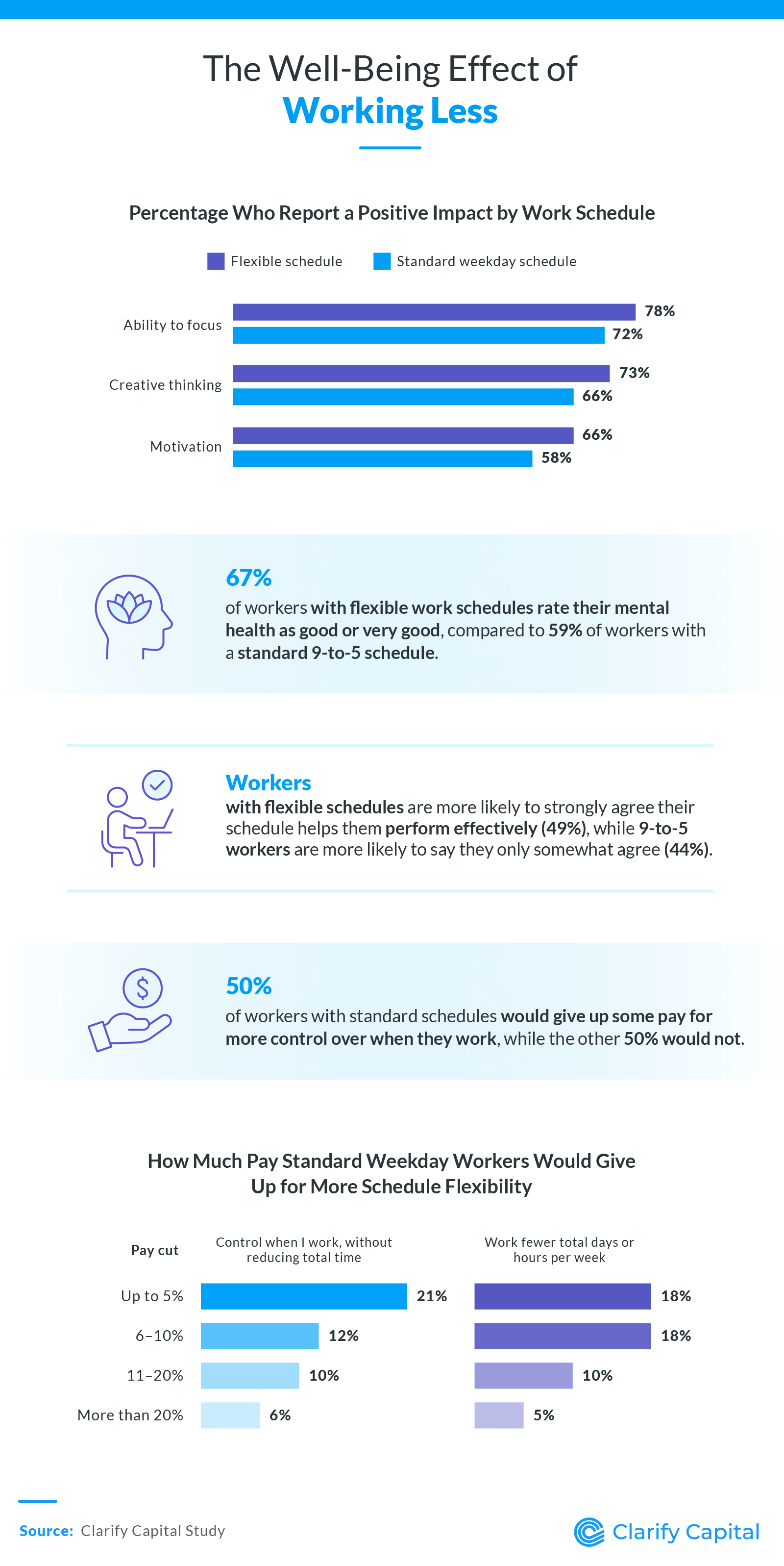
Workers with flexible schedules were more likely than traditional 9 to 5 workers to report that their work arrangement improved their focus (78% vs. 72%). Creative thinking followed a similar pattern (73% vs. 66%), as did motivation (66% vs. 58%). Half of flexible workers strongly agreed their schedule helped them perform effectively, while 44% of traditional workers said they only somewhat agreed.
Mental health ratings also differed. A total of 67% of workers with flexible arrangements rated their mental health as good or very good, compared to 59% of those on standard schedules. For business owners, that gap can contribute to burnout, absenteeism, and turnover.
Traditional workers were evenly divided when asked whether they would trade pay for flexibility. Half said they would give up some pay for more control over their schedule, while half would not. Additionally, 36% said they would be willing to part with up to 10% of their pay to work fewer total days or hours per week. For some employees, flexibility carries real financial value.
What Employers Report After Experimenting With Flexible Work
For many leaders, the big question is whether flexibility creates more problems than it solves. Managers in our survey offered a clear view of what happened inside their companies.
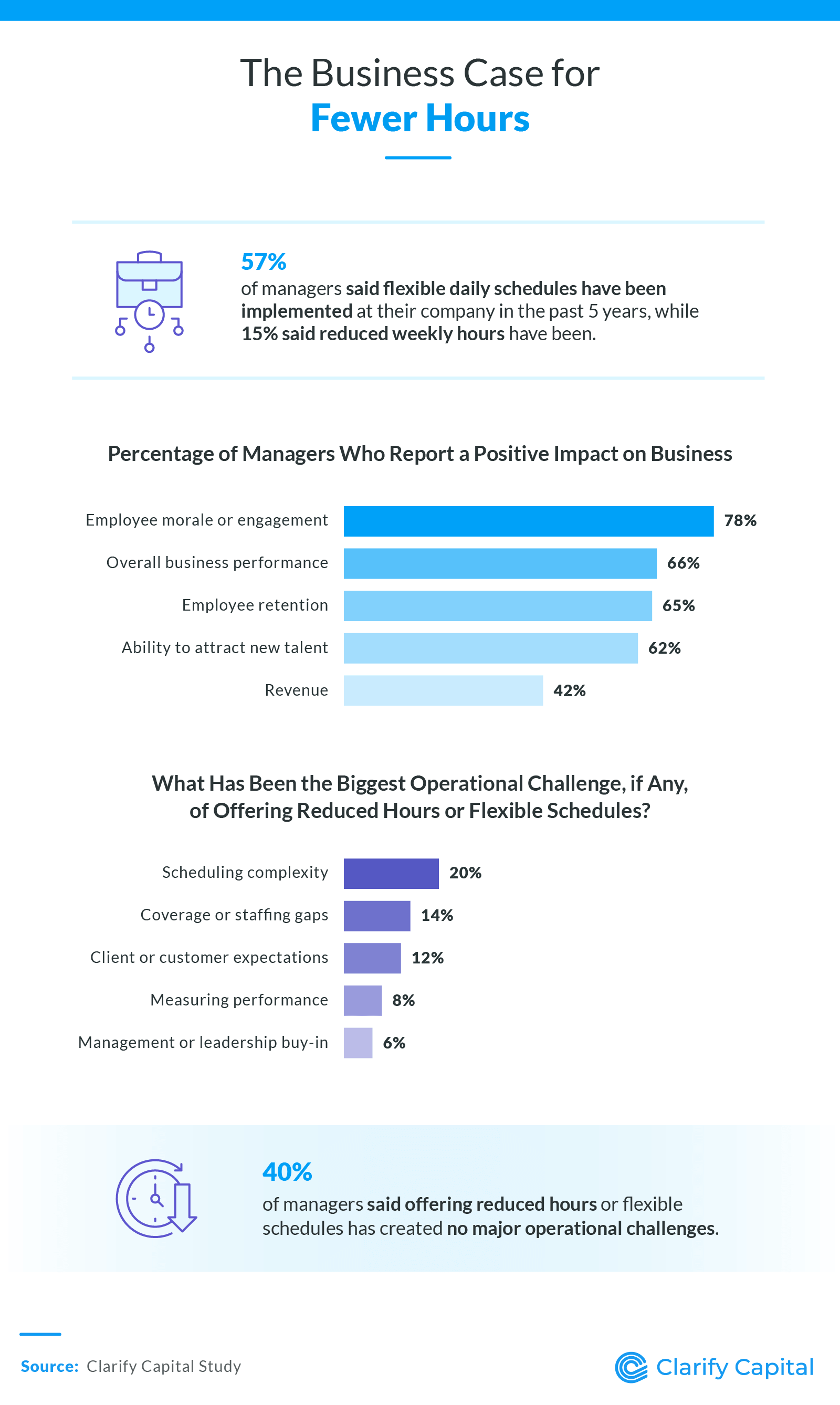
Flexible work is no longer rare. It's already part of many business models. More than half of managers (57%) said their company had implemented flexible daily schedules in the past 5 years. Another 15% had reduced weekly hours. Only 31% said none of these arrangements had been introduced.
Employee morale was the most commonly reported benefit of work flexibility (78%), followed by:
Improvements in overall business performance followed (66%)
Employee retention (65%)
Ability to attract new talent (62%)
About 2 in 5 managers (42%) reported a positive revenue impact, while 47% said flexible work had no noticeable effect on revenue.
Operational concerns were less dramatic than some might expect: 40% said offering reduced hours or flexible schedules posed no major operational challenges. Among managers who reported challenges, 20% ranked scheduling complexity as the top issue. For many businesses, the transition was manageable.
Why Flexibility Is Becoming a Business Strategy
Flexible work is not simply about employee preference. It can influence focus, morale, retention, and in many cases, revenue stability. Workers with adaptable schedules reported stronger performance and better mental health, and many managers did not see negative financial consequences.
If you're considering offering more flexibility, start with structure. Define performance benchmarks, monitor results closely, and make sure your working capital can support any transition period. The right adjustments, backed by smart planning, can position your business to grow without burning out your team.
Methodology
Clarify Capital surveyed 996 workers to better understand how traditional 9-to-5 schedules compare to flexible work arrangements in terms of performance, productivity, mental health, and attitudes toward pay and schedule control. We also asked managers about how flexible policies have affected business operations, revenue, and retention.
Respondents had an average age of 40. The sample included 57% women, 41% men, and 2% nonbinary participants. Overall, 15% reported working a standard 9-to-5 schedule, while 85% reported having some form of flexible work arrangement. The survey was conducted in February 2026.
About Clarify Capital
Clarify Capital helps small and midsize business owners access the financing they need to grow with confidence. Flexibility starts with financial options. Our fast business loans give business owners the capital to invest in the kind of workplace that keeps productivity high.
Fair Use Statement
This information is available for noncommercial use only. If you share these findings, please include proper attribution and a link back to Clarify Capital.

Michael Baynes
Co-founder, Clarify
Michael has over 15 years of experience in the business finance industry working directly with entrepreneurs. He co-founded Clarify Capital with the mission to cut through the noise in the finance industry by providing fast funding and clear answers. He holds dual degrees in Accounting and Finance from the Kelley School of Business at Indiana University. More about the Clarify team →
Related Posts