
 Reviewed by
Key Takeaways:
39% of SBOs say they have hit a pricing ceiling with customers. They have either reached the limit customers will tolerate, would lose customers if prices rose again, or have already had to lower their prices.
1 in 3 SBOs (33%) believe even a modest price increase would drive customers away, leaving them with no room to respond to inflation.
More than half of SBOs (51%) have raised their prices 2 to 3 times over the past 24 months, and 7% have raised prices 4 or more times.
Consumer price sensitivity ranks as the No. 1 threat to small business (27%), ahead of rising operating costs (24%), economic uncertainty (22%), and competition (13%).
73% say their operating costs have risen faster than their ability to raise prices.
60% have delayed growth plans in the past 12 months due to rising costs and customer price sensitivity.
32% have turned to outside financing just to manage cash flow or everyday operating expenses.
How Many Small Businesses Feel They Can No Longer Charge More
For a growing share of SBOs, the question isn't whether to raise prices, but whether customers will tolerate it.
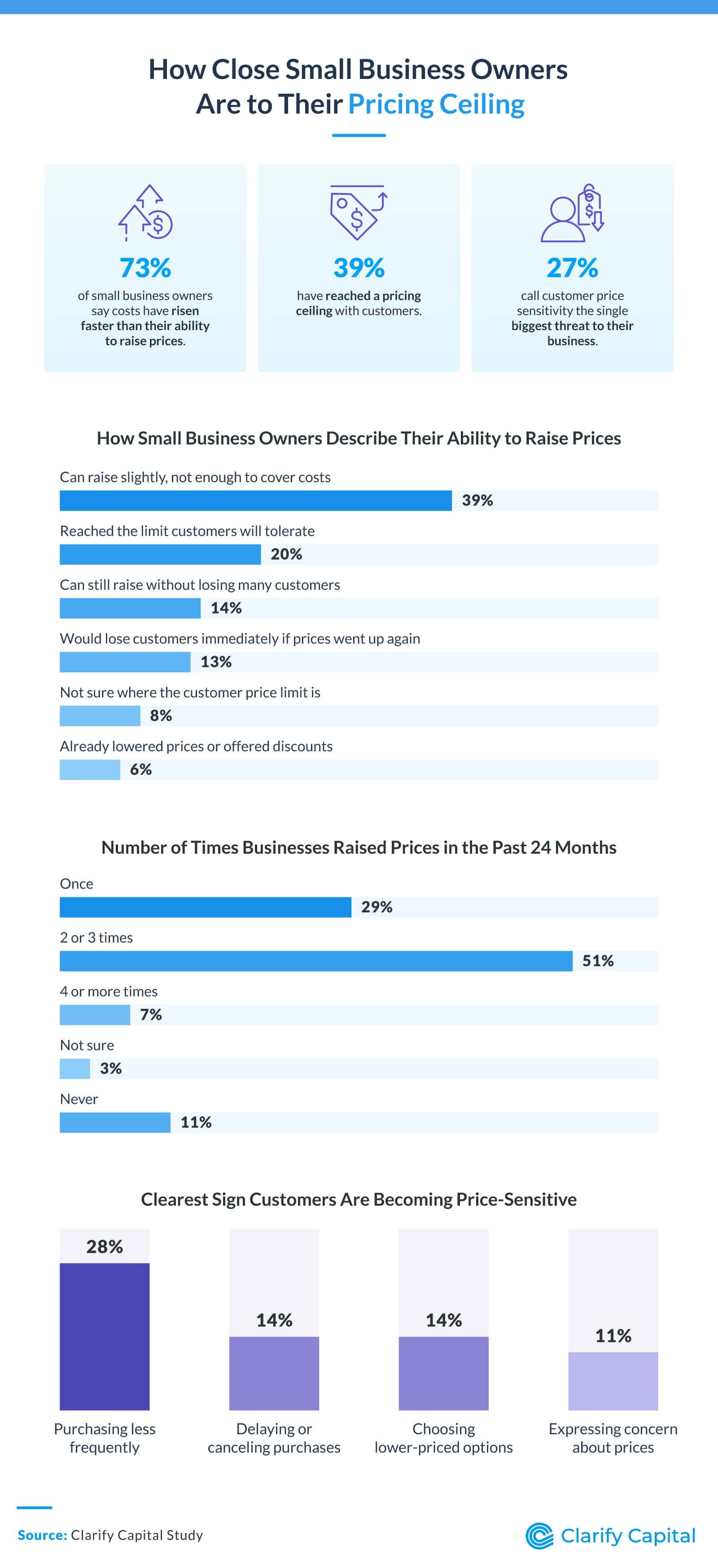
Nearly three-quarters of SBOs (73%) said costs have risen faster than they can raise prices. And 39% had already hit a pricing ceiling:
20% said they had reached the limit that customers will tolerate.
13% believed that another increase would cost them customers, right away.
6% had already lowered prices or offered customer discounts.
Price sensitivity now tops the list of SBOs' worries. More than a quarter (27%) called it their single biggest threat, ahead of rising costs (24%) and economic uncertainty (22%). The clearest warning sign of price sensitivity was customers buying less often, which 28% pointed to.
The pressure hit some industries harder. Wholesale and retail SBOs reported the highest pricing-ceiling rate (43%), with arts and entertainment (42%) and education (42%) close behind. By generation, 45% of Gen X said their businesses have hit a ceiling, versus 37% of millennials and 32% of baby boomers.
What Businesses Are Sacrificing Instead of Raising Prices
When small business owners can't pass costs along, the difference has to come from somewhere. Usually, it's their own margins.
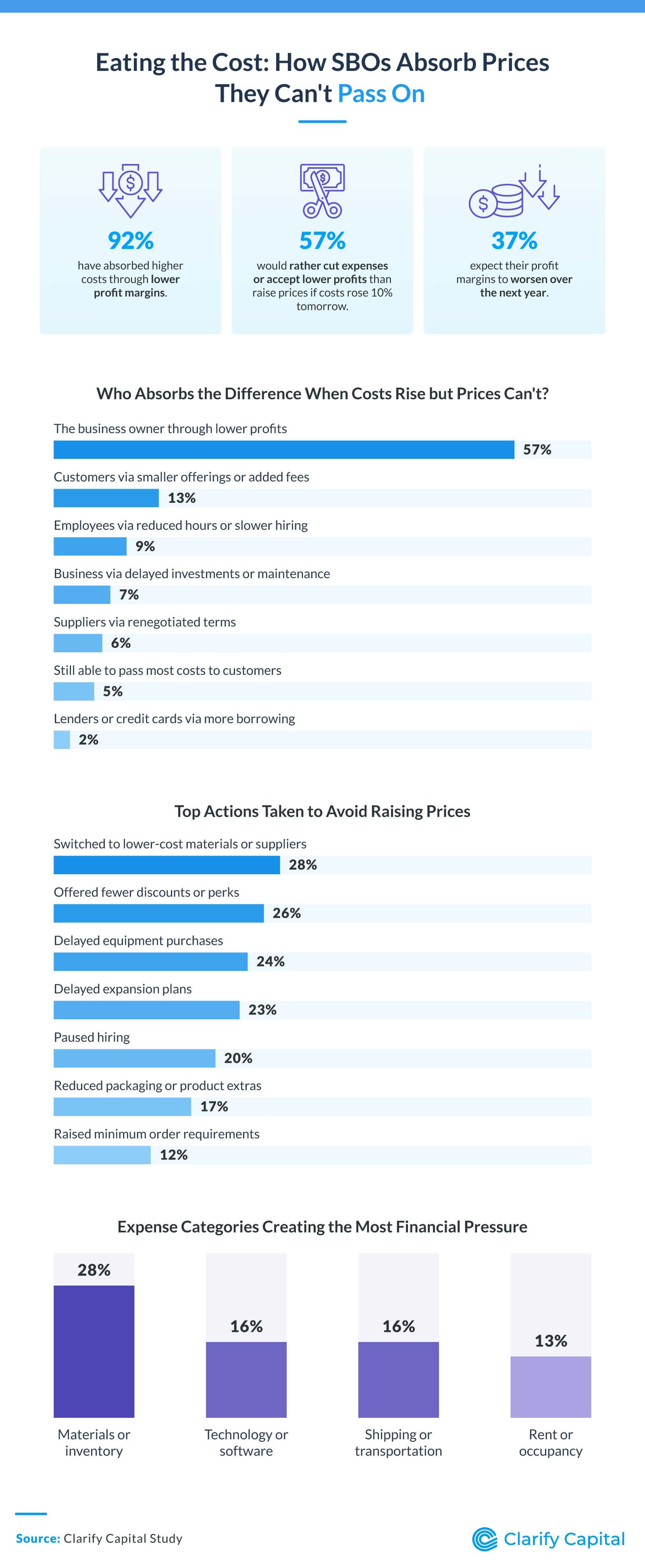
Most SBOs (92%) said they have absorbed higher costs through lower profit margins. If costs rose 10% tomorrow, 57% said they would rather cut expenses or take lower profits than raise prices. When prices can't move, that same 57% said the owner personally absorbs the difference, far more than customers (13%) or employees (9%).
To hold prices steady, SBOs made certain trade-offs. The most common were:
Switching to lower-cost suppliers (28%)
Offering fewer discounts or perks (26%)
Delaying equipment purchases (24%) or expansion plans (23%)
The squeeze fell unevenly by industry. Arts and entertainment SBOs (73%) and wholesale and retail ones (69%) were the most likely to say they personally absorb the cost. Arts and entertainment SBOs were also the most pessimistic, with 53% expecting margins to worsen over the next year.
How Pricing Pressure Is Affecting Small Business Plans
Absorbing costs quietly has a longer-term price of its own: the plans small business owners put off to keep the doors open. For many, growth is now on hold.
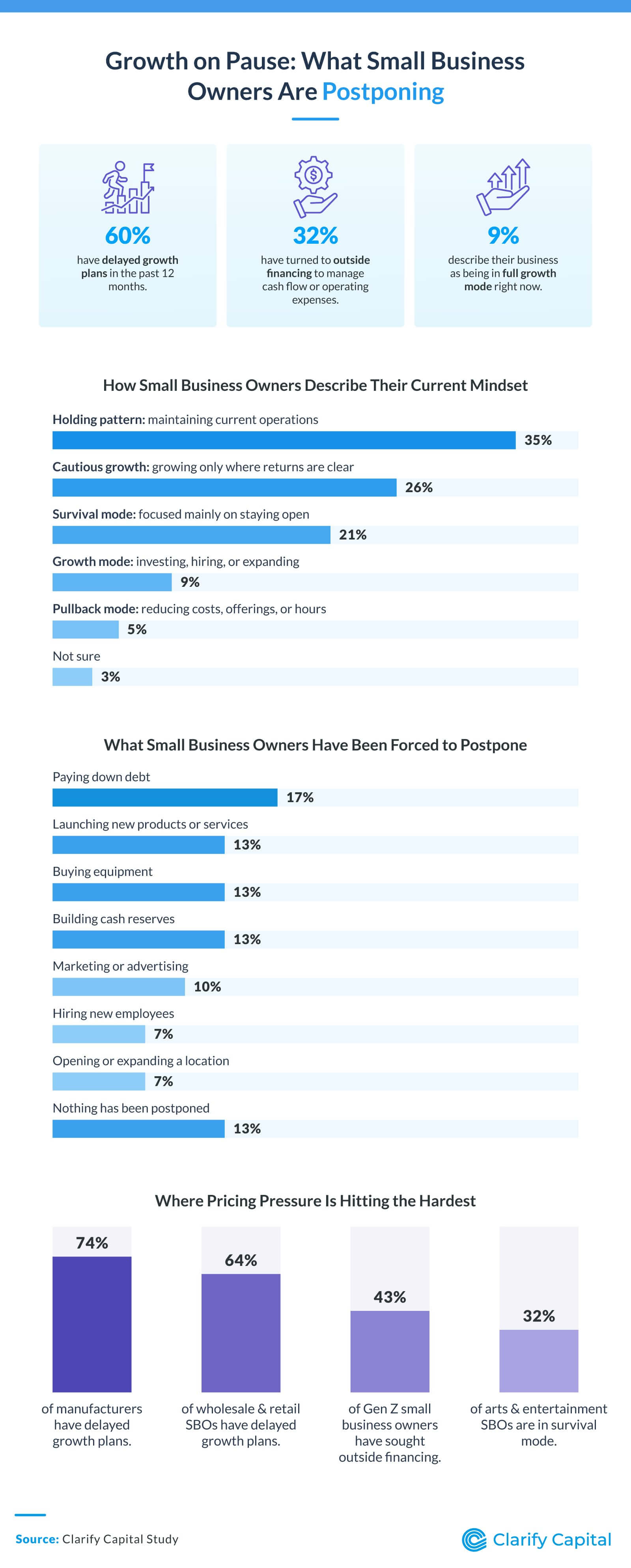
Six in 10 SBOs (60%) delayed growth plans in the past year, and just 9% described their business as being in full growth mode. Most were in a holding pattern (35%) or cautious growth (26%), while 21% said they were in survival mode.
SBOs most often delayed paying down debt (17%), followed by delaying launching new products, buying equipment, and building cash reserves (each 13%). Manufacturers have been hit hardest, with 74% postponing growth plans.
To keep operating, 32% turned to external financing to cover cash flow or everyday expenses. Younger SBOs relied most on financing. Among Gen Z, 43% sought outside financing, compared to 32% of millennials, 26% of Gen X, and 18% of baby boomers.
When Holding the Line Becomes the Strategy
For many small business owners, steady prices have become a survival strategy rather than a sign of strength. Absorbing costs protects customer relationships now, but it thins the margins and reserves SBOs rely on for the next surprise. Separating short-term cash flow gaps from longer-term pricing problems can help, since the two call for very different responses.
Methodology
We surveyed 710 small business owners in July 2026 to understand how rising operating costs and increasingly price-sensitive customers are reshaping the way small businesses set prices, absorb costs, and plan for growth.
The gender breakdown was 53% women, 45% men, and 2% nonbinary or other. Millennials made up the largest share of respondents (56%), followed by Gen X (26%), Gen Z (12%), and baby boomers (5%). Respondents came from a wide range of industries, with the largest concentrations in wholesale and retail (18%), arts, entertainment, and recreation (13%), technology (12%), finance and insurance (8%), hotel, food services, and hospitality (7%), medical and health care (6%), manufacturing (6%), and education (6%).
About Clarify Capital
Clarify Capital helps small and midsize business owners access the financing they need to grow with confidence. When you can't raise prices but costs keep climbing, our working capital loans give you the flexibility to cover the gap without cutting corners.
Fair Use Statement
You're welcome to share these findings for noncommercial purposes. Please include an attribution to Clarify Capital and a link back to this page so readers can access the full report and methodology.

Michael Baynes
Co-founder, Clarify
Michael has over 15 years of experience in the business finance industry working directly with entrepreneurs. He co-founded Clarify Capital with the mission to cut through the noise in the finance industry by providing fast funding and clear answers. He holds dual degrees in Accounting and Finance from the Kelley School of Business at Indiana University. More about the Clarify team →
Related Posts