

 Reviewed by
Key Takeaways:
Nashville-Davidson-Murfreesboro-Franklin, TN, tops America as the best metro to expand a business.
Portland-Vancouver-Hillsboro, OR-WA, ranks last for expansion readiness.
Salt Lake City-Murray, UT, is adding workers faster than any metro studied, with a 3.20% employment growth.
Austin-Round Rock-San Marcos, TX, is adding jobs faster than any other U.S. metro in the study (5.30% net job creation rate).
The Metros With the Strongest Expansion Conditions
The highest-ranking metros combine labor-market momentum with steady business formation and relatively favorable local employment conditions.
Nashville takes the No. 1 spot without leading any single metric. It ranks fifth for employment growth, third for net job creation, second for unemployment, 12th for establishment entry, and 19th for establishment exits. That consistency gives it the strongest overall expansion profile.
Raleigh-Cary, NC, ranks second overall, supported by the third-best employment growth ranking and the fourth-best unemployment ranking. Its seventh-place net job creation rank adds another sign of labor-market momentum.
Austin places third and has the strongest job-creation engine in the study. It ranks first for net job creation and second for establishment entry, though it ranks at 40th place for establishment exit ranking.
At the other end of the scorecard, Portland ranks last among the 56 metros, weighed down by one of the steepest employment declines in the study at -1.40%.
The Labor and Business Signals Behind Expansion Readiness
No single metric determines whether a metro is ready for business growth. The scorecard shows where momentum is building and where another source of risk may offset a favorable signal.
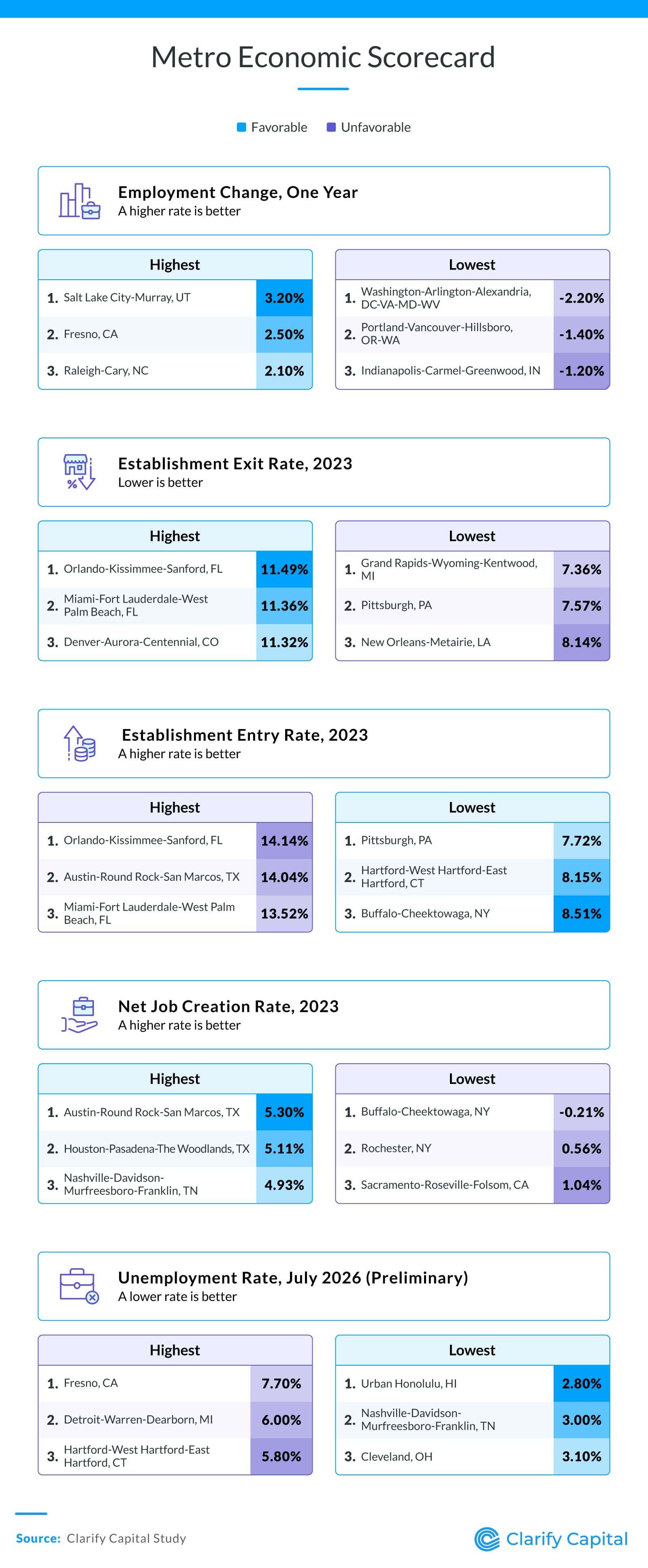
Salt Lake City has the strongest one-year employment growth at 3.20%, followed by Fresno, CA, at 2.50% and Raleigh at 2.10%. Washington, D.C., Portland, and Indianapolis-Carmel-Greenwood, IN, have the steepest declines at -2.20%, -1.40%, and -1.20%, respectively.
Grand Rapids-Wyoming-Kentwood, MI, has the lowest establishment exit rate at 7.36%, followed by Pittsburgh (7.57%) and New Orleans-Metairie, LA (8.14%). Orlando-Kissimmee-Sanford, FL, has the highest exit rate at 11.49%, despite also leading the study in new entries.
Orlando has the highest establishment entry rate in the study at 14.14%. Austin (14.04%) and Miami-Fort Lauderdale-West Palm Beach, FL (13.52%), follow closely, showing strong new-business formation in Florida and Texas.
Pittsburgh, PA, has the lowest establishment entry rate at 7.72%, followed by Hartford-West Hartford-East Hartford, CT (8.15%), and Buffalo-Cheektowaga, NY (8.51%).
Austin leads net job creation at 5.30%, followed by Houston-Pasadena-The Woodlands, TX, at 5.11% and Nashville at 4.93%. Buffalo ranks last at -0.21%, behind Rochester, NY (0.56%), and Sacramento-Roseville-Folsom, CA (1.04%).
Fresno has the highest unemployment rate in the study at 7.70%, followed by Detroit-Warren-Dearborn, MI (6.00%), and Hartford (5.80%).
Urban Honolulu, HI, has the lowest unemployment rate at 2.80%, followed by Nashville (3.00%) and Cleveland, OH (3.10%).
Expansion Readiness Comes From Balance
The strongest markets aren't necessarily the ones with the fastest employment growth or the most new businesses. Nashville's first-place finish comes from performing well across the full scorecard, while places like Orlando and Fresno show how a leading result in one category can coexist with pressure in another.
For business owners, the ranking is a starting point rather than a guarantee. Local demand, competition, operating costs, and access to capital still shape whether an expansion works. Building enough cash-flow room for hiring, equipment, and unexpected expenses can help small and midsize business owners take advantage of a strong market without stretching the business too thin.
Methodology
Clarify Capital compared 56 U.S. metros with complete data across five economic and labor metrics, weighted by how strongly each signals expansion readiness:
One-year employment change carried the most weight at 30%. A higher rate was better.
2023 establishment exit rate carried 25% of the weight. A lower rate was better.
2023 establishment entry rate carried 20% of the weight. A higher rate was better.
2023 net job creation rate carried 15% of the weight. A higher rate was better.
The preliminary July 2026 unemployment rate carried 10% of the weight. A lower rate was better.
For each metric, we ranked the 56 metros from best to worst and converted each rank to a score from 0 to 100. When metros tied on a metric, they shared the same displayed rank, and their scores were calculated from the average of the rank positions they spanned. The final rankings are based on each metro's combined score. These scores show how each metro compares to the others in the study.
About Clarify Capital
Clarify Capital connects small and midsize business owners with financing options designed to support cash flow, unexpected expenses, and growth. Its network offers flexible solutions, including no-doc business loans and fast business financing tailored to a company's needs.
Fair Use Statement
This content is available for noncommercial use. If you cite or share these findings, please credit Clarify Capital and link back to this page as the original source.

Michael Baynes
Co-founder, Clarify
Michael has over 15 years of experience in the business finance industry working directly with entrepreneurs. He co-founded Clarify Capital with the mission to cut through the noise in the finance industry by providing fast funding and clear answers. He holds dual degrees in Accounting and Finance from the Kelley School of Business at Indiana University. More about the Clarify team →
Related Posts