

 Reviewed by
Key Takeaways:
Workers leave an average of 6 days of paid vacation unused each year.
About 1 in 6 workers (15%) say guilt about being away keeps them from taking time off.
The biggest barrier to taking time off isn't workload or company policy, it's caution: 44% of workers are saving days "just in case."
More than a third of employees (35%) have lied about the reason for their time off.
Burned-out employees are more than twice as likely to postpone or cancel a vacation due to work pressures (19% vs. 8%).
44% of employees say they take less PTO than their manager, despite 78% saying managers model taking time off.
Medical and health care workers are the most likely to forgo vacation due to staffing issues, with 26% saying no one would be available to cover their work.
How Much Paid Time Off Goes Unused and Why
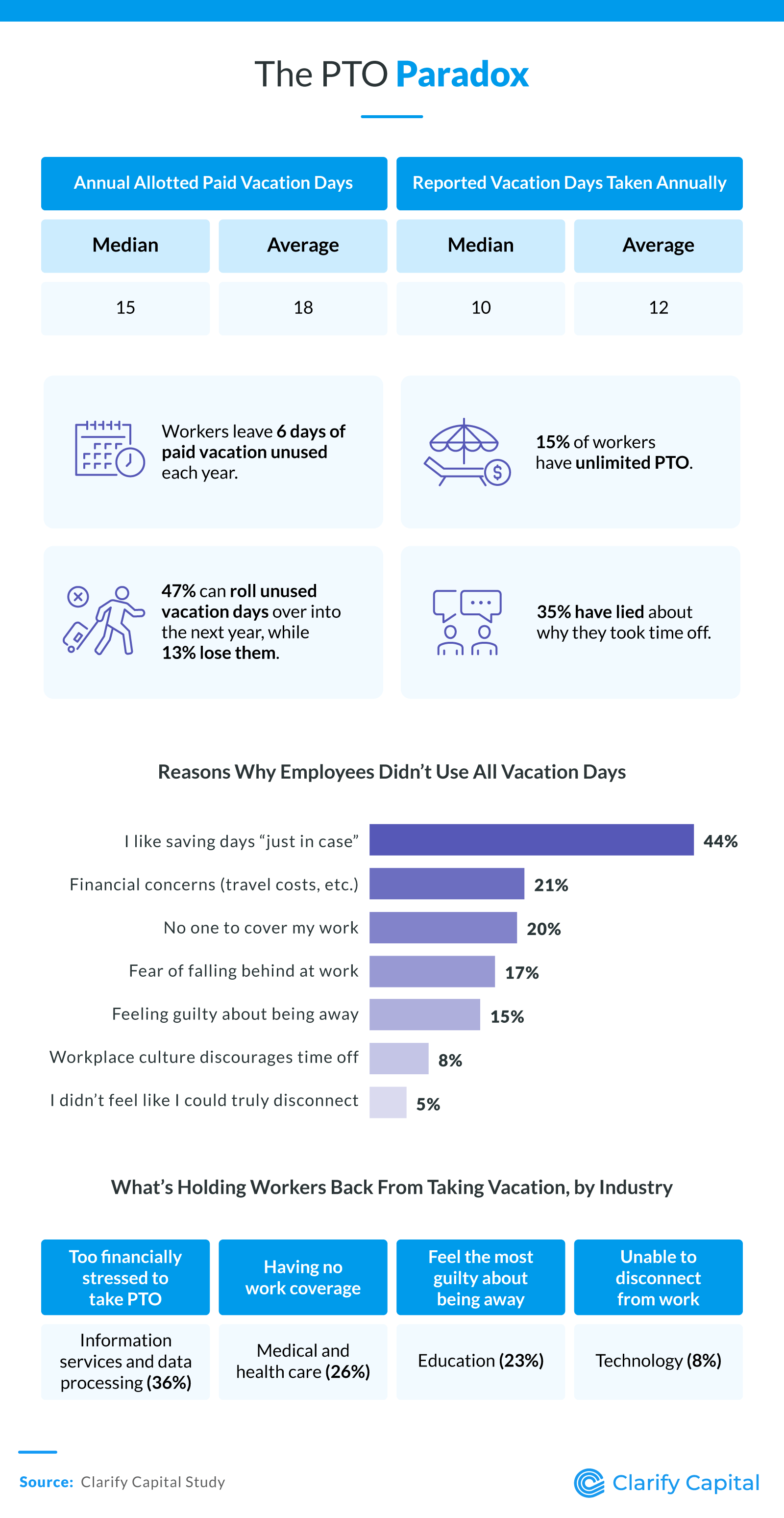
Workers have an average of 18 paid vacation days per year, but take only 12, leaving 6 days unused each year.
47% of employees can roll over unused PTO days, while 13% just lose them.
Saving days "just in case" is the top reason why workers aren't taking all their vacation days (44%), followed by financial concerns (21%) and not having anyone to cover for them at work (20%).
About 1 in 6 workers (15%) say feeling guilty about being away from work keeps them from taking time off.
Medical and health care workers are most likely to skip PTO due to staffing shortages (26%), while educators are most likely to do so out of guilt (23%).
35% of employees have lied about why they were taking time off.
Just 15% of respondents have unlimited PTO.
How Workplace Vibes Shape Vacation Habits
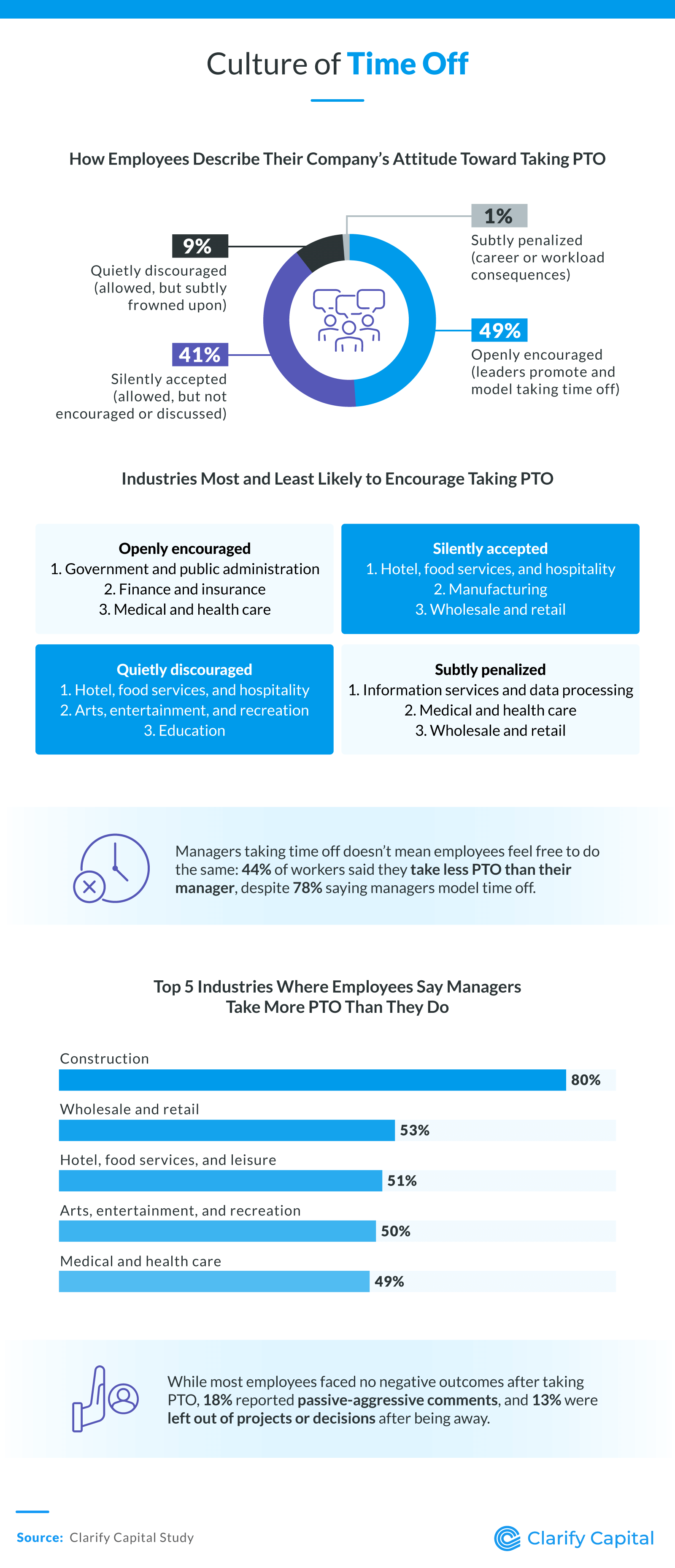
Most workers fall into one of two camps: 49% say PTO is openly encouraged, and 41% say it's silently accepted, but not encouraged or even discussed.
The hospitality industry has the most negative PTO culture, ranking highest for quietly discouraging time off and lowest for openly encouraging it.
44% of workers say they take less PTO than their manager, even though 78% say their managers model time off.
While most employees have experienced no negative outcomes after taking PTO, 18% have heard passive-aggressive comments, and 13% say they were left out of projects or decisions.
What Unused PTO Says About Your Mental State
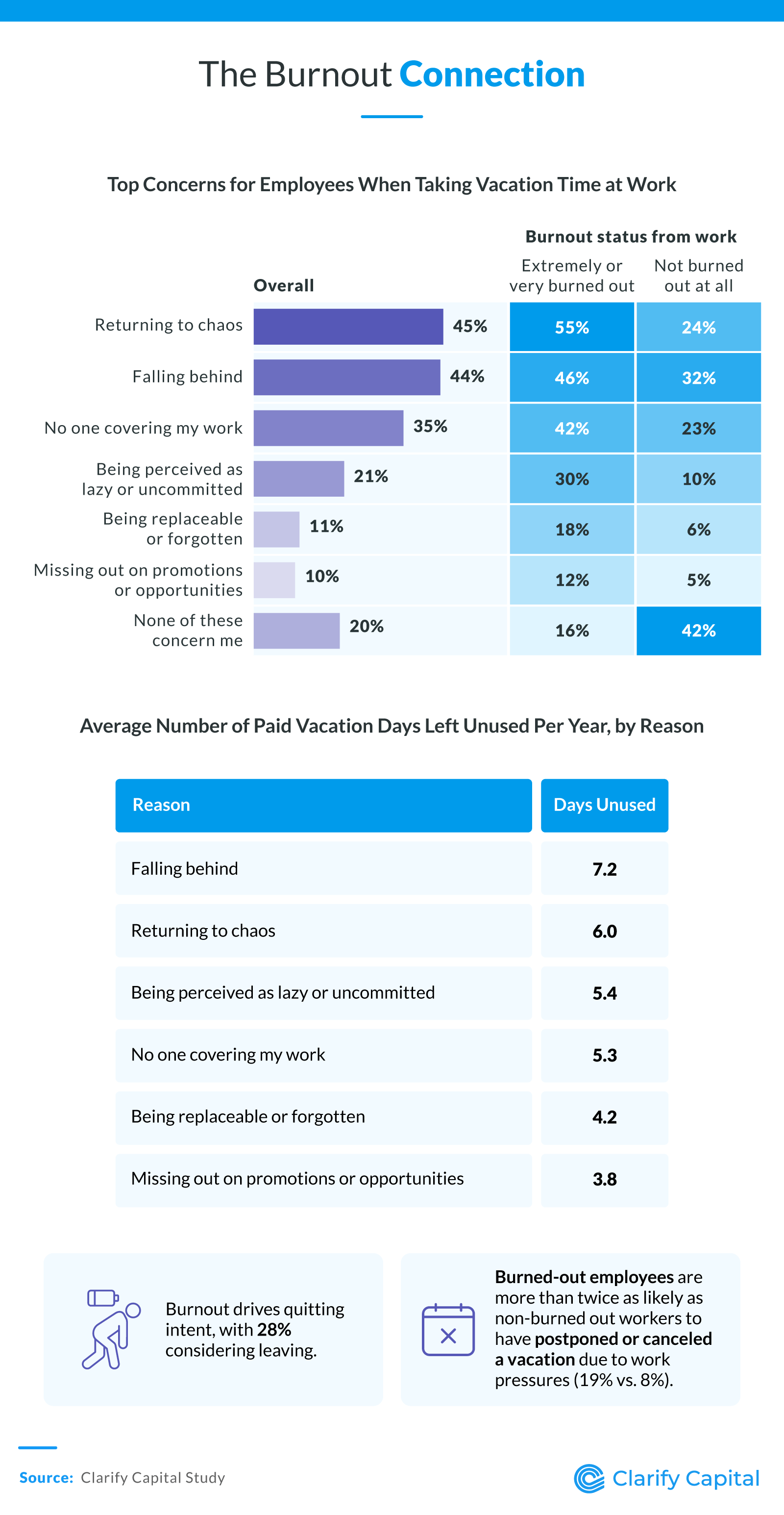
Returning to chaos is the top fear employees have about taking time off (45%), followed by falling behind (44%).
Nearly half of burned-out employees (46%) worry about falling behind, compared to about one-third of those who are not burned out (32%).
More than 1 in 4 burned-out workers (28%) are thinking about quitting.
Burned-out employees are more than twice as likely to have postponed or canceled a vacation due to work pressures (19% vs 8%).
Methodology
This survey polled 1,005 U.S. adults working full-time or part-time to understand how employees use paid time off, how workplace culture affects vacation habits, and how unused PTO relates to guilt, burnout, and intent to quit. The average respondent age was 41. The sample included 50% men, 49% women, and 1% nonbinary respondents. Generationally, 5% were baby boomers, 29% were Gen X, 56% were millennials, and 10% were Gen Z. Industry-level analysis included only industries with at least 25 respondents to ensure meaningful comparisons. Data was collected in December 2025.
About Clarify Capital
Clarify Capital helps small and midsize business owners access the financing they need to grow with confidence. If your team is skipping PTO because there's no one to cover them, it may be a staffing problem. Our fast business loans help you hire before burnout becomes turnover.
Fair Use Statement
This content is provided for informational and noncommercial use only. If you reference or share these findings, please include attribution and a link to Clarify Capital.

Michael Baynes
Co-founder, Clarify
Michael has over 15 years of experience in the business finance industry working directly with entrepreneurs. He co-founded Clarify Capital with the mission to cut through the noise in the finance industry by providing fast funding and clear answers. He holds dual degrees in Accounting and Finance from the Kelley School of Business at Indiana University. More about the Clarify team →
Related Posts