

 Reviewed by
Can you get a business loan with just an EIN? The short answer is no. While you may see “EIN-only business loans” advertised online, lenders typically need more than your Employer Identification Number (EIN) to approve you for financing.
However, some alternative lenders offer low-documentation business loans that rely more heavily on your business revenue and recent bank statements. This can make it easier to access financing without providing tax returns, detailed financial statements, or a business plan that may be required by traditional banks.
Below, I'll break down what lenders require, how no-doc and low-doc business loans work, and the financing options available if you're looking to qualify with minimal documentation.
What "No-Doc" and "EIN-Only" Really Mean
The terms "no-doc" and "EIN-only" are often used together and describe the same types of financing: options that rely more on revenue and cash flow than traditional documentation or credit requirements. But here's the difference:
| Loan type | What it's supposed to mean | What it really means in practice |
|---|---|---|
| No-doc loans | Minimal documentation required | No tax returns, but still requires bank statements and revenue verification |
| EIN-only loans | Approval based on business (not personal credit) | Less reliance on personal credit, but still may check it and require a guarantee |
Loans that actually require zero documentation are very rare, if not completely nonexistent. "No-doc" actually just means fewer documents and a fairly easy application process. It refers to lending options where documents like tax returns and profit and loss statements (P&Ls) aren't required, but things like bank statements and a soft check of your personal credit most likely still are.
Similarly, "EIN only" loans are not lending options that you can obtain by only giving out your employer identification number. Rather, they're business loans that you can qualify for based on business performance rather than your personal credit.
Your Low-Doc Financing Options
Low-doc loan types may have higher rates and shorter terms. But that's the trade-off of applying with fewer qualifications and more flexible requirements. We'll go over the best options below.
Invoice Factoring
Invoice factoring is a type of invoice financing where a business sells its unpaid invoices to a factoring company. The factoring company gives you an up-front payment and takes over the legwork of collecting payments on future invoices in exchange for a cut of them.
This is a great option if you tend to have trouble with slow-paying clients and don't mind a third party intervening in the relationship. Invoice factoring is often one of the easiest to obtain because eligibility is based on the strength of your invoices rather than your personal ability to repay a loan.
Equipment Financing
Equipment financing is a financing option specifically for businesses that need to purchase new equipment, from machinery to tech and vehicles. It's great if you need to replace old assets or expand your operations, but you can't quite shoulder the huge up-front cost that often comes with it. The equipment loan helps you spread payments over time. Key to this funding is that the equipment itself serves as collateral, so if you default on payments, the equipment can be taken away.
Merchant Cash Advance
A merchant cash advance (MCA) gives you a lump sum up front in exchange for a portion of your future credit card sales. After getting the cash advance, you repay a fixed percentage of your daily or weekly revenue (called a holdback) until the agreed repayment total is paid off. The main caveat is that you pay more when sales are high (and less when they're slow), but eligibility is based primarily on revenue consistency and sales volume.
Short-Term Working Capital
If you have immediate business expenses (like payroll or inventory), short-term loan financing provides a lump sum that you repay on a fixed schedule, typically over six to 36 months. Some lenders offer a low-doc option that relies on your business revenue and bank statements.
What's Required for Low-Doc Business Financing?
Here's the type of documentation lenders expect for each low-doc option.
| Loan option | Documentation/info required | What's important for qualifying | Typical funding speed | Best for |
|---|---|---|---|---|
| Invoice factoring | Business invoices and business bank account details (no tax returns typically required) | The strength of your invoices | Often within one to two weeks (after invoice verification) | Business-to-business (B2B) businesses with unpaid invoices that need fast access to cash flow |
| Equipment financing | Equipment quote or invoice, basic business info, and sometimes bank statements | Equipment as the loan collateral | Usually one to five days | Businesses buying or upgrading equipment without shouldering high up-front costs |
| Merchant cash advance | Recent bank statements or business credit card processing statements (no tax returns typically required) | Revenue consistency and sales volume | As fast as same day | Businesses with steady sales that want fast and flexible financing |
| Short-term working capital loan | Recent bank statements and sometimes a soft credit check | Consistent revenue | As fast as same day | Established businesses that need fast financing for payroll, seasonal expenses, or other short-term cash flow needs |
What Does Low-Doc Business Financing Cost?
Low-doc business financing has a quick turnaround time, but that convenience can come at a cost. You may have higher rates and shorter repayment terms than you would with a traditional business loan.
The cost depends on the type of financing, your business revenue, repayment term, and lender. Merchant cash advances, for example, use a factor rate instead of an interest rate. A $20,000 advance with a factor rate of 1.3 would require $26,000 in total repayment.
How Much Is the Monthly Payment on a $50,000 Business Loan?
Your monthly payment on a $50,000 business loan depends on your rate and repayment term. For example, a $50,000 loan with a 12% annual interest rate and a two-year repayment term would have monthly payments of approximately $2,353.67, assuming monthly payments and no additional fees, such as administrative or origination fees.
What Lenders Look for With Low-Doc Business Loans
When lenders can't rely on things like tax returns and personal credit scores, they tend to focus instead on a few key factors:
Banking activity and loan history. Lenders will want to see if you've taken out other loans or financing options in the past, and if so, how you handled repayment and money management.
Cash flow and deposit patterns. Looking at the way cash flows in and out of your business will tell lenders how reliably your business generates and manages income.
Business credit history. If you have a business credit profile, it can help demonstrate how your business handles financial obligations independently of your personal credit.
Revenue consistency. Lenders want to see steady or predictable revenue over time, rather than large fluctuations.
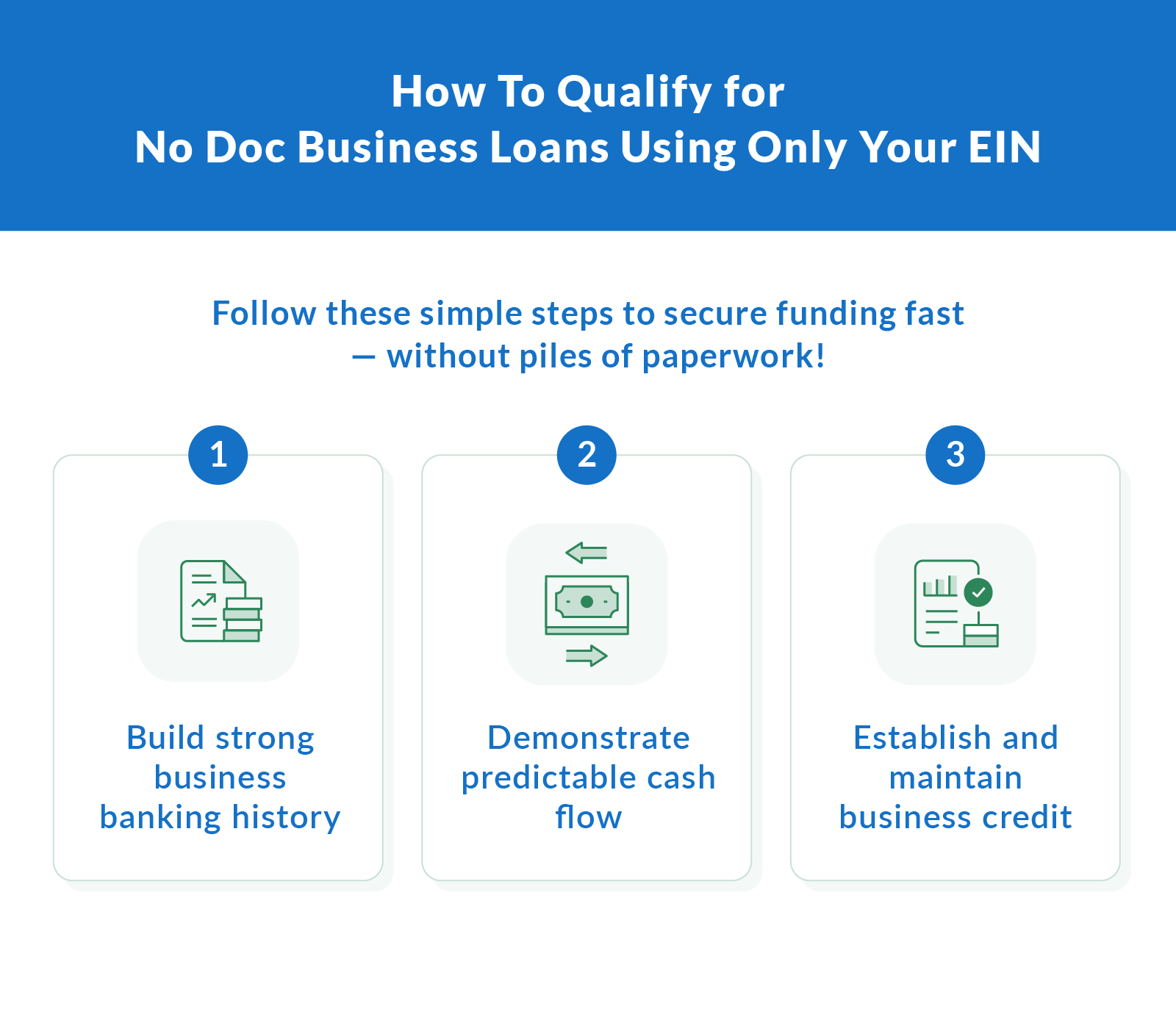
If your business is lacking on any of these, spend time figuring out how you can build a strong business banking history, demonstrate predictable cash flow, and establish a good business credit score before applying for EIN-only/no-doc business loans.
Clarify Customer Testimonial: Scaling Faster Than Revenue
At Clarify Capital, we're dedicated to helping businesses not only survive, but grow. Listen to a real customer talk about his experience using Clarify for a business loan.
Other Loan Options
Depending on your business and situation, traditional financing might make more sense. They tend to offer lower rates, larger amounts, and longer terms. You might just meet more qualifications than you think. Here are some other options.
SBA Loans
SBA loans are designed for small businesses and are backed by the Small Business Administration (SBA), a government agency that aims to expand loan access for more small businesses. The SBA 7(a) is one of the most common types of SBA loans, and can be used for working capital, expansion, or refinancing. SBA Microloans are another type of financing that is generally for smaller amounts (typically up to $50,000) and designed for startups or early-stage businesses.
Business Line of Credit
A business line of credit is similar to a credit card. It allows you to spend up to a certain amount of money on a revolving basis, and you only pay back and accrue interest on what you use in a given period. They usually have lower interest rates than business credit cards, and they can be used for a variety of expenses. Plus, you won't be charged for paying back your balance early. The main caveat is that qualifying can still be challenging, especially for higher limits.
Get a Low-Doc Business Loan With Clarify Capital
If you have an established business and want to use the strength of your revenue to qualify with minimal documentation, Clarify Capital offers financing options to help. We can help you cover seasonal cash flow gaps, purchase inventory, or manage payroll. You can find an option that fits your business without the paperwork of a traditional bank loan.
See what you qualify for and apply today.
FAQs About EIN-Only/No-Doc Loans
Here, I've gathered and answered some of the questions I get most about EIN-only loans and low-doc financing.
Can You Get a No-Doc Business Loan?
It's important to understand that "no-doc" actually just means fewer documents. It refers to lending options where documents like tax returns and profit and loss statements (P&Ls) aren't required, but things like bank statements and a soft check of your personal credit most likely still are.
Can I Get a Loan With My EIN Number?
Usually, you'll need more than your EIN alone. But you can find lenders who focus on your business's revenue and cash flow rather than your personal credit score.
Can I Get a Business Loan With an LLC With Bad Credit?
As always, it depends on your scenario. LLCs can qualify for business loans with low credit scores, but options will likely be more limited. Most lenders will look at a combination of your personal credit, business revenue, and time in business. Online and alternative lenders are usually more flexible.
What's the Minimum Credit Score I Need To Qualify for a Business Loan?
It depends on the financing option. Some lenders may consider credit scores as low as 500, but better credit means better terms.
How Much Is a Down Payment for a Loan?
Many no-doc or EIN-only financing options don't require a traditional down payment, but some options may require 10% to 20% up front, depending on the lender.
How Does Clarify Capital Protect My Business and Financial Information?
Clarify Capital follows SOC 2 security principles designed to protect sensitive business and financial information. This includes safeguards such as secure data handling practices, controlled access to information, and ongoing monitoring to help protect your data throughout the application and financing process.
Can I Get a Business Loan Without Collateral?
Yes. Business loans without collateral may include business lines of credit, merchant cash advances, and invoice factoring. However, you may be asked to sign a personal guarantee, which means you are personally responsible for repayment if your business defaults.

Michael Baynes
Co-founder, Clarify
Michael has over 15 years of experience in the business finance industry working directly with entrepreneurs. He co-founded Clarify Capital with the mission to cut through the noise in the finance industry by providing fast funding and clear answers. He holds dual degrees in Accounting and Finance from the Kelley School of Business at Indiana University. More about the Clarify team →
Related Posts